Japanese
English
- 有料閲覧
PPV購入案内
1,320円 (1,200円+税10%) こちらは、349ページから353ページの文献です。購入には医書.jp本会員登録が必要です。
会員登録完了後に改めて上記「購入サイトへ」を選択してください。
または「購入サイトへ」選択後に「購入ログイン」、「新規会員登録」の順に進んでください。
会員登録について詳しくはをご確認ください。
- Abstract 文献概要
- 1ページ目 Look Inside
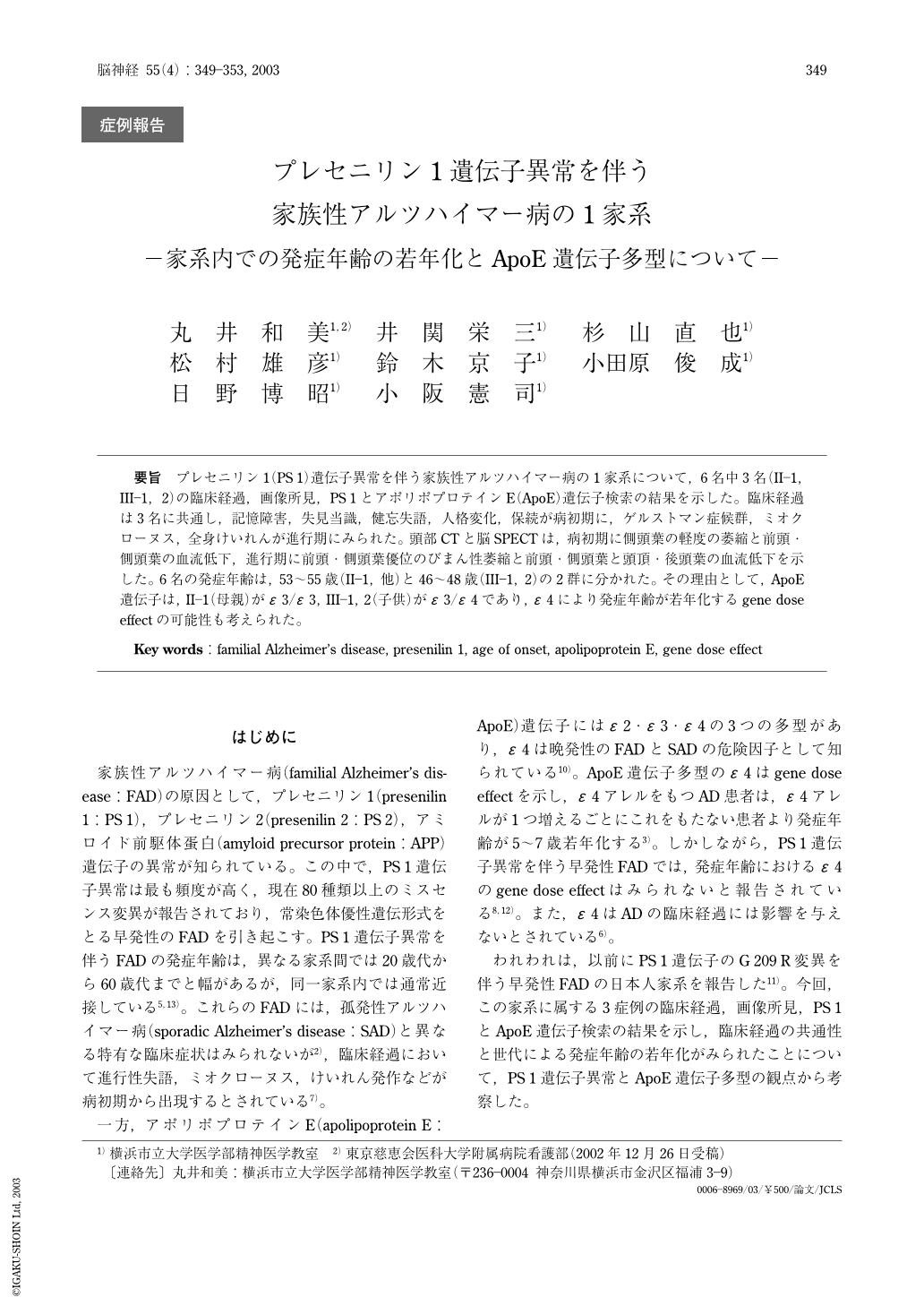
要旨 プレセニリン1(PS 1)遺伝子異常を伴う家族性アルツハイマー病の1家系について,6名中3名(II-1,III-1,2)の臨床経過,画像所見,PS 1とアポリポプロテインE(ApoE)遺伝子検索の結果を示した。臨床経過は3名に共通し,記憶障害,失見当識,健忘失語,人格変化,保続が病初期に,ゲルストマン症候群,ミオクローヌス,全身けいれんが進行期にみられた。頭部CTと脳SPECTは,病初期に側頭葉の軽度の萎縮と前頭・側頭葉の血流低下,進行期に前頭・側頭葉優位のびまん性萎縮と前頭・側頭葉と頭頂・後頭葉の血流低下を示した。6名の発症年齢は,53~55歳(II-1,他)と46~48歳(III-1,2)の2群に分かれた。その理由として,ApoE遺伝子は,II-1(母親)がε3/ε3,III-1,2(子供)がε3/ε4であり,ε4により発症年齢が若年化するgene dose effectの可能性も考えられた。
We previously reported a Japanese family with early-onset familial Alzheimer's disease associated with G209R presenilin 1(PS 1) mutation. There have been six patients across three generations in this family. In the present report, we described the clinical course, findings with neuroimaging and results of genetic examination of PS 1 and apolipoprotein E(ApoE) in three of six patients(II-1, III-1 and 2). The clinical course was common to all three patients. Memory disturbance, disorientation, amnestic aphasia, personality changes and perseveration appeared at early stages, whereas Gerstmann's syndrome, myoclonus and general convulsion were recognized at advanced stages. CT disclosed mild brain atrophy in the temporal lobes at early stages and diffuse brain atrophy predominantly in the fronto-temporal lobes at advanced stages. SPECT exhibited hypoperfusion in the fronto-temporal areas at early stages and hypoperfusion in the fronto-temporal and parieto-occipital areas at advanced stages. The age of onset in six patients demonstrated two clusters at age 53-55(I-1, II-1, 2 and 5) and age 46-48(III-1 and 2). PS 1 genotyping demonstrated that the heterozygous exonic missense mutation G209R was confirmed in all three patients. Regarding the ApoE genotyping, II-1(mother) was ε3/ε3, whereas III-1 and 2(children) were ε3/ε4. These findings suggest the possibility that there might be a gene dose effect, since the age of onset ranged from 5 to 7 years younger in patients who received ε4 alleles from the father.
Copyright © 2003, Igaku-Shoin Ltd. All rights reserved.