Japanese
English
- 有料閲覧
PPV購入案内
1,320円 (1,200円+税10%) こちらは、679ページから690ページの文献です。購入には医書.jp本会員登録が必要です。
会員登録完了後に改めて上記「購入サイトへ」を選択してください。
または「購入サイトへ」選択後に「購入ログイン」、「新規会員登録」の順に進んでください。
会員登録について詳しくはをご確認ください。
- Abstract 文献概要
- 1ページ目 Look Inside
- 参考文献 Reference
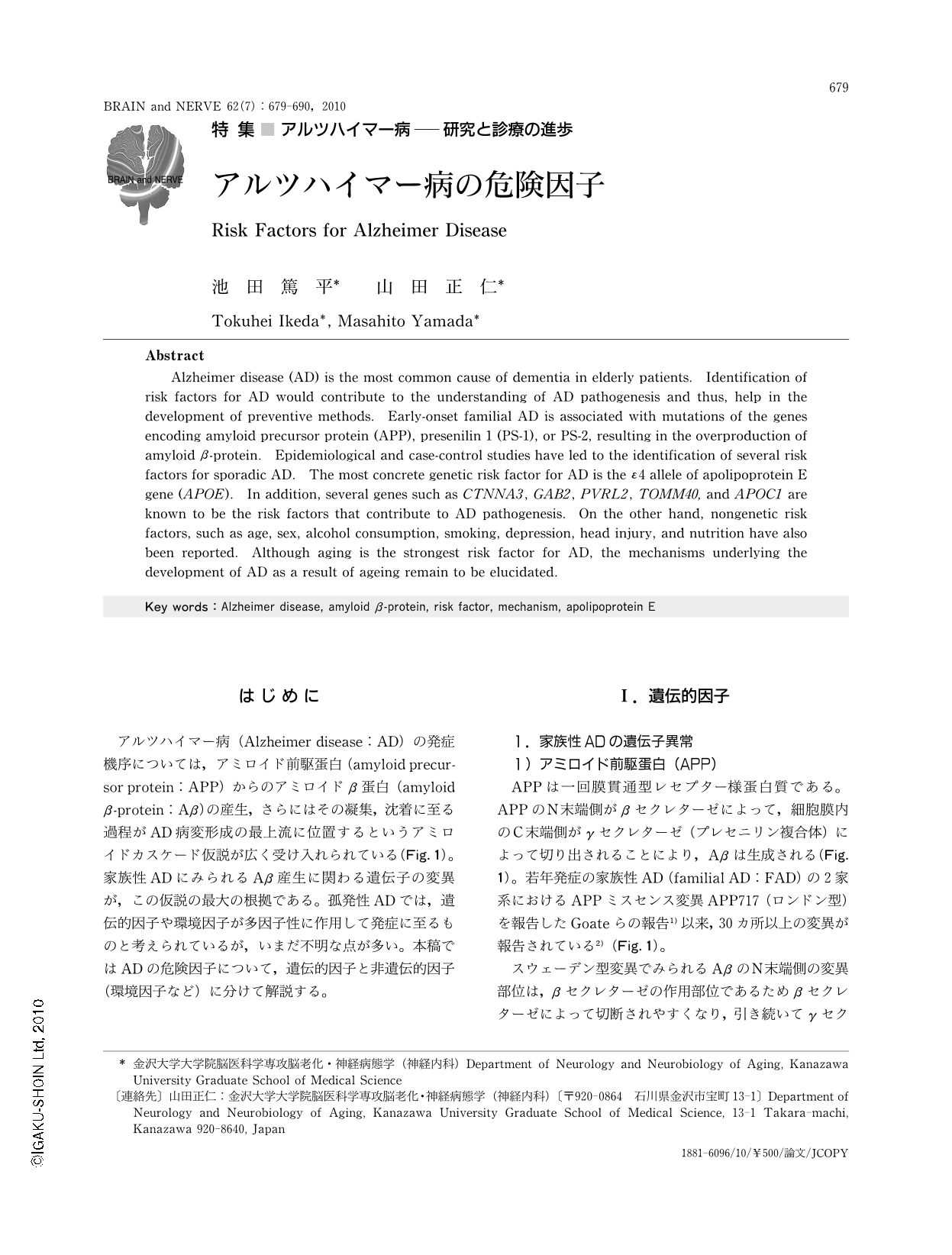
はじめに
アルツハイマー病(Alzheimer disease:AD)の発症機序については,アミロイド前駆蛋白(amyloid precursor protein:APP)からのアミロイドβ蛋白(amyloid β-protein:Aβ)の産生,さらにはその凝集,沈着に至る過程がAD病変形成の最上流に位置するというアミロイドカスケード仮説が広く受け入れられている(Fig.1)。家族性ADにみられるAβ産生に関わる遺伝子の変異が,この仮説の最大の根拠である。孤発性ADでは,遺伝的因子や環境因子が多因子性に作用して発症に至るものと考えられているが,いまだ不明な点が多い。本稿ではADの危険因子について,遺伝的因子と非遺伝的因子(環境因子など)に分けて解説する。
Abstract
Alzheimer disease (AD) is the most common cause of dementia in elderly patients. Identification of risk factors for AD would contribute to the understanding of AD pathogenesis and thus,help in the development of preventive methods. Early-onset familial AD is associated with mutations of the genes encoding amyloid precursor protein (APP),presenilin 1 (PS-1),or PS-2,resulting in the overproduction of amyloid β-protein. Epidemiological and case-control studies have led to the identification of several risk factors for sporadic AD. The most concrete genetic risk factor for AD is the ε4 allele of apolipoprotein E gene (APOE). In addition,several genes such as CTNNA3,GAB2,PVRL2,TOMM40,and APOC1 are known to be the risk factors that contribute to AD pathogenesis. On the other hand,nongenetic risk factors,such as age,sex,alcohol consumption,smoking,depression,head injury,and nutrition have also been reported. Although aging is the strongest risk factor for AD,the mechanisms underlying the development of AD as a result of ageing remain to be elucidated.
Copyright © 2010, Igaku-Shoin Ltd. All rights reserved.