Japanese
English
- 有料閲覧
PPV購入案内
1,320円 (1,200円+税10%) こちらは、407ページから412ページの文献です。購入には医書.jp本会員登録が必要です。
会員登録完了後に改めて上記「購入サイトへ」を選択してください。
または「購入サイトへ」選択後に「購入ログイン」、「新規会員登録」の順に進んでください。
会員登録について詳しくはをご確認ください。
- Abstract 文献概要
- 1ページ目 Look Inside
- 参考文献 Reference
Point
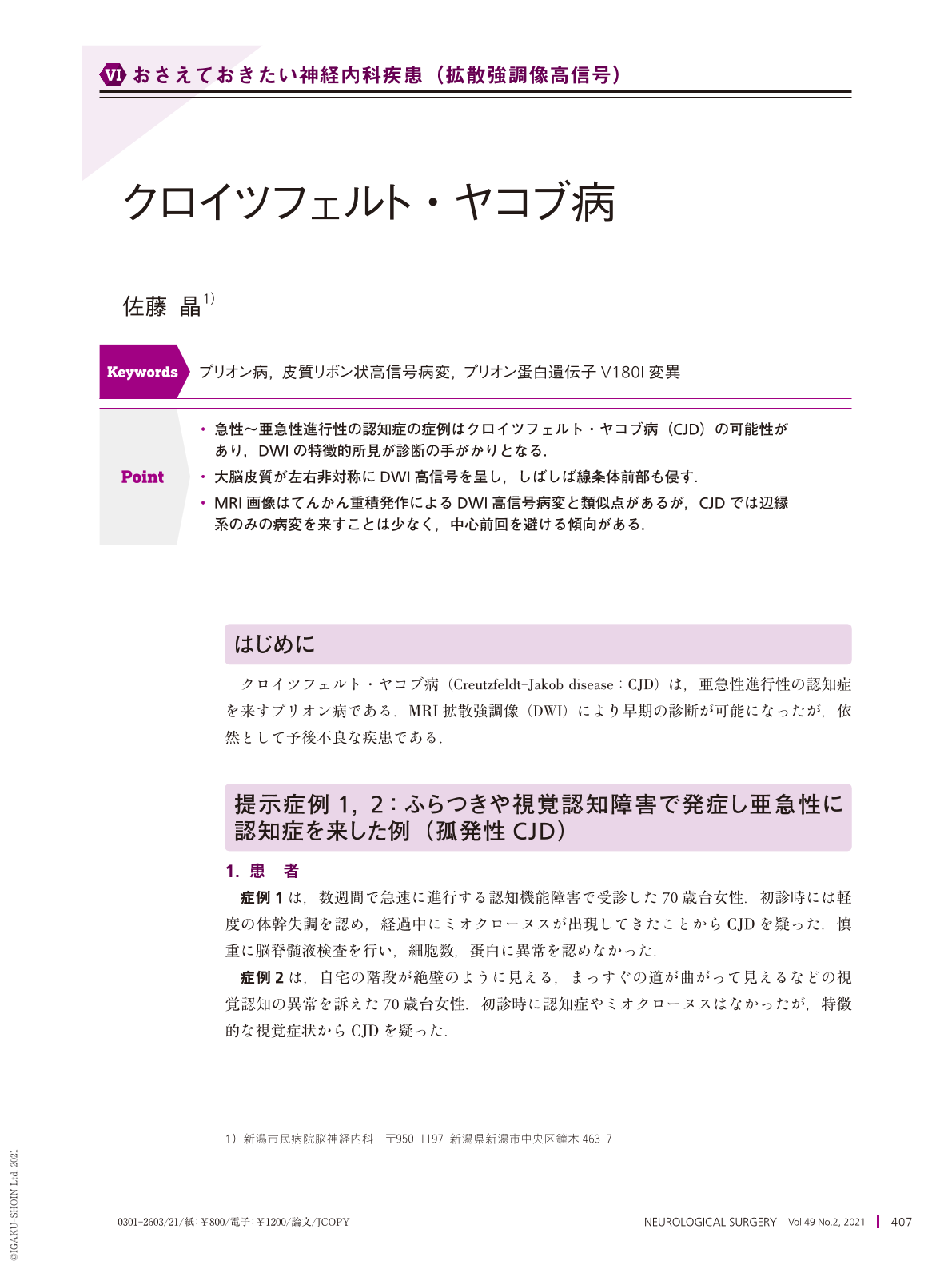
・急性〜亜急性進行性の認知症の症例はクロイツフェルト・ヤコブ病(CJD)の可能性があり,DWIの特徴的所見が診断の手がかりとなる.
・大脳皮質が左右非対称にDWI高信号を呈し,しばしば線条体前部も侵す.
・MRI画像はてんかん重積発作によるDWI高信号病変と類似点があるが,CJDでは辺縁系のみの病変を来すことは少なく,中心前回を避ける傾向がある.
Sporadic Creutzfeldt-Jacob disease(sCJD)is a prion disease presenting with subacute or rapidly progressive dementia with a poor prognosis. Asymmetrical cortical lesions with thalamic involvement are found in sCJD cases, which is similar distribution to status epileptics, but the lesions are not observed in the limbic systems, and they rarely occur in the precentral gyrus. Characteristically, hyperintense abnormal findings are more prominent on DWI than on FLAIR and T2WI.
19.9% of CJD is genetic CJD(gCJD), and CJD with a mutation of codon 180 from valine to isoleucine(V180I)accounts for 40% of gCJD in Japan. Patients with this type of gCJD rarely have a family history because of the low penetration rate. The age of onset is usually later, and its clinical symptoms deteriorate more slowly than sCJD. DWI shows abnormal cortical hyperintense signals(cortical ribboning).
Copyright © 2021, Igaku-Shoin Ltd. All rights reserved.