Japanese
English
- 有料閲覧
PPV購入案内
1,650円 (1,500円+税10%) こちらは、1193ページから1198ページの文献です。購入には医書.jp本会員登録が必要です。
会員登録完了後に改めて上記「購入サイトへ」を選択してください。
または「購入サイトへ」選択後に「購入ログイン」、「新規会員登録」の順に進んでください。
会員登録について詳しくはをご確認ください。
- Abstract 文献概要
- 1ページ目 Look Inside
- 参考文献 Reference
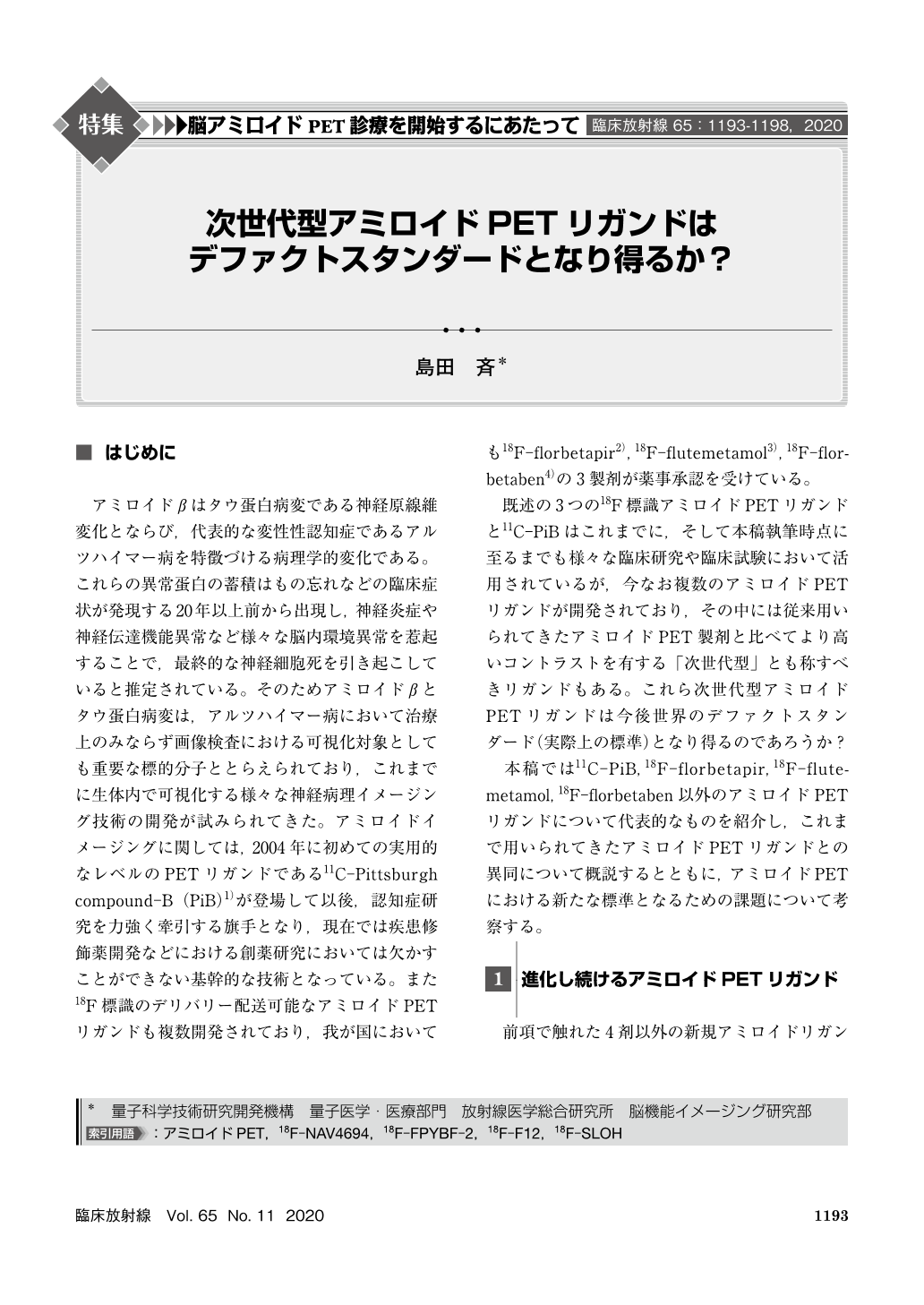
アミロイドβはタウ蛋白病変である神経原線維変化とならび,代表的な変性性認知症であるアルツハイマー病を特徴づける病理学的変化である。これらの異常蛋白の蓄積はもの忘れなどの臨床症状が発現する20年以上前から出現し,神経炎症や神経伝達機能異常など様々な脳内環境異常を惹起することで,最終的な神経細胞死を引き起こしていると推定されている。そのためアミロイドβとタウ蛋白病変は,アルツハイマー病において治療上のみならず画像検査における可視化対象としても重要な標的分子ととらえられており,これまでに生体内で可視化する様々な神経病理イメージング技術の開発が試みられてきた。アミロイドイメージングに関しては,2004年に初めての実用的なレベルのPETリガンドである11C-Pittsburgh compound-B(PiB)1)が登場して以後,認知症研究を力強く牽引する旗手となり,現在では疾患修飾薬開発などにおける創薬研究においては欠かすことができない基幹的な技術となっている。また18F標識のデリバリー配送可能なアミロイドPETリガンドも複数開発されており,我が国においても18F-florbetapir2),18F-flutemetamol3),18F-florbetaben4)の3製剤が薬事承認を受けている。
Amyloid-βdeposits, which are pathognomonic hallmarks of Alzheimer’s disease in addition to neurofibrillary tangles, are a pivotal target for imaging as well as therapy. Even recently, novel amyloid PET ligands have been under development. Some ligands show lower off-target binding to white matter compared with conventional ones, leading to the realization of the early possible detection of subtle Aβdeposition. If disease modifying agents are approved in the near future, preclinical diagnosis by PET with novel ligands will become increasingly important. Key issues for novel amyloid PET ligands, which are needed to become the de facto standard, include “standardization” and “neuroimaging-pathological correlation”.
Copyright © 2020, KANEHARA SHUPPAN Co.LTD. All rights reserved.