Japanese
English
- 有料閲覧
- Abstract 文献概要
- 1ページ目 Look Inside
- 参考文献 Reference
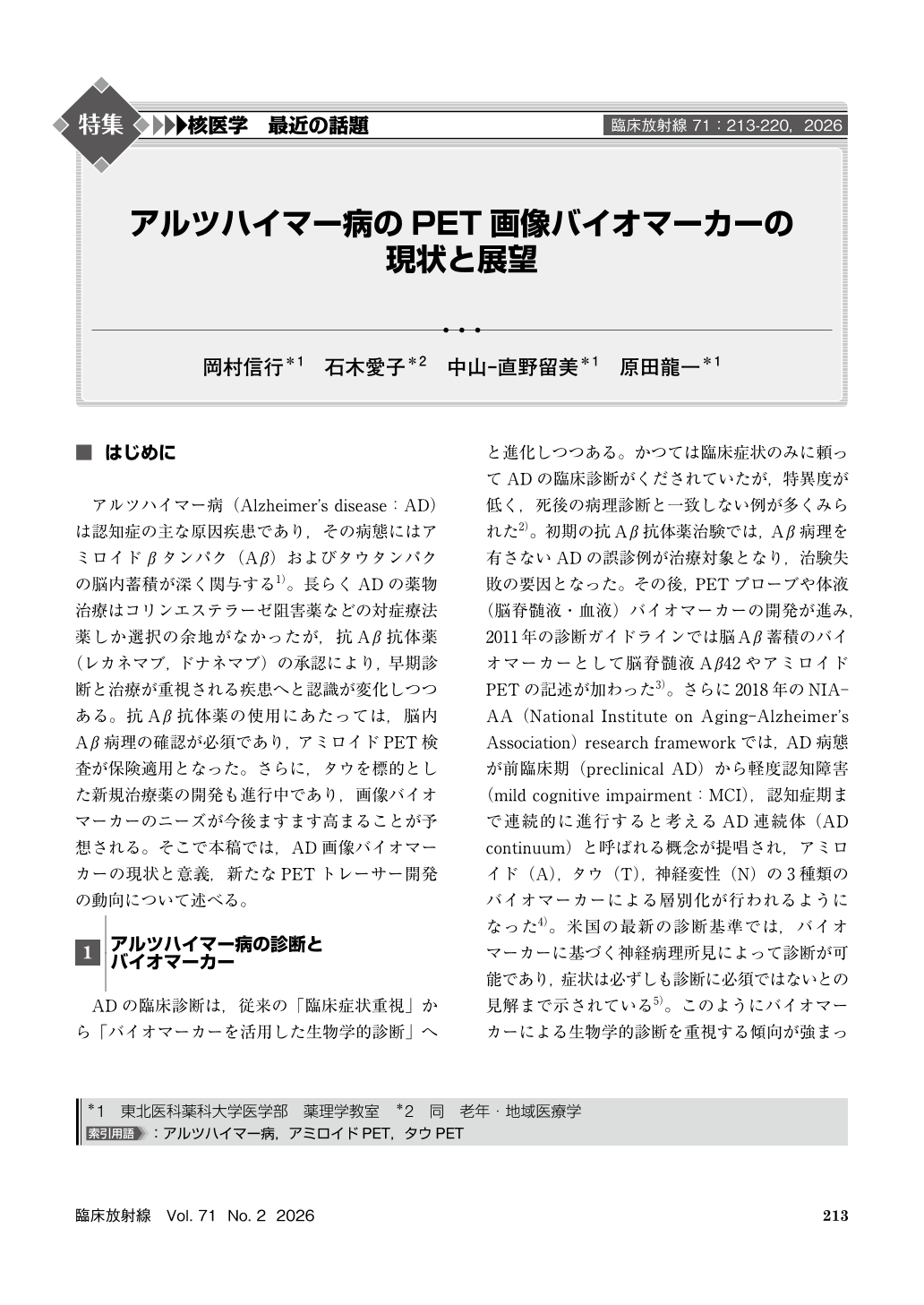
アルツハイマー病(Alzheimer’s disease:AD)は認知症の主な原因疾患であり,その病態にはアミロイドβタンパク(Aβ)およびタウタンパクの脳内蓄積が深く関与する1)。長らくADの薬物治療はコリンエステラーゼ阻害薬などの対症療法薬しか選択の余地がなかったが,抗Aβ抗体薬(レカネマブ,ドナネマブ)の承認により,早期診断と治療が重視される疾患へと認識が変化しつつある。抗Aβ抗体薬の使用にあたっては,脳内Aβ病理の確認が必須であり,アミロイドPET検査が保険適用となった。さらに,タウを標的とした新規治療薬の開発も進行中であり,画像バイオマーカーのニーズが今後ますます高まることが予想される。そこで本稿では,AD画像バイオマーカーの現状と意義,新たなPETトレーサー開発の動向について述べる。
Alzheimer’s disease is increasingly approached through biological diagnosis using biomarkers, reflecting the development of anti-amyloid antibodies and the need for earlier and more accurate detection. Amyloid PET remains the gold standard for confirming brain Aβ pathology, while blood biomarkers are rapidly advancing. Tau PET complements amyloid imaging by reflecting disease stage and neurodegenerative risk, although first-generation tracers had limitations in specificity, newer agents such as MK-6240 and SNFT-1 offer improved sensitivity. Neuroinflammation imaging, particularly MAO-B-targeted PET(e.g., SMBT-1), visualizes reactive astrogliosis from preclinical stages and may help predict disease progression. Together, these evolving PET biomarkers will play an increasingly important role in stratifying patients and guiding therapy.
Copyright © 2026, KANEHARA SHUPPAN Co.LTD. All rights reserved.