Japanese
English
- 有料閲覧
PPV購入案内
1,650円 (1,500円+税10%) こちらは、177ページから188ページの文献です。購入には医書.jp本会員登録が必要です。
会員登録完了後に改めて上記「購入サイトへ」を選択してください。
または「購入サイトへ」選択後に「購入ログイン」、「新規会員登録」の順に進んでください。
会員登録について詳しくはをご確認ください。
- Abstract 文献概要
- 1ページ目 Look Inside
- 参考文献 Reference
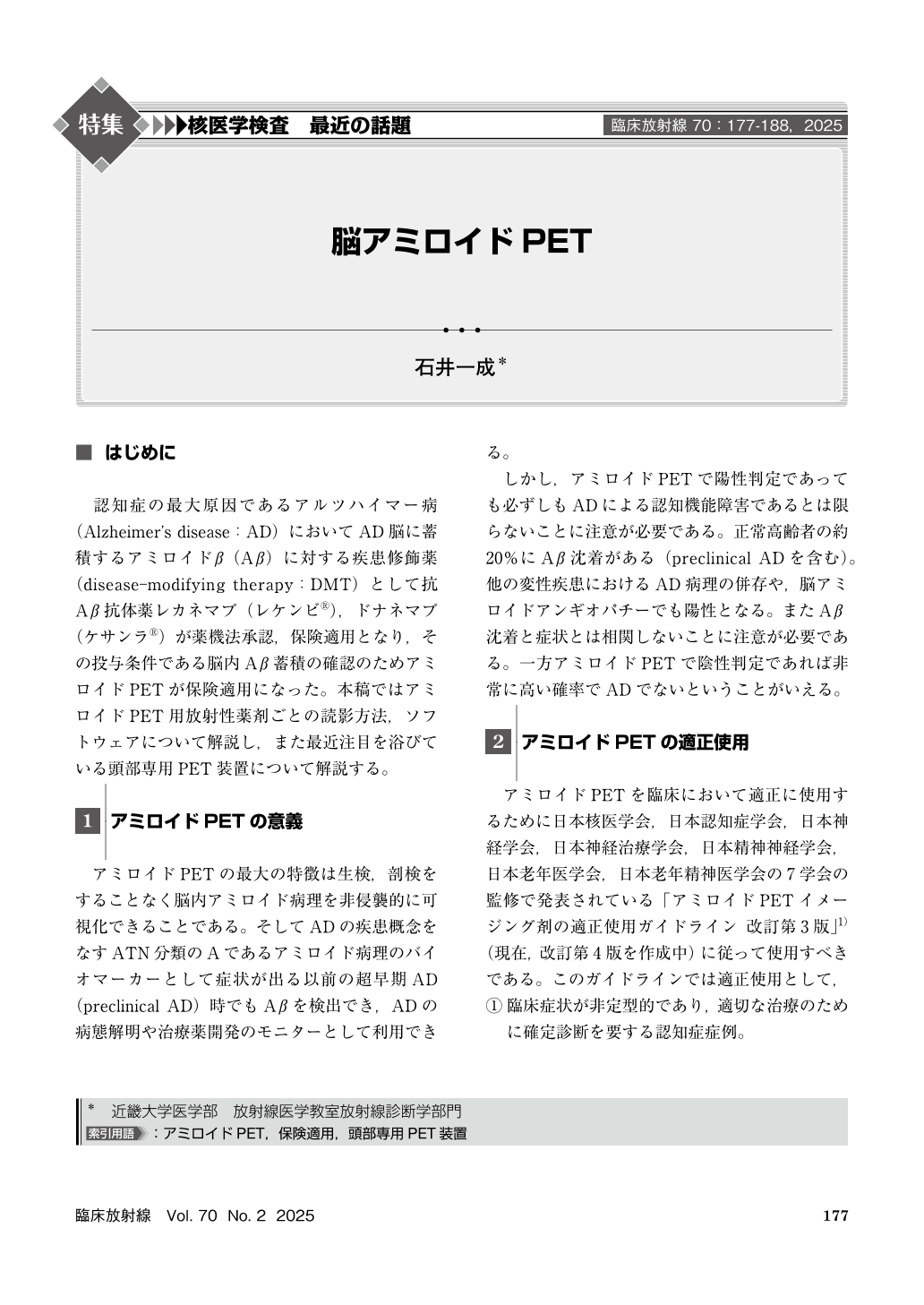
認知症の最大原因であるアルツハイマー病(Alzheimer’s disease:AD)においてAD脳に蓄積するアミロイドβ(Aβ)に対する疾患修飾薬(disease-modifying therapy:DMT)として抗Aβ抗体薬レカネマブ(レケンビ®),ドナネマブ(ケサンラ®)が薬機法承認,保険適用となり,その投与条件である脳内Aβ蓄積の確認のためアミロイドPETが保険適用になった。本稿ではアミロイドPET用放射性薬剤ごとの読影方法,ソフトウェアについて解説し,また最近注目を浴びている頭部専用PET装置について解説する。
Alzheimer’s disease(AD)is the most common cause of dementia. Newly approved anti-amyloid beta(Aβ)therapies, such as lecanemab and donanemab, have made amyloid PET essential for confirming cerebral Aβ deposition. Three 18F-labeled radiopharmaceuticals(florbetapir, flutemetamol, and florbetaben)are clinically available in Japan with standardized interpretation protocols. While amyloid PET can visualize Aβ noninvasively, a positive scan does not necessarily imply AD-related cognitive impairment. For accurate diagnosis, visual interpretation must adhere to established guidelines, and quantitative indices(SUVR or Centiloid scale)may help refine assessments. Recently, dedicated brain PET systems(e.g., BresTome® and Vrain®)have emerged, offering higher spatial resolution for brain PET imaging.
Copyright © 2025, KANEHARA SHUPPAN Co.LTD. All rights reserved.