Japanese
English
- 有料閲覧
PPV購入案内
1,320円 (1,200円+税10%) こちらは、1011ページから1016ページの文献です。購入には医書.jp本会員登録が必要です。
会員登録完了後に改めて上記「購入サイトへ」を選択してください。
または「購入サイトへ」選択後に「購入ログイン」、「新規会員登録」の順に進んでください。
会員登録について詳しくはをご確認ください。
- Abstract 文献概要
- 1ページ目 Look Inside
- 参考文献 Reference
- サイト内被引用 Cited by
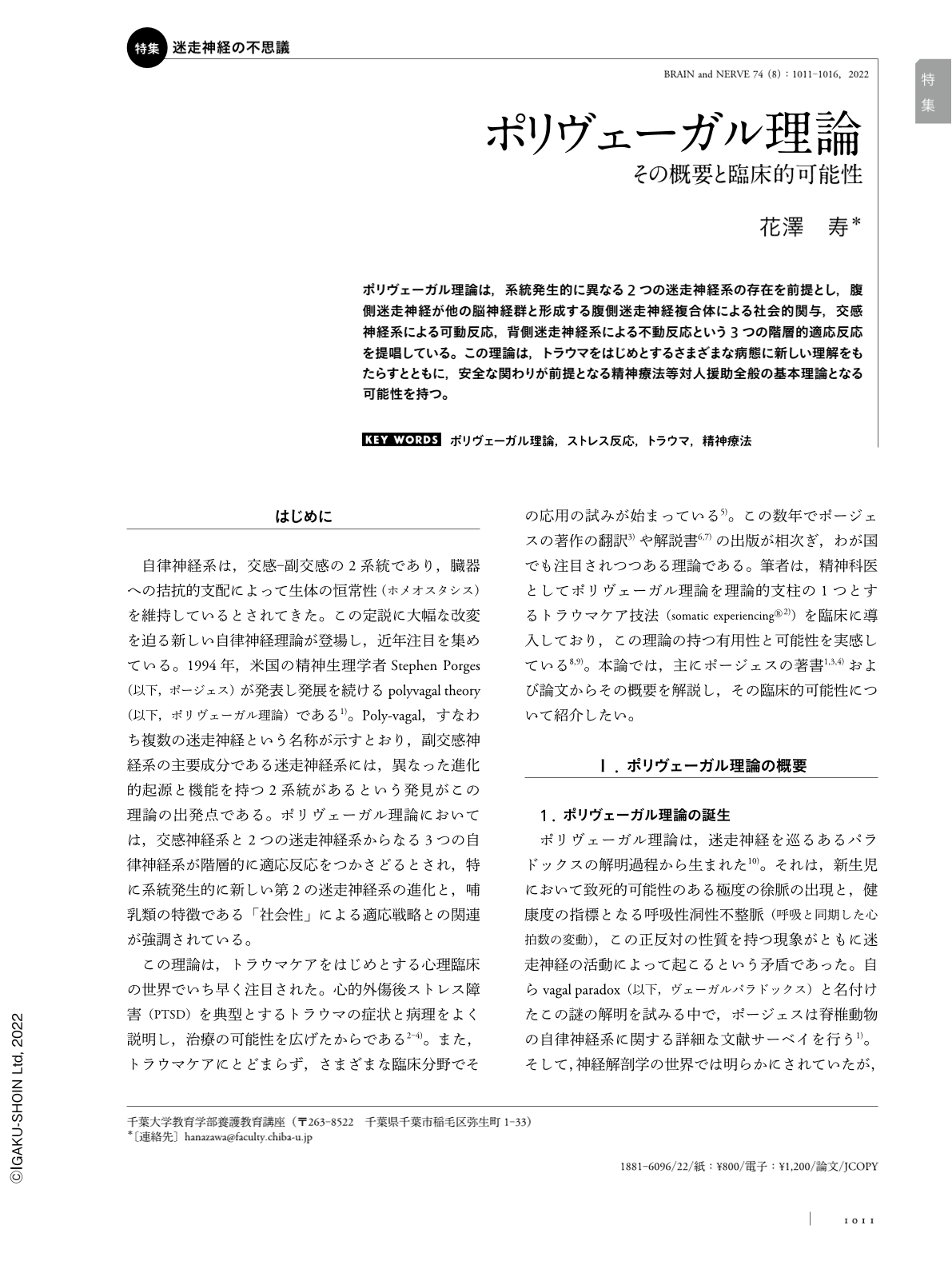
ポリヴェーガル理論は,系統発生的に異なる2つの迷走神経系の存在を前提とし,腹側迷走神経が他の脳神経群と形成する腹側迷走神経複合体による社会的関与,交感神経系による可動反応,背側迷走神経系による不動反応という3つの階層的適応反応を提唱している。この理論は,トラウマをはじめとするさまざまな病態に新しい理解をもたらすとともに,安全な関わりが前提となる精神療法等対人援助全般の基本理論となる可能性を持つ。
Abstract
The polyvagal theory, proposed by Stephen Porges, describes the adaptive responses of the mammalian autonomic nervous system. According to this novel theory, the vagus nerve functions through two independent pathways, referred to as the ventral and the dorsal vagal pathways. The ventral vagus is a myelinated nerve that has newly emerged in mammals and in coordination with cranial nerves regulates the muscles of the face and head to form the ventral vagal complex, which enables social engagement via exchange of safety cues and downregulating sympathetic defense reaction. In a safe environment, mammals normally adapt using the social engagement system; however, depending on the degree of risk exposure in the environment, activation of the sympathetic nervous system triggers the fight-or-flight response, and the dorsal vagal system initiates the immobilization shutdown response. The involuntary neural process through which the nervous system evaluates risk is referred to as neuroception. The polyvagal theory explains the pathophysiology of trauma and various physical symptoms associated with ventral vagal complex dysfunction. Moreover, this may potentially be useful as a fundamental theory in psychotherapy, in which the quality of social interaction is critical.
Copyright © 2022, Igaku-Shoin Ltd. All rights reserved.