Japanese
English
- 有料閲覧
PPV購入案内
1,320円 (1,200円+税10%) こちらは、633ページから639ページの文献です。購入には医書.jp本会員登録が必要です。
会員登録完了後に改めて上記「購入サイトへ」を選択してください。
または「購入サイトへ」選択後に「購入ログイン」、「新規会員登録」の順に進んでください。
会員登録について詳しくはをご確認ください。
- Abstract 文献概要
- 1ページ目 Look Inside
- 参考文献 Reference
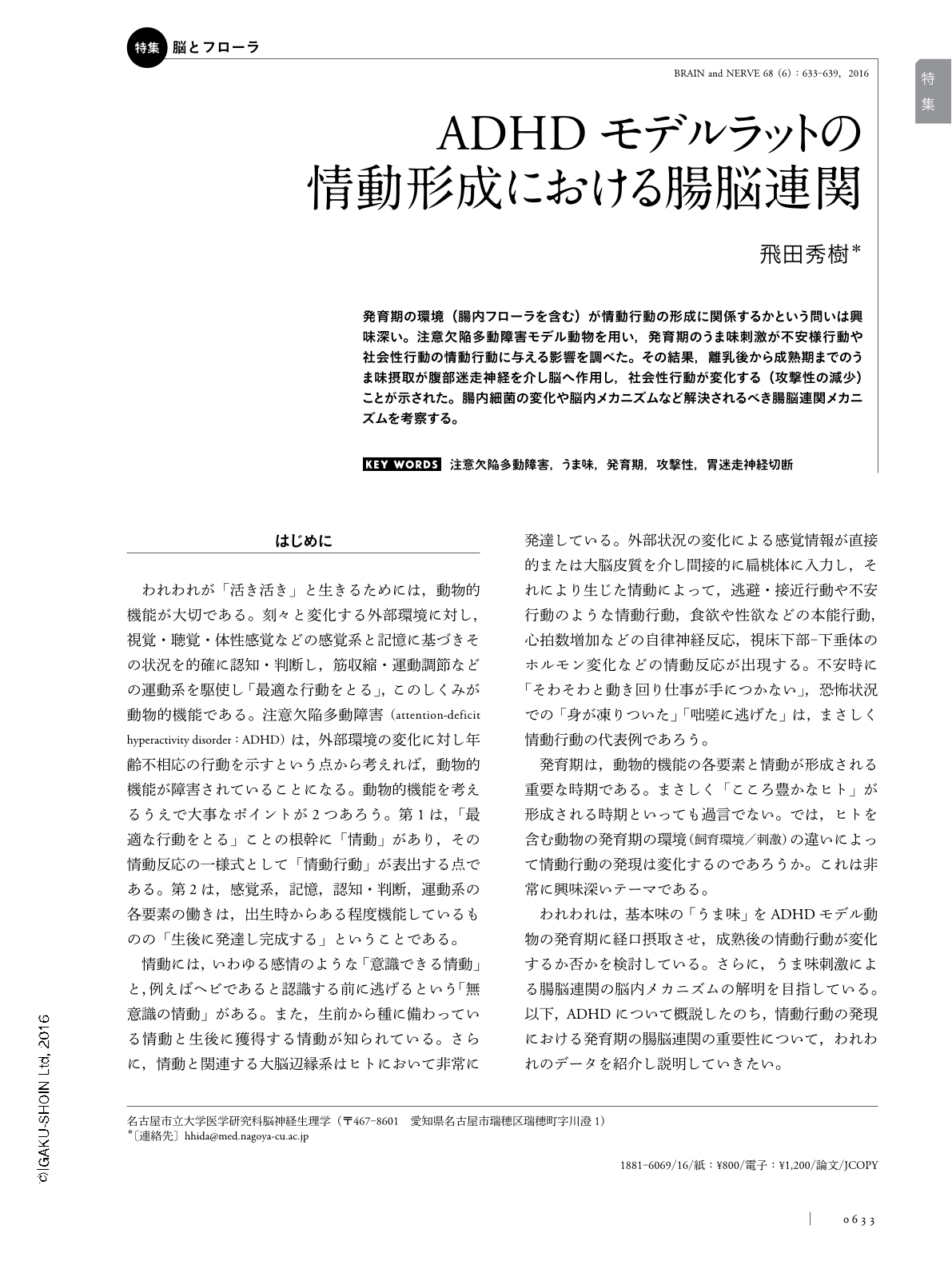
発育期の環境(腸内フローラを含む)が情動行動の形成に関係するかという問いは興味深い。注意欠陥多動障害モデル動物を用い,発育期のうま味刺激が不安様行動や社会性行動の情動行動に与える影響を調べた。その結果,離乳後から成熟期までのうま味摂取が腹部迷走神経を介し脳へ作用し,社会性行動が変化する(攻撃性の減少)ことが示された。腸内細菌の変化や脳内メカニズムなど解決されるべき腸脳連関メカニズムを考察する。
Abstract
It is of interest to know how environmental stimuli contribute to the formation of emotion during development. In a rat model of attention-deficit hyperactivity disorder, monosodium L- glutamate (MSG), a taste substance of umami, was administered for 5 weeks during developmental period, followed by emotional behavior tests such as open-field test and social interaction test in adulthood. Although no significant change was observed in anxiety-like behavior, MSG intake caused a reduction in aggressive behavior. Vagotomy under the level of diaphragm resulted in eliminating the MSG effect on aggression, indicating the importance of neuronal activity of the vagus nerve in this effect. Futher studies will focus on futher questions regarding the gut-brain axis such as the change of microbiota and the mechanism of the axis in the brain.
Copyright © 2016, Igaku-Shoin Ltd. All rights reserved.