Japanese
English
- 有料閲覧
PPV購入案内
1,650円 (1,500円+税10%) こちらは、169ページから175ページの文献です。購入には医書.jp本会員登録が必要です。
会員登録完了後に改めて上記「購入サイトへ」を選択してください。
または「購入サイトへ」選択後に「購入ログイン」、「新規会員登録」の順に進んでください。
会員登録について詳しくはをご確認ください。
- Abstract 文献概要
- 1ページ目 Look Inside
- 参考文献 Reference
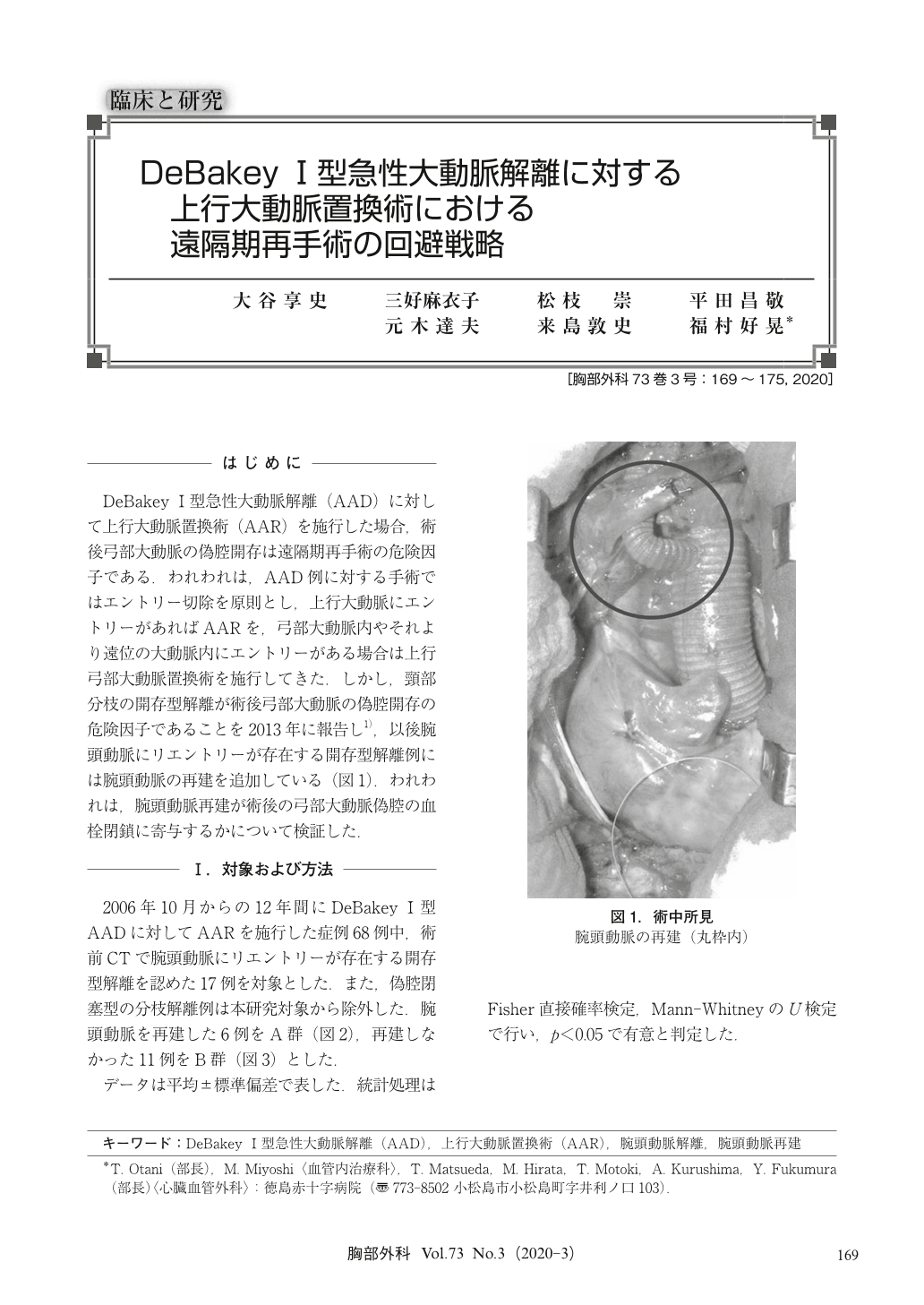
DeBakeyⅠ型急性大動脈解離(AAD)に対して上行大動脈置換術(AAR)を施行した場合,術後弓部大動脈の偽腔開存は遠隔期再手術の危険因子である.われわれは,AAD例に対する手術ではエントリー切除を原則とし,上行大動脈にエントリーがあればAARを,弓部大動脈内やそれより遠位の大動脈内にエントリーがある場合は上行弓部大動脈置換術を施行してきた.しかし,頸部分枝の開存型解離が術後弓部大動脈の偽腔開存の危険因子であることを2013年に報告し1),以後腕頭動脈にリエントリーが存在する開存型解離例には腕頭動脈の再建を追加している(図1).われわれは,腕頭動脈再建が術後の弓部大動脈偽腔の血栓閉鎖に寄与するかについて検証した.
When ascending aortic replacement (AAR) is performed in patients with DeBakey typeⅠ acute aortic dissection (AAD), residual false lumen of the aortic arch after AAR is a risk factor of remote aortic reoperation. We have principally considered entry resection as a surgical policy for AAD, but since 2013, for cases of re-entry in the brachiocephalic artery, reconstruction of the brachiocephalic artery has been added. We verified whether brachiocephalic artery reconstruction contributes to the thrombus closure of the false lumen of the aortic arch after the operation. Of 68 patients who underwent AAR for DeBakey typeⅠ AAD within a 12 year period, 17 had re-entry in the brachiocephalic artery on preoperative computed tomography (CT). Six patients who underwent brachiocephalic artery reconstruction were assigned to group A, and 11 patients who did not were assigned to group B. We compared the 2 groups. Aortic clamp and selective cerebral perfusion times were significantly longer in group A. By postoperative CT, false lumen of the aortic arch was not found in any case (0%) in group A, but was found in 10 (90.9%) of the 11 cases in group B (p=0.0006). The risk of residual false lumen of the aortic arch significantly decreased in group A. In conclusion, in cases where re-entry is found in the brachiocephalic artery, a false lumen often remains in the aortic arch after AAR. However, by reconstructing the dissected brachiocephalic artery, the false lumen of the aortic arch can be obliterated, which contributes to avoidance of reoperation in a chronic phase.
© Nankodo Co., Ltd., 2020