Japanese
English
- 有料閲覧
PPV購入案内
1,320円 (1,200円+税10%) こちらは、124ページから132ページの文献です。購入には医書.jp本会員登録が必要です。
会員登録完了後に改めて上記「購入サイトへ」を選択してください。
または「購入サイトへ」選択後に「購入ログイン」、「新規会員登録」の順に進んでください。
会員登録について詳しくはをご確認ください。
- Abstract 文献概要
- 1ページ目 Look Inside
- 参考文献 Reference
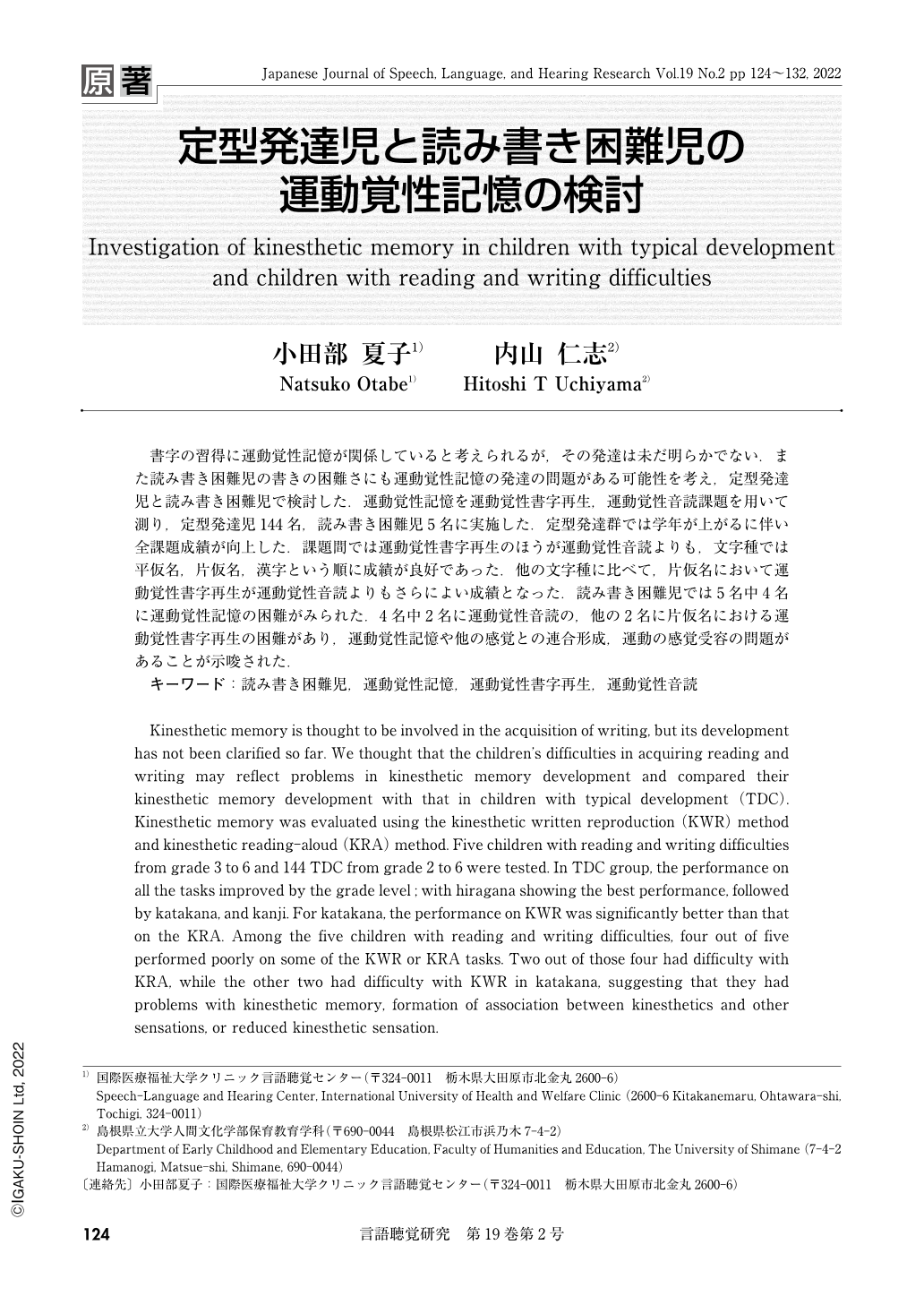
書字の習得に運動覚性記憶が関係していると考えられるが,その発達は未だ明らかでない.また読み書き困難児の書きの困難さにも運動覚性記憶の発達の問題がある可能性を考え,定型発達児と読み書き困難児で検討した.運動覚性記憶を運動覚性書字再生,運動覚性音読課題を用いて測り,定型発達児144名,読み書き困難児5名に実施した.定型発達群では学年が上がるに伴い全課題成績が向上した.課題間では運動覚性書字再生のほうが運動覚性音読よりも,文字種では平仮名,片仮名,漢字という順に成績が良好であった.他の文字種に比べて,片仮名において運動覚性書字再生が運動覚性音読よりもさらによい成績となった.読み書き困難児では5名中4名に運動覚性記憶の困難がみられた.4名中2名に運動覚性音読の,他の2名に片仮名における運動覚性書字再生の困難があり,運動覚性記憶や他の感覚との連合形成,運動の感覚受容の問題があることが示唆された.
Kinesthetic memory is thought to be involved in the acquisition of writing, but its development has not been clarified so far. We thought that the children's difficulties in acquiring reading and writing may reflect problems in kinesthetic memory development and compared their kinesthetic memory development with that in children with typical development (TDC). Kinesthetic memory was evaluated using the kinesthetic written reproduction (KWR) method and kinesthetic reading-aloud (KRA) method. Five children with reading and writing difficulties from grade 3 to 6 and 144 TDC from grade 2 to 6 were tested. In TDC group, the performance on all the tasks improved by the grade level;with hiragana showing the best performance, followed by katakana, and kanji. For katakana, the performance on KWR was significantly better than that on the KRA. Among the five children with reading and writing difficulties, four out of five performed poorly on some of the KWR or KRA tasks. Two out of those four had difficulty with KRA, while the other two had difficulty with KWR in katakana, suggesting that they had problems with kinesthetic memory, formation of association between kinesthetics and other sensations, or reduced kinesthetic sensation.
Copyright © 2022, Japanese Association of Speech-Language-Hearing Therapists. All rights reserved.