Japanese
English
- 有料閲覧
PPV購入案内
1,320円 (1,200円+税10%) こちらは、1113ページから1120ページの文献です。購入には医書.jp本会員登録が必要です。
会員登録完了後に改めて上記「購入サイトへ」を選択してください。
または「購入サイトへ」選択後に「購入ログイン」、「新規会員登録」の順に進んでください。
会員登録について詳しくはをご確認ください。
- Abstract 文献概要
- 1ページ目 Look Inside
- 参考文献 Reference
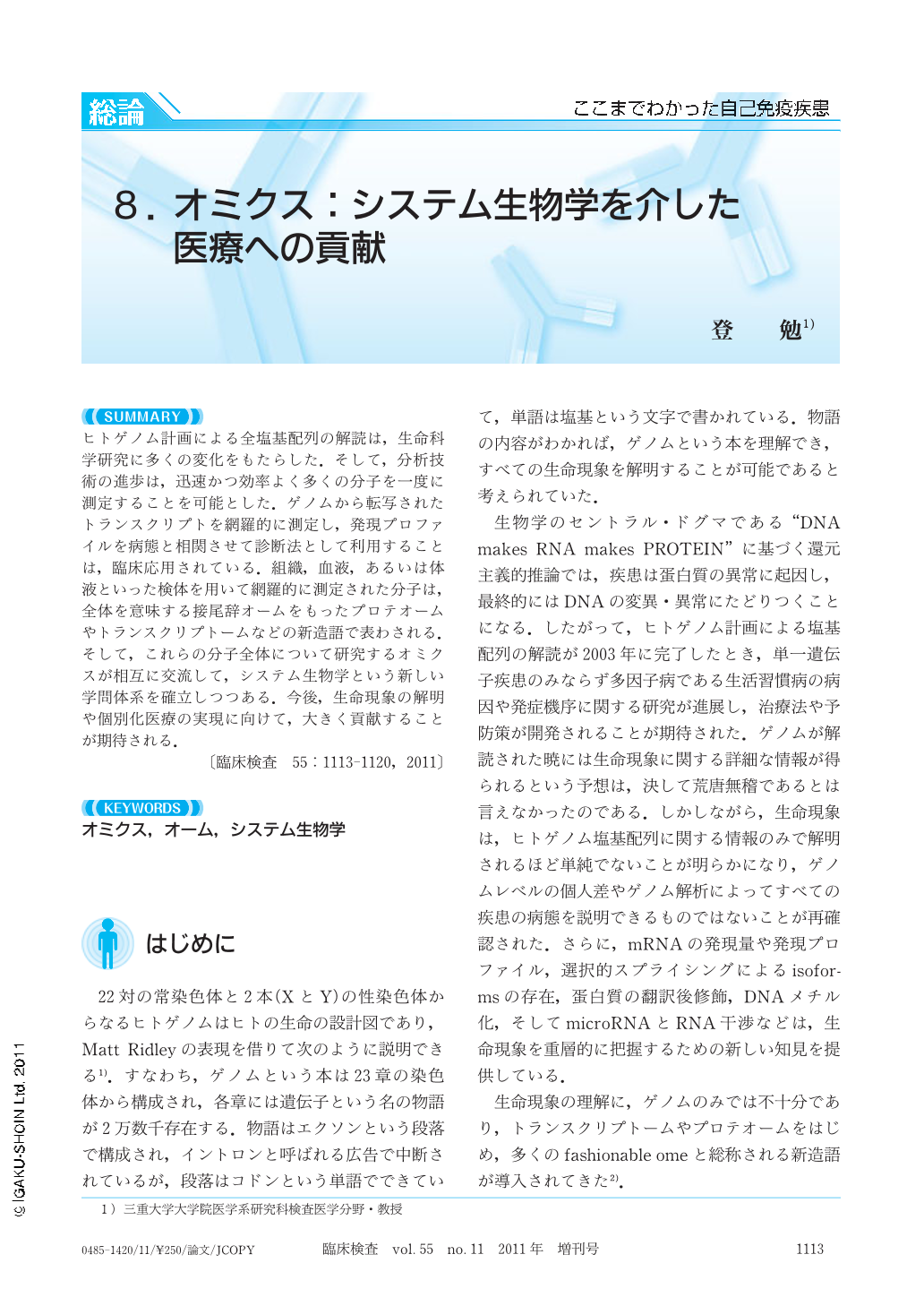
ヒトゲノム計画による全塩基配列の解読は,生命科学研究に多くの変化をもたらした.そして,分析技術の進歩は,迅速かつ効率よく多くの分子を一度に測定することを可能とした.ゲノムから転写されたトランスクリプトを網羅的に測定し,発現プロファイルを病態と相関させて診断法として利用することは,臨床応用されている.組織,血液,あるいは体液といった検体を用いて網羅的に測定された分子は,全体を意味する接尾辞オームをもったプロテオームやトランスクリプトームなどの新造語で表わされる.そして,これらの分子全体について研究するオミクスが相互に交流して,システム生物学という新しい学問体系を確立しつつある.今後,生命現象の解明や個別化医療の実現に向けて,大きく貢献することが期待される.
When the draft reference sequence of the human genome was reported in 2003, the first page of the post-genomic era was opened. The development of various omics technologies made the global and high-throughput analyses possible. Neologisms with the suffix "ome" such as genome, transcriptome, proteome, and so on, were created. For instance, the genome means the entire set of genetic instructions found in a cell, since "ome" is derived from the Sanskrit OM ("completeness and fullness"). Omics means to study the entire set of molecules, e. g. genes in genomics. In omics science, the process of research is fundamentally altered from the "first hypothesize-then-experiment" to "first experiment-then-hypothesize" approach. This kind of omics approach leads to biomarker discovery and personalized medicine through systems biology.
Copyright © 2011, Igaku-Shoin Ltd. All rights reserved.