Japanese
English
- 有料閲覧
PPV購入案内
1,320円 (1,200円+税10%) こちらは、291ページから294ページの文献です。購入には医書.jp本会員登録が必要です。
会員登録完了後に改めて上記「購入サイトへ」を選択してください。
または「購入サイトへ」選択後に「購入ログイン」、「新規会員登録」の順に進んでください。
会員登録について詳しくはをご確認ください。
- Abstract 文献概要
- 1ページ目 Look Inside
序
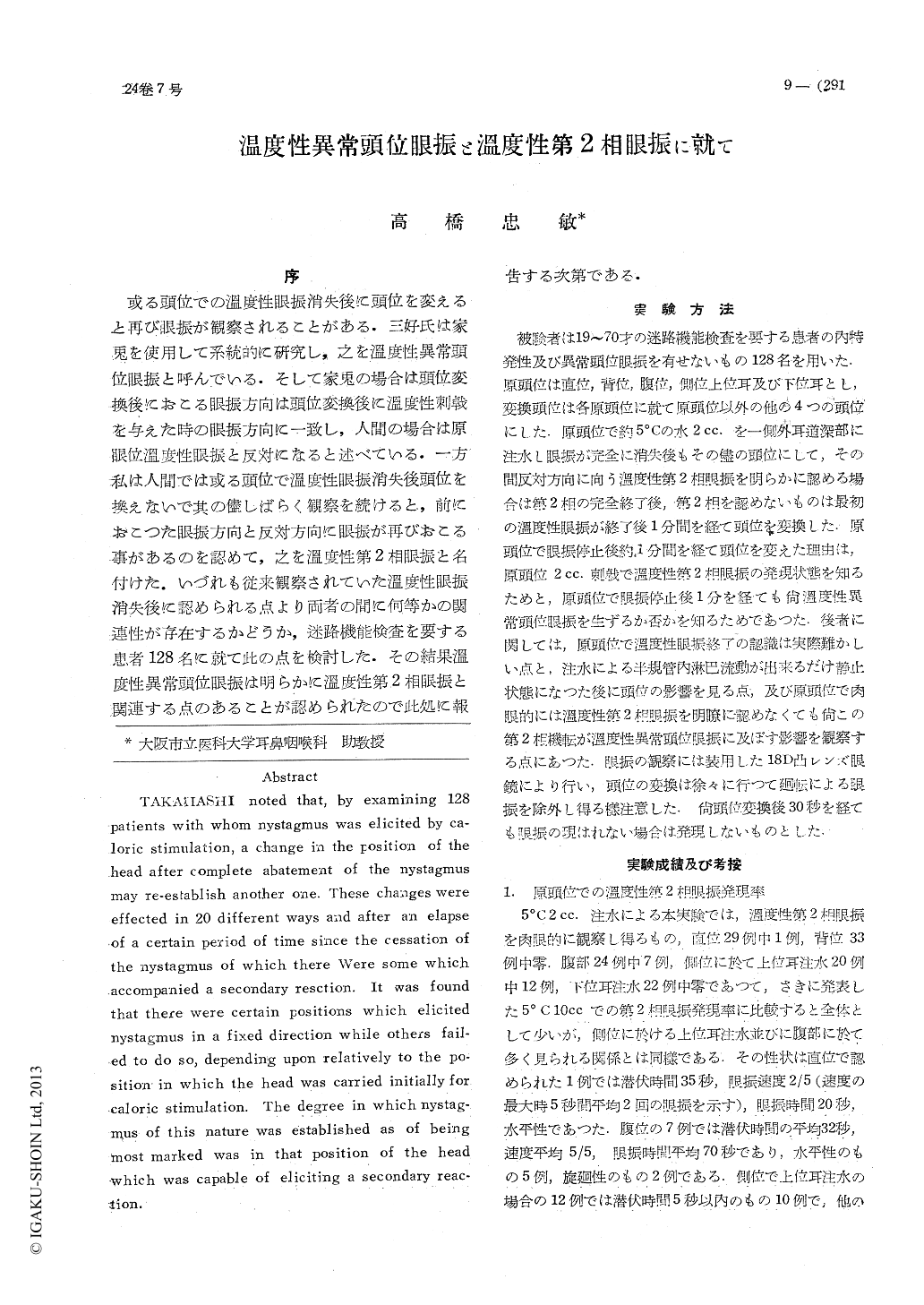
或る頭位での温度性眼振消失後に頭位を変えると再び眼振が観察されることがある.三好氏は家兎を使用して系統的に研究し,之を温度性異常頭位眼振と呼んでいる.そして家兎の場合は頭位変換後におこる眼振方向は頭位変換後に温度性刺戟を与えた時の眼振方向に一致し,人間の場合は原眼位温度性眼振と反対になると述べている.一方私は人間では或る頭位で温度性眼振消失後頭位を換えないで其の儘しばらく観察を続けると,前におこつた眼振方向と反対方向に眼振が再びおこる事があるのを認めて,之を温度性第2相眼振と名付けた.いづれも従来観察されていた温度性眼振消失後に認められる点より両者の間に何等かの関連性が存在するかどうか,迷路機能検査を要する患者128名に就て此の点を倹討した.その結果温度性異常頭位眼振は明らかに温度性第2相眼振と関連する点のあることが認められたので此処に報告する次第である.
TAKAHASHI noted that, by examining 128 patients with whom nystagmus was elicited by caloric stimulation, a change in the position of the head after complete abatement of the nystagmus may reestablish another one. These changes were effected in 20 different ways and after an elapse of a certain period of time since the cessation of the nystagmus of which there Were some which accompanied a secondary reaction. It was found that there were certain positions which elicited nystagmus in a fixed direction while others failed to do so, depending upon relatively to the position in which the head was carried initially for caloric stimulation. The degree in which nystagmus of this nature was established as of being most marked was in that position of the head which was capable of eliciting a secondary reaction.
Copyright © 1952, Igaku-Shoin Ltd. All rights reserved.