Japanese
English
- 有料閲覧
PPV購入案内
1,320円 (1,200円+税10%) こちらは、1023ページから1026ページの文献です。購入には医書.jp本会員登録が必要です。
会員登録完了後に改めて上記「購入サイトへ」を選択してください。
または「購入サイトへ」選択後に「購入ログイン」、「新規会員登録」の順に進んでください。
会員登録について詳しくはをご確認ください。
- Abstract 文献概要
- 1ページ目 Look Inside
緒言
温度性眼振検査法は非適合刺激であり,また迷路以外の刺激が同時に加わる等の欠点があるにも拘らず,一側迷路を別々に刺激し得るという利点がある為に,今日なお重要な前庭機能検査法の一つとして広く行われている現状である。
しかるに実際にcalosit testを行うに当つてはその方法・注水の温度・量・観察方法等,人によつてまちまちで現在迄,幾多の異なつた方法が紹介され,その各部の長短についても論ぜられている。最近,猪らは種々の検査条件を詳しく検討した結果,注水温度としては30℃,44℃,注水量としては20ccが最も適当であると述べ,本法が今日広く行われている実情である。しかるに本法をもつてしても初めてこの方法を行う者にとつては,眼振の開始,終結を明瞭に見分ける事はいささか困難であり,又注水方法についても若干の熟練を必要とする。
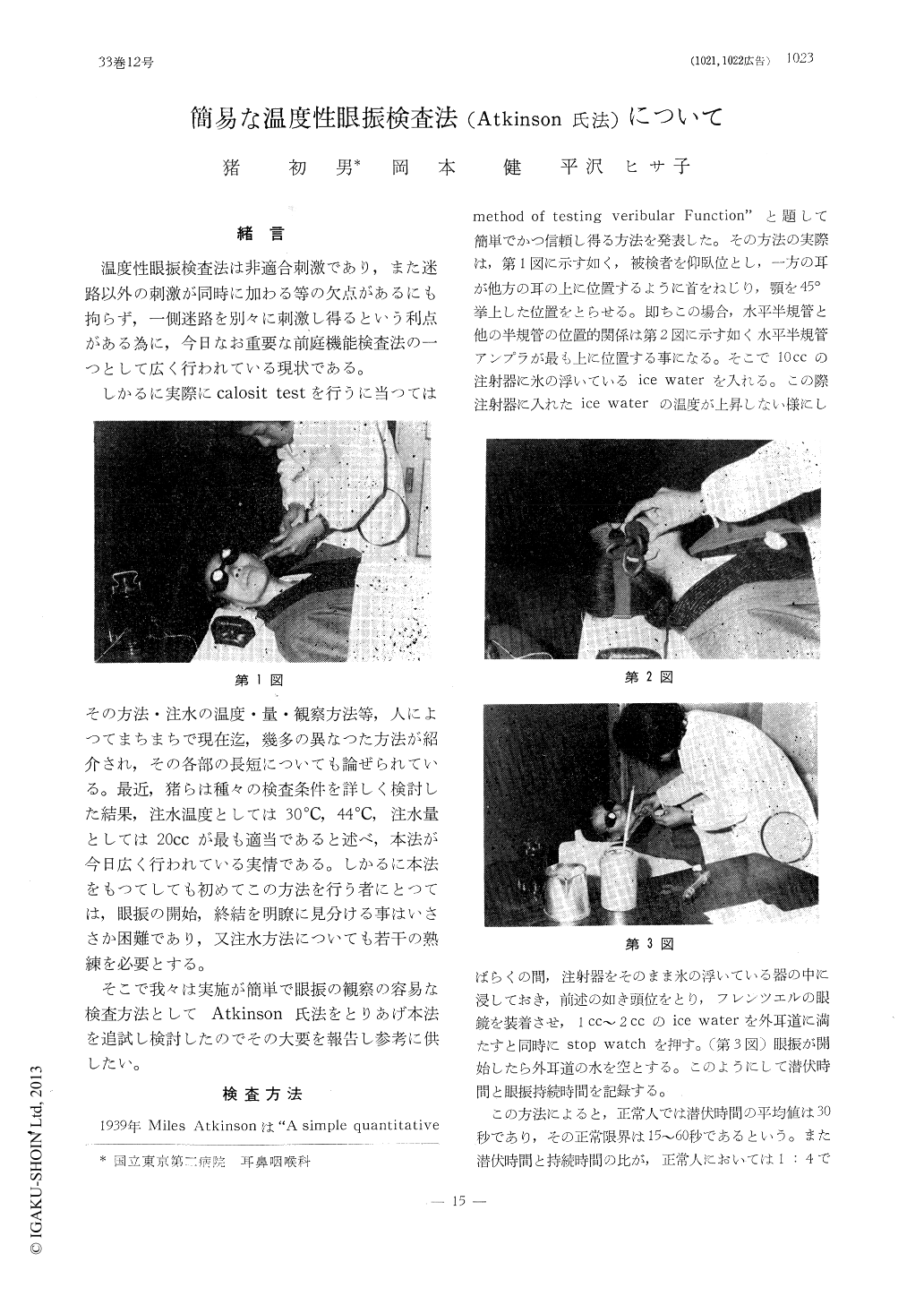
As a simplified clinical method of eliciting nystagmus Atkison's method is reexamined ; it's normal value among normal individuals appeared to have 20-40 seconds as a period of latency and 100-160 as a lasting period. According to Atkinson the ration between the period of latency and that of lasting is stated to be 1 : 4 ; in the present experiment it is 1 : 4.4.
In diseased cases this ratio becomes highly disturbed ranging from 1 : 2.7 to 1 : 23.45.
For clinical screening test of vestibular function Atkinson's method is highly effici-ent.
Copyright © 1961, Igaku-Shoin Ltd. All rights reserved.