Japanese
English
- 有料閲覧
PPV購入案内
1,320円 (1,200円+税10%) こちらは、419ページから428ページの文献です。購入には医書.jp本会員登録が必要です。
会員登録完了後に改めて上記「購入サイトへ」を選択してください。
または「購入サイトへ」選択後に「購入ログイン」、「新規会員登録」の順に進んでください。
会員登録について詳しくはをご確認ください。
- Abstract 文献概要
- 1ページ目 Look Inside
- 参考文献 Reference
はじめに
細胞骨格系はすべての細胞に不可欠な構造基盤であり,細胞分裂・形態形成・運動・物質輸送など,根源的な生命現象を支えるインフラストラクチャーである。神経系,ことに軸索や樹状突起など長大な極性構造を持ち,微小管に沿った高速物質輸送が盛んな大型ニューロンは細胞骨格系への依存度が高く,その破綻は神経機能障害や神経疾患に直結する。また,アクチン系は神経成長円錐や樹状突起棘(スパイン)などの微細構造基盤として,神経回路形成やシナプス可塑性に重要な役割を果たす。このような例を挙げるまでもなく,神経系の構造・機能・病態を知るために細胞骨格系の理解は欠かせない。
細胞骨格系の中で最も研究が進んでいるアクチン系や微小管系は,重合性蛋白質が多数の関連蛋白質とともに形成する連続的なネットワークであり,モーター蛋白質群と協調して多彩な生命現象に関与する。中間径フィラメント系はコイルドコイル蛋白質のストランドであり,例えばニューロンでは神経突起の断面積を規定し,物理的強度と伝導速度の決定因子となる。これらに加えて,unconventional cytoskeletonと称されるいくつかの重合性蛋白質群がある。このうちヌクレオチド結合性を持ち,酵母からヒトまで普遍的に存在するのはセプチン系のみであるが(Table1),その動作原理や存在意義には解明すべき問題が数多く残されている1)。以下にその主な理由を挙げる。
(1)アクチン系では1種類のATP結合蛋白質(アクチン・モノマー),微小管系では2種類のGTP結合蛋白質(α/β-チューブリン・ヘテロダイマー)が自己集合して一様な極性線維を形成するのに対し,セプチン系は2~5種類のGTP結合蛋白質からなる短い非極性線維(セプチン・オリゴマー)が,多様な組み合わせで多様な形状に高次集合する複雑なシステムである。
(2)セプチンは独立かつ連続的な高次集合体を形成する一方,既存の細胞骨格系の構成成分としてふるまう性質を併せ持つ。後者は独立した線維性構造物の形を取らず,アクチン系や微小管系に沿って散在し,多彩な役割を果たす。
(3)セプチン系のサブユニット構成や機能は,種・発生段階・細胞系譜・細胞周期によって異なるため,ある生物種におけるある状況での知見を一般化しがたい。
(4)特に哺乳類ではセプチン系の多機能性とサブユニット間の機能重複が,遺伝学的・逆遺伝学的解析を妨げてきた。マウスゲノムに存在する13種類のセプチン遺伝子ファミリーのうち7種類に関してnull変異体が作製されているが,ハウスキーピング遺伝子でよくみられるall or none(胎生致死か代償)のパターンをとる場合が多く,有意義な知見をもたらした例は少ない(Table2)。
上記の理由から,酵母の細胞質分裂変異体の責任蛋白質として発見されたセプチンの哺乳類ホモログの細胞分裂以外での重要性は,最近までまったく不明であった。しかし,多様な手法で得られた断片的な情報をつき合わせることにより,哺乳類セプチン系の構成原理や存在意義の一端が明らかになりつつある。本稿の前半では,ユビキタスな細胞支持基盤としてのセプチン系の機能を概説する。後半では,ドーパミンニューロンにおけるセプチン系の生理機能と,パーキンソン病など神経疾患との関連を紹介する。
Abstract
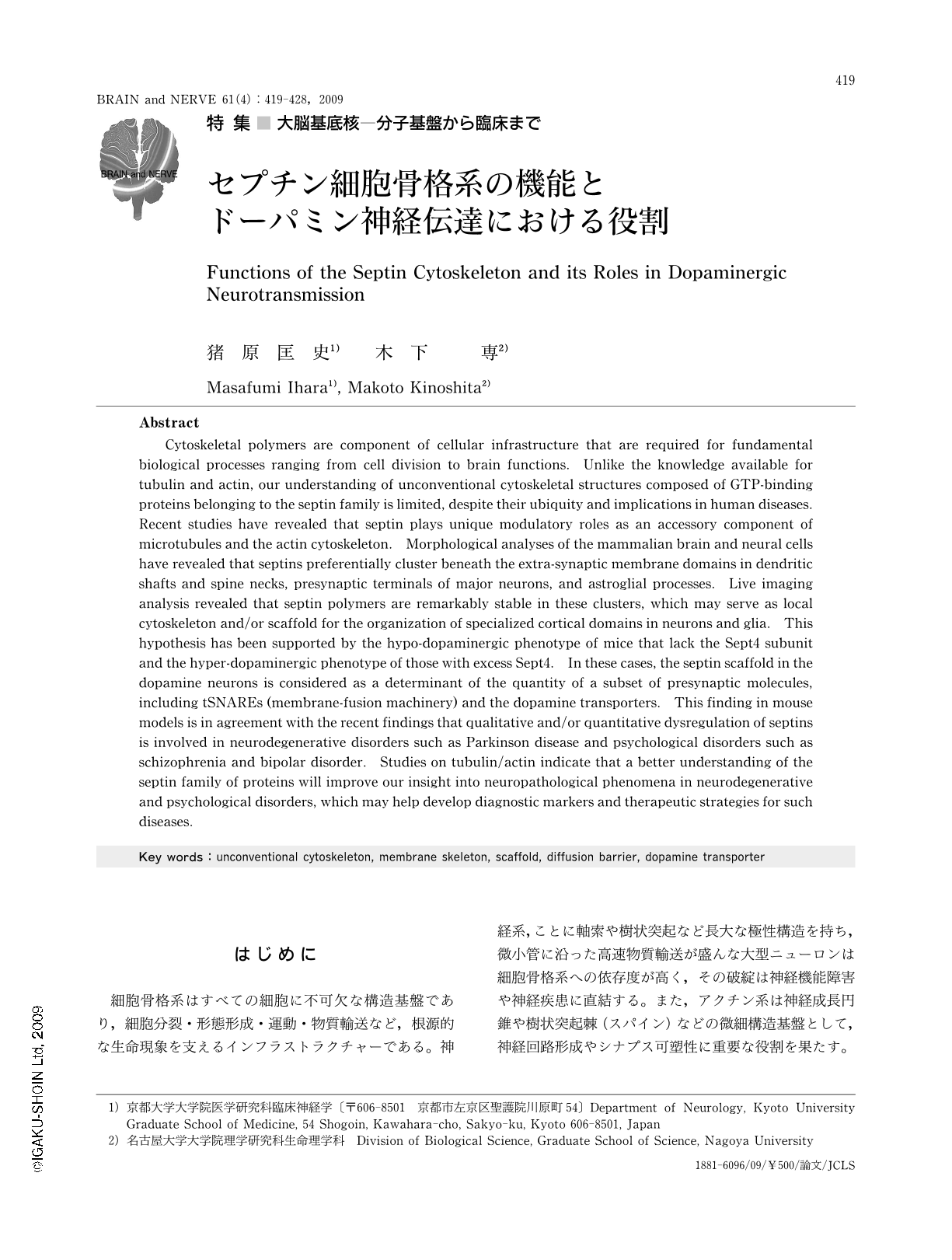
Cytoskeletal polymers are component of cellular infrastructure that are required for fundamental biological processes ranging from cell division to brain functions. Unlike the knowledge available for tubulin and actin,our understanding of unconventional cytoskeletal structures composed of GTP-binding proteins belonging to the septin family is limited,despite their ubiquity and implications in human diseases. Recent studies have revealed that septin plays unique modulatory roles as an accessory component of microtubules and the actin cytoskeleton. Morphological analyses of the mammalian brain and neural cells have revealed that septins preferentially cluster beneath the extra-synaptic membrane domains in dendritic shafts and spine necks,presynaptic terminals of major neurons,and astroglial processes. Live imaging analysis revealed that septin polymers are remarkably stable in these clusters,which may serve as local cytoskeleton and/or scaffold for the organization of specialized cortical domains in neurons and glia. This hypothesis has been supported by the hypo-dopaminergic phenotype of mice that lack the Sept4 subunit and the hyper-dopaminergic phenotype of those with excess Sept4. In these cases,the septin scaffold in the dopamine neurons is considered as a determinant of the quantity of a subset of presynaptic molecules,including tSNAREs (membrane-fusion machinery) and the dopamine transporters. This finding in mouse models is in agreement with the recent findings that qualitative and/or quantitative dysregulation of septins is involved in neurodegenerative disorders such as Parkinson disease and psychological disorders such as schizophrenia and bipolar disorder. Studies on tubulin/actin indicate that a better understanding of the septin family of proteins will improve our insight into neuropathological phenomena in neurodegenerative and psychological disorders,which may help develop diagnostic markers and therapeutic strategies for such diseases.
Copyright © 2009, Igaku-Shoin Ltd. All rights reserved.