Japanese
English
- 有料閲覧
PPV購入案内
1,320円 (1,200円+税10%) こちらは、133ページから135ページの文献です。購入には医書.jp本会員登録が必要です。
会員登録完了後に改めて上記「購入サイトへ」を選択してください。
または「購入サイトへ」選択後に「購入ログイン」、「新規会員登録」の順に進んでください。
会員登録について詳しくはをご確認ください。
- Abstract 文献概要
- 1ページ目 Look Inside
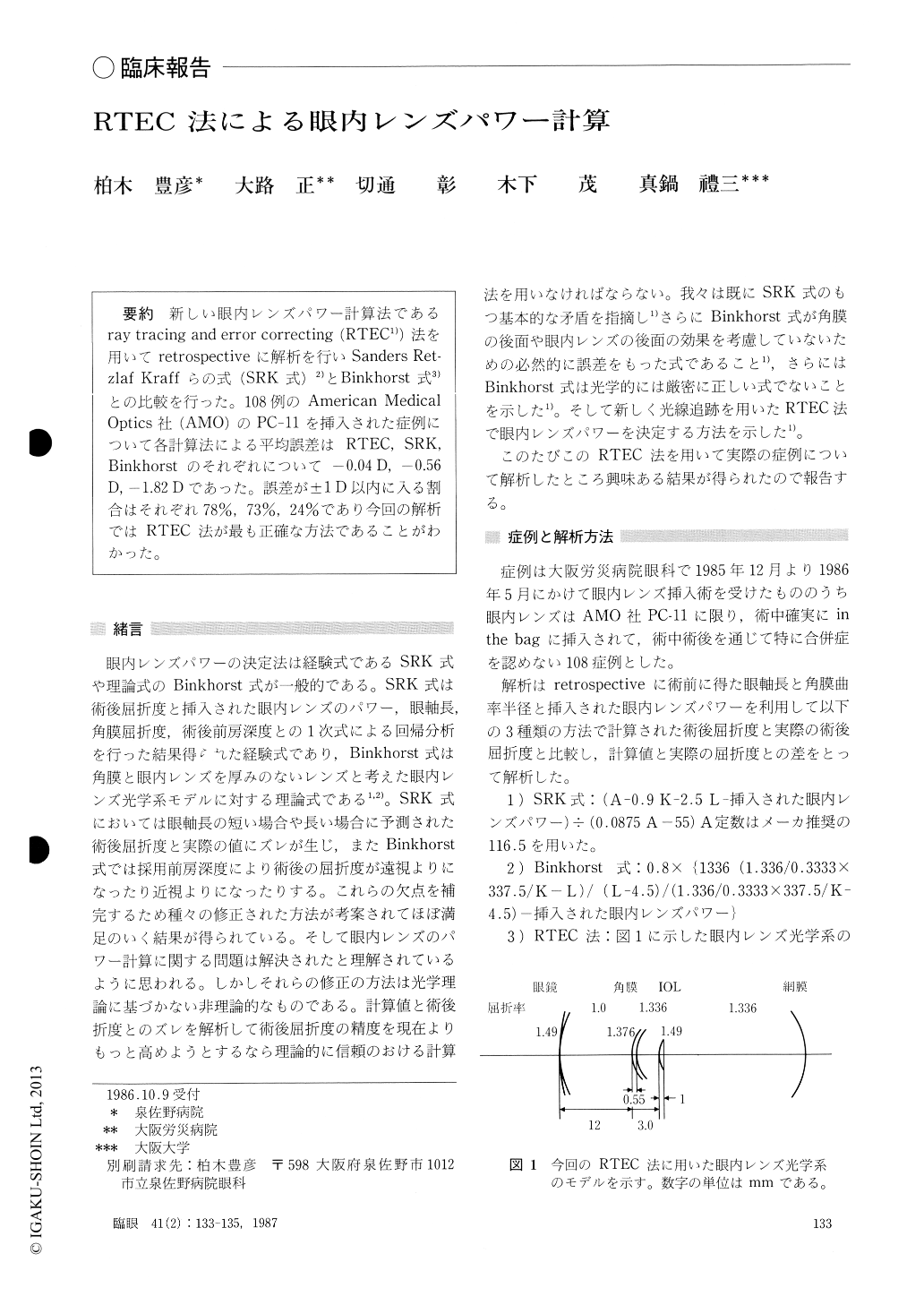
新しい眼内レンズパワー計算法であるray tracing and error correcting (RTEC1))法を用いてretrospectiveに解析を行いSanders Ret-zlaf Kraffらの式(SRK式)2)とBinkhorst式3)との比較を行った.108例のAmerican MedicalOptics社(AMO)のPC-11を挿入された症例について各計算法による平均誤差はRTEC, SRK,Binkhorstのそれぞれについて-0.04 D,-0.56D,-1.82 Dであった.誤差が±1D以内に入る割合はそれぞれ78%,73%,24%であり今回の解析ではRTEC法が最も正確な方法であることがわかった.
We evaluated the validity of three methods of calcu-lating the power of intraocular lens : Binkhorst's for-mula, SRK formula and the ray tracing error correcting method (RTEC). As material for the evaluation, we used 108 eyes which were implanted with posterior chamber lens (PC-11) made by American Medical Optics (AMO).
The deviation between the calculated and the actual value of refraction averaged -1.82 D, -0.56 D and -0.04 D respectively by Binkhorst's, SRK and RTEC methods. The incidence of deviation which fell within ±1.0 D was 24%, 83% and 78% respectively for Binkhorst's, SRK and RTEC methods. The deviation was less dependent on the axial length when calculated by RTEC than by the other two methods. The present findings suggest that the RTEC method is of particular value in decreasing postoperative re-fractive error in intraocular lens implanting surgery.
Rinsho Ganka (Jpn J Clin Ophthalmol) 41(2) : 133-135, 1987
Copyright © 1987, Igaku-Shoin Ltd. All rights reserved.