Japanese
English
- 有料閲覧
PPV購入案内
1,320円 (1,200円+税10%) こちらは、975ページから979ページの文献です。購入には医書.jp本会員登録が必要です。
会員登録完了後に改めて上記「購入サイトへ」を選択してください。
または「購入サイトへ」選択後に「購入ログイン」、「新規会員登録」の順に進んでください。
会員登録について詳しくはをご確認ください。
- Abstract 文献概要
- 1ページ目 Look Inside
I.はじめに
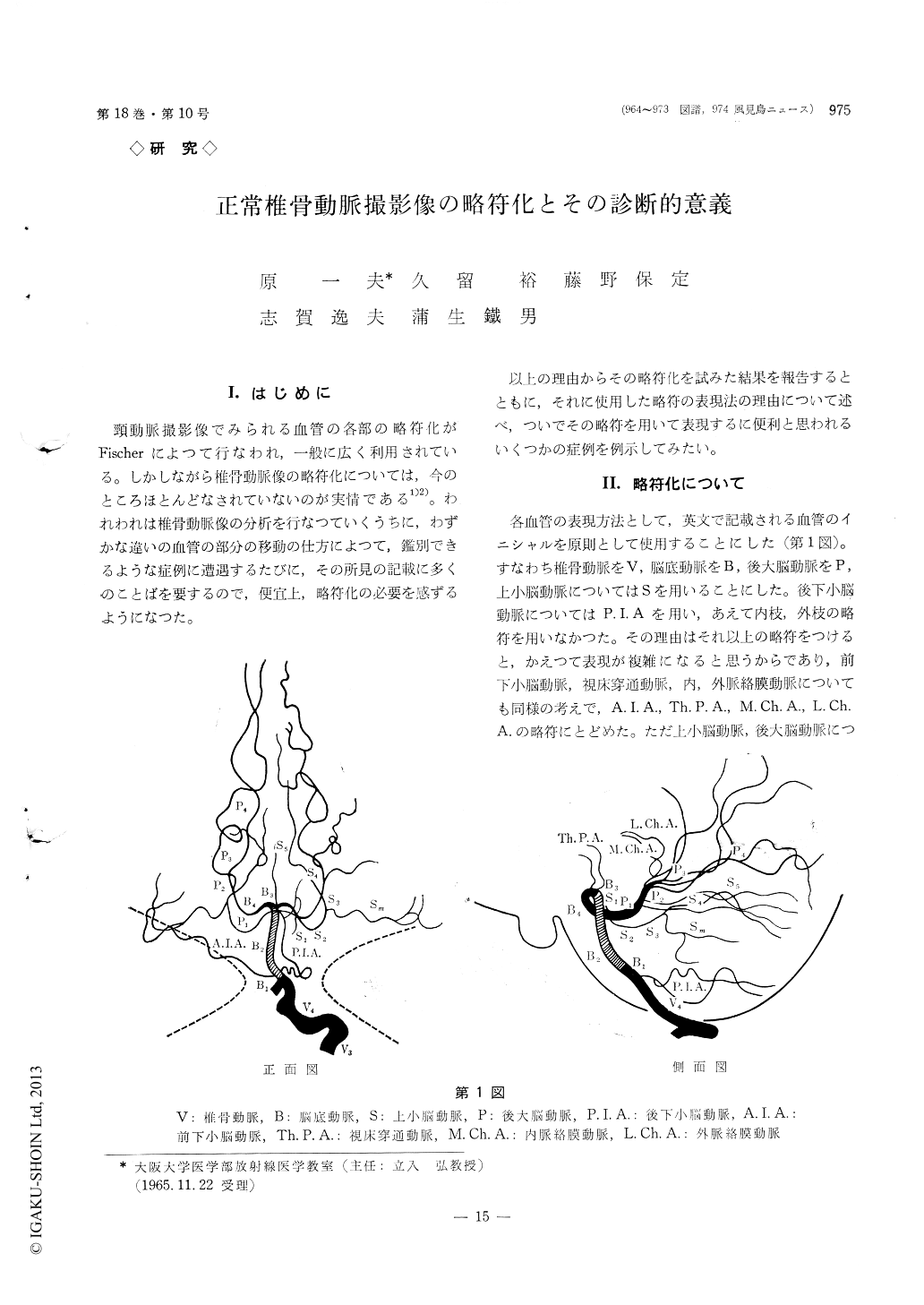
頸動脈撮影像でみられる血管の各部の略符化がFischerによつて行なわれ,一般に広く利用されている。しかしながら椎骨動脈像の略符化については,今のところほとんどなされていないのが実情である1)2)。われわれは椎骨動脈像の分析を行なつていくうちに,わずかな違いの血管の部分の移動の仕方によつて,鑑別できるような症例に遭遇するたびに,その所見の記載に多くのことばを要するので,便宜上,略符化の必要を感ずるようになつた。
以上の理由からその略符化を試みた結果を報告するとともに,それに使用した略符の表現法の理由について述べ,ついでその略符を用いて表現するに便利と思われるいくつかの症例を例示してみたい。
To designate the vertebral, basilar, superior cere-bellar, and posterior cerebral arteries, the initial V, B, S, and P are used respectively. Following the course of these arteries, each portions are divided and num-bered. For example, anteriorly situated portion of the superior cerebellar artery to the brain stem is called Si, A. I. A., P. I. A., Th. P. A., M. Ch. A. and L.Ch.A. mean the anterior inferior cerebellar, posterior inferior cerebellar, thalamoperf orating, middle chorioidal, and lateral chorioidal arteries. These detail designations are shown in the schema in this paper. In Japanese, asymmetrical form of S1, S2, S3, B4, P1 and P2 is thought to be not so frequent.
Copyright © 1966, Igaku-Shoin Ltd. All rights reserved.