Japanese
English
- 有料閲覧
PPV購入案内
2,750円 (2,500円+税10%) こちらは、162ページから170ページの文献です。購入には医書.jp本会員登録が必要です。
会員登録完了後に改めて上記「購入サイトへ」を選択してください。
または「購入サイトへ」選択後に「購入ログイン」、「新規会員登録」の順に進んでください。
会員登録について詳しくはをご確認ください。
- Abstract 文献概要
- 1ページ目 Look Inside
- 参考文献 Reference
要旨
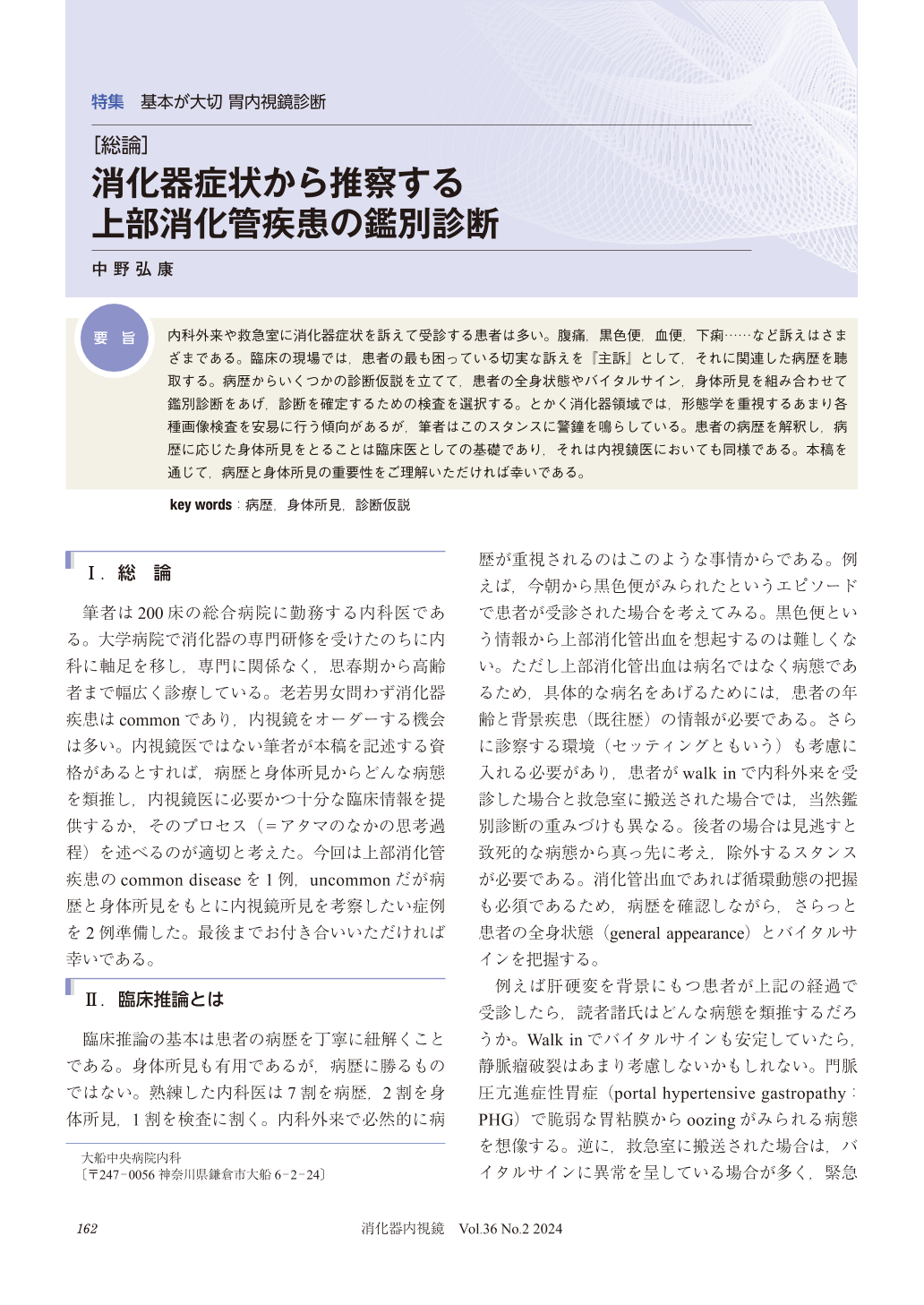
内科外来や救急室に消化器症状を訴えて受診する患者は多い。腹痛,黒色便,血便,下痢……など訴えはさまざまである。臨床の現場では,患者の最も困っている切実な訴えを『主訴』として,それに関連した病歴を聴取する。病歴からいくつかの診断仮説を立てて,患者の全身状態やバイタルサイン,身体所見を組み合わせて鑑別診断をあげ,診断を確定するための検査を選択する。とかく消化器領域では,形態学を重視するあまり各種画像検査を安易に行う傾向があるが,筆者はこのスタンスに警鐘を鳴らしている。患者の病歴を解釈し,病歴に応じた身体所見をとることは臨床医としての基礎であり,それは内視鏡医においても同様である。本稿を通じて,病歴と身体所見の重要性をご理解いただければ幸いである。
Gastrointestinal (GI) manifestations are common not only in the outpatient clinic, but also in the emergency department. We see various complaints such as abdominal pain, tarry stool, hematochezia, diarrhea, etc. In clinical practice, we make it a rule to take the patient’s history, emphasizing the most urgent complaint. We formulate several diagnostic hypotheses based on the patient’s medical history, then come up with a differential diagnosis based on a combination of patient’s general appearance, vital signs, and physical findings, and select diagnostic tests in order to confirm the diagnosis. There is a tendency to place much emphasis on morphology in GI fields and to simply perform various imaging tests, but the author warns against this stance. Interpreting a patient’s medical history and using physical findings together with the medical history is the basis of clinical reasoning, which is also applicable for endoscopists. The author hopes that this article will help practitioners to understand the importance of medical history and physical findings.
© tokyo-igakusha.co.jp. All right reserved.