Japanese
English
- 販売していません
PPV購入案内
都合により販売していません- Abstract 文献概要
- 1ページ目 Look Inside
- 参考文献 Reference
はじめに
痙縮は,脳卒中,頭部外傷や脊髄損傷などの疾患によって生じる,いわゆる上位運動ニューロン症候群による症候の1つである1).腱反射亢進を伴った緊張性伸張反射(筋緊張)の速度依存性増加を特徴とする運動障害2)で,伸張反射の亢進の結果生じる,上位運動ニューロン症候群の一徴候と定義されている3).
上位運動ニューロン症候群の特徴的な所見には,いわゆる陽性徴候と陰性徴候がある.陽性徴候としては筋緊張の増加,腱反射の亢進,伸張反射の他筋への波及,クローヌスといった痙縮の所見および痙性異常姿勢,病的共同運動,病的同時収縮,屈曲反射の亢進などがある.一方,陰性徴候として麻痺,筋力低下を認め,運動は巧緻性に欠け,労力を要する4). 上位運動ニューロン症候群においては,陽性徴候,陰性徴候のほかに,運動麻痺による筋の不動にともない,筋硬直,拘縮,線維化,萎縮など,いわゆる非神経性の変化が生じ,筋の粘弾性が高まる.上述した陽性徴候の1つとしての筋緊張の増加に加えて,筋の粘弾性増加は筋緊張を増加させるもう1つの要因となる5).
痙縮,痙性異常姿勢,病的同時収縮などの異常な過活動が起こる一方,運動麻痺により不動となり,二次的に筋骨格系に変化を及ぼし,筋粘弾性の変化,拘縮,筋硬直,関節の構造変化などが生じ,さらに相乗的に病態を悪化させ,最終的に機能障害にいたる6).
本稿では,痙縮の病態生理について述べる.
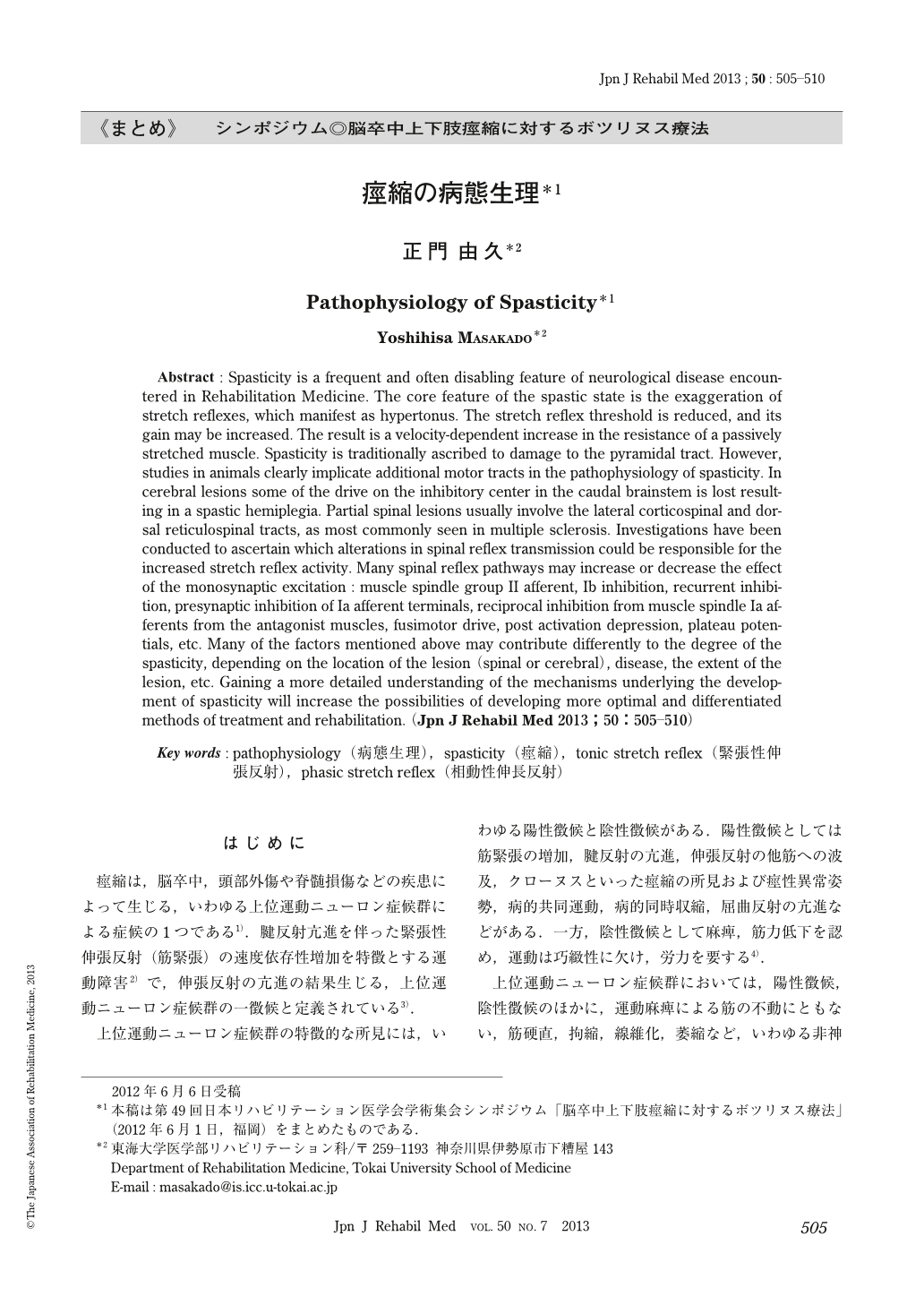
Abstract : Spasticity is a frequent and often disabling feature of neurological disease encountered in Rehabilitation Medicine. The core feature of the spastic state is the exaggeration of stretch reflexes, which manifest as hypertonus. The stretch reflex threshold is reduced, and its gain may be increased. The result is a velocity-dependent increase in the resistance of a passively stretched muscle. Spasticity is traditionally ascribed to damage to the pyramidal tract. However, studies in animals clearly implicate additional motor tracts in the pathophysiology of spasticity. In cerebral lesions some of the drive on the inhibitory center in the caudal brainstem is lost resulting in a spastic hemiplegia. Partial spinal lesions usually involve the lateral corticospinal and dorsal reticulospinal tracts, as most commonly seen in multiple sclerosis. Investigations have been conducted to ascertain which alterations in spinal reflex transmission could be responsible for the increased stretch reflex activity. Many spinal reflex pathways may increase or decrease the effect of the monosynaptic excitation : muscle spindle group Ⅱ afferent, Ib inhibition, recurrent inhibition, presynaptic inhibition of Ia afferent terminals, reciprocal inhibition from muscle spindle Ia afferents from the antagonist muscles, fusimotor drive, post activation depression, plateau potentials, etc. Many of the factors mentioned above may contribute differently to the degree of the spasticity, depending on the location of the lesion (spinal or cerebral), disease, the extent of the lesion, etc. Gaining a more detailed understanding of the mechanisms underlying the development of spasticity will increase the possibilities of developing more optimal and differentiated methods of treatment and rehabilitation.
Copyright © 2013, The Japanese Association of Rehabilitation Medicine. All rights reserved.