Japanese
English
- 有料閲覧
PPV購入案内
1,320円 (1,200円+税10%) こちらは、89ページから99ページの文献です。購入には医書.jp本会員登録が必要です。
会員登録完了後に改めて上記「購入サイトへ」を選択してください。
または「購入サイトへ」選択後に「購入ログイン」、「新規会員登録」の順に進んでください。
会員登録について詳しくはをご確認ください。
- Abstract 文献概要
- 1ページ目 Look Inside
- 参考文献 Reference
- サイト内被引用 Cited by
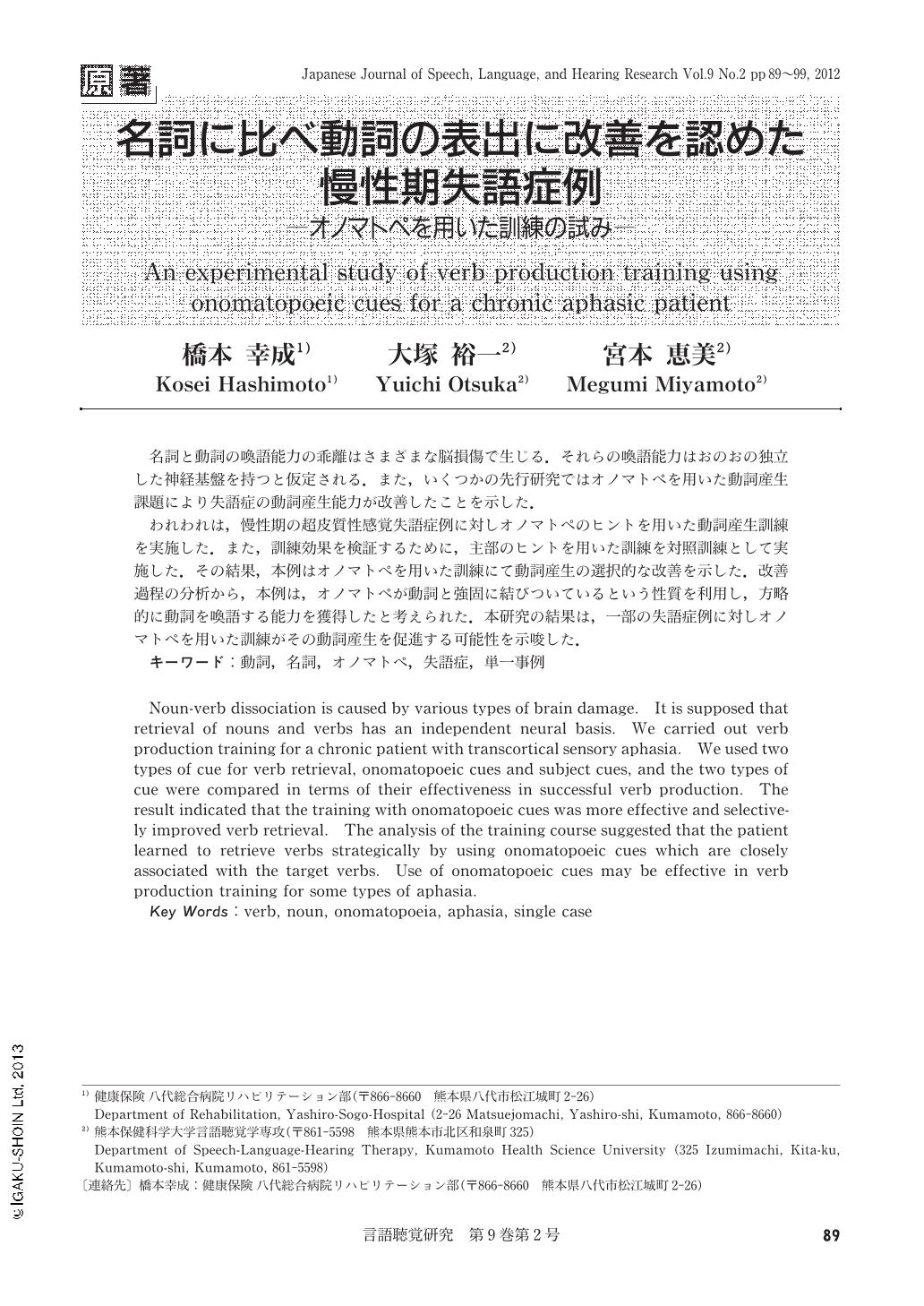
名詞と動詞の喚語能力の乖離はさまざまな脳損傷で生じる.それらの喚語能力はおのおの独立した神経基盤を持つと仮定される.また,いくつかの先行研究ではオノマトペを用いた動詞産生課題により失語症の動詞産生能力が改善したことを示した.
われわれは,慢性期の超皮質性感覚失語症例に対しオノマトペのヒントを用いた動詞産生訓練を実施した.また,訓練効果を検証するために,主部のヒントを用いた訓練を対照訓練として実施した.その結果,本例はオノマトペを用いた訓練にて動詞産生の選択的な改善を示した.改善過程の分析から,本例は,オノマトペが動詞と強固に結びついているという性質を利用し,方略的に動詞を喚語する能力を獲得したと考えられた.本研究の結果は,一部の失語症例に対しオノマトペを用いた訓練がその動詞産生を促進する可能性を示唆した.
Noun-verb dissociation is caused by various types of brain damage. It is supposed that retrieval of nouns and verbs has an independent neural basis. We carried out verb production training for a chronic patient with transcortical sensory aphasia. We used two types of cue for verb retrieval, onomatopoeic cues and subject cues, and the two types of cue were compared in terms of their effectiveness in successful verb production. The result indicated that the training with onomatopoeic cues was more effective and selectively improved verb retrieval. The analysis of the training course suggested that the patient learned to retrieve verbs strategically by using onomatopoeic cues which are closely associated with the target verbs. Use of onomatopoeic cues may be effective in verb production training for some types of aphasia.
Copyright © 2012, Japanese Association of Speech-Language-Hearing Therapists. All rights reserved.