Japanese
English
- 有料閲覧
PPV購入案内
1,320円 (1,200円+税10%) こちらは、62ページから70ページの文献です。購入には医書.jp本会員登録が必要です。
会員登録完了後に改めて上記「購入サイトへ」を選択してください。
または「購入サイトへ」選択後に「購入ログイン」、「新規会員登録」の順に進んでください。
会員登録について詳しくはをご確認ください。
- Abstract 文献概要
- 1ページ目 Look Inside
- 参考文献 Reference
- サイト内被引用 Cited by
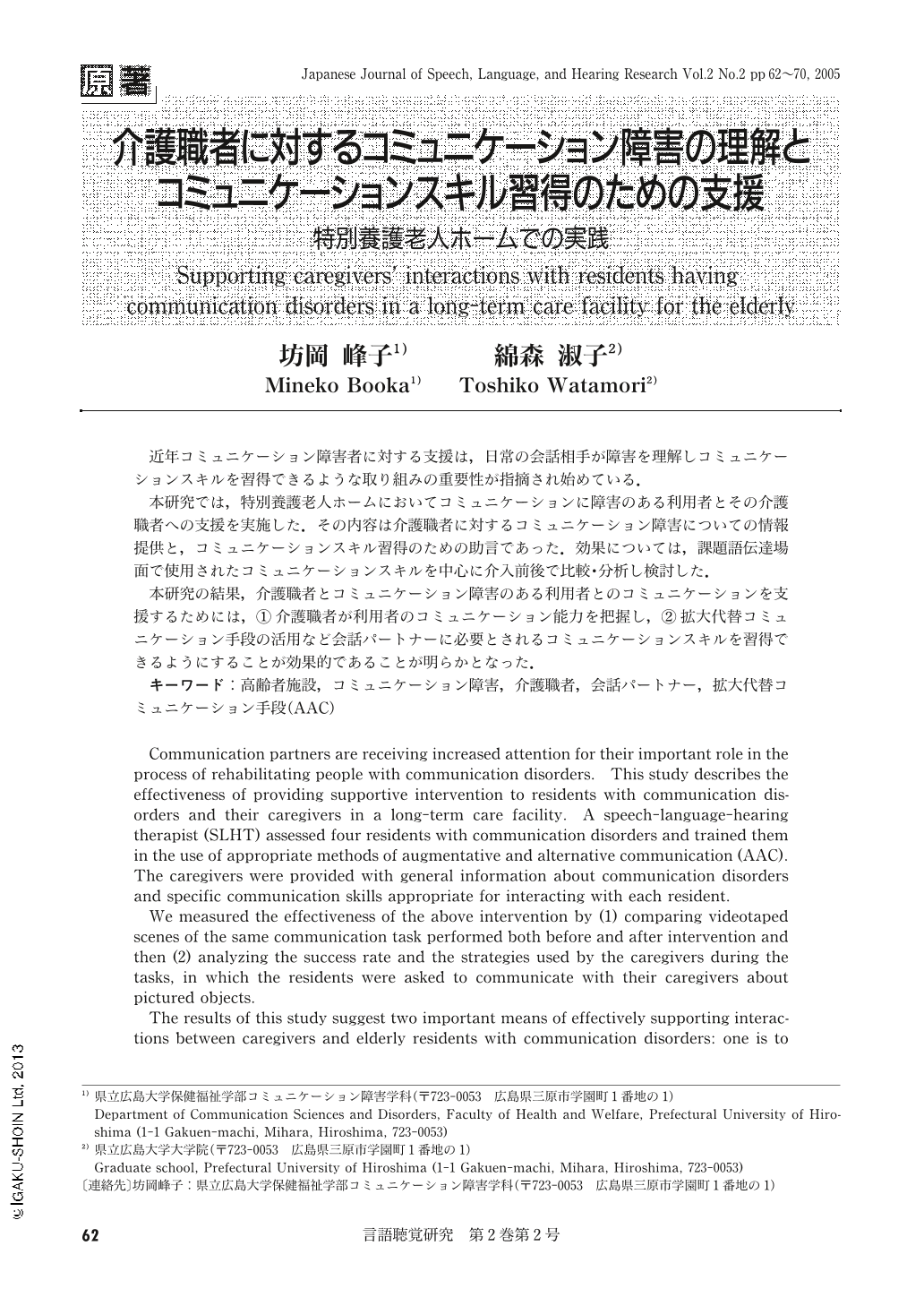
近年コミュニケーション障害者に対する支援は,日常の会話相手が障害を理解しコミュニケーションスキルを習得できるような取り組みの重要性が指摘され始めている.
本研究では,特別養護老人ホームにおいてコミュニケーションに障害のある利用者とその介護職者への支援を実施した.その内容は介護職者に対するコミュニケーション障害についての情報提供と,コミュニケーションスキル習得のための助言であった.効果については,課題語伝達場面で使用されたコミュニケーションスキルを中心に介入前後で比較・分析し検討した.
本研究の結果,介護職者とコミュニケーション障害のある利用者とのコミュニケーションを支援するためには,①介護職者が利用者のコミュニケーション能力を把握し,②拡大代替コミュニケーション手段の活用など会話パートナーに必要とされるコミュニケーションスキルを習得できるようにすることが効果的であることが明らかとなった.
Communication partners are receiving increased attention for their important role in the process of rehabilitating people with communication disorders. This study describes the effectiveness of providing supportive intervention to residents with communication disorders and their caregivers in a long-term care facility. A speech-language-hearing therapist (SLHT) assessed four residents with communication disorders and trained them in the use of appropriate methods of augmentative and alternative communication (AAC). The caregivers were provided with general information about communication disorders and specific communication skills appropriate for interacting with each resident.
We measured the effectiveness of the above intervention by (1) comparing videotaped scenes of the same communication task performed both before and after intervention and then (2) analyzing the success rate and the strategies used by the caregivers during the tasks, in which the residents were asked to communicate with their caregivers about pictured objects.
The results of this study suggest two important means of effectively supporting interactions between caregivers and elderly residents with communication disorders: one is to help caregivers understand the communication disorders of residents, and the other is to support caregivers in gaining specific communication skills, including AAC, appropriate for each resident.
Copyright © 2005, Japanese Association of Speech-Language-Hearing Therapists. All rights reserved.