Japanese
English
- 有料閲覧
PPV購入案内
1,320円 (1,200円+税10%) こちらは、1151ページから1159ページの文献です。購入には医書.jp本会員登録が必要です。
会員登録完了後に改めて上記「購入サイトへ」を選択してください。
または「購入サイトへ」選択後に「購入ログイン」、「新規会員登録」の順に進んでください。
会員登録について詳しくはをご確認ください。
- Abstract 文献概要
- 1ページ目 Look Inside
I.はじめに
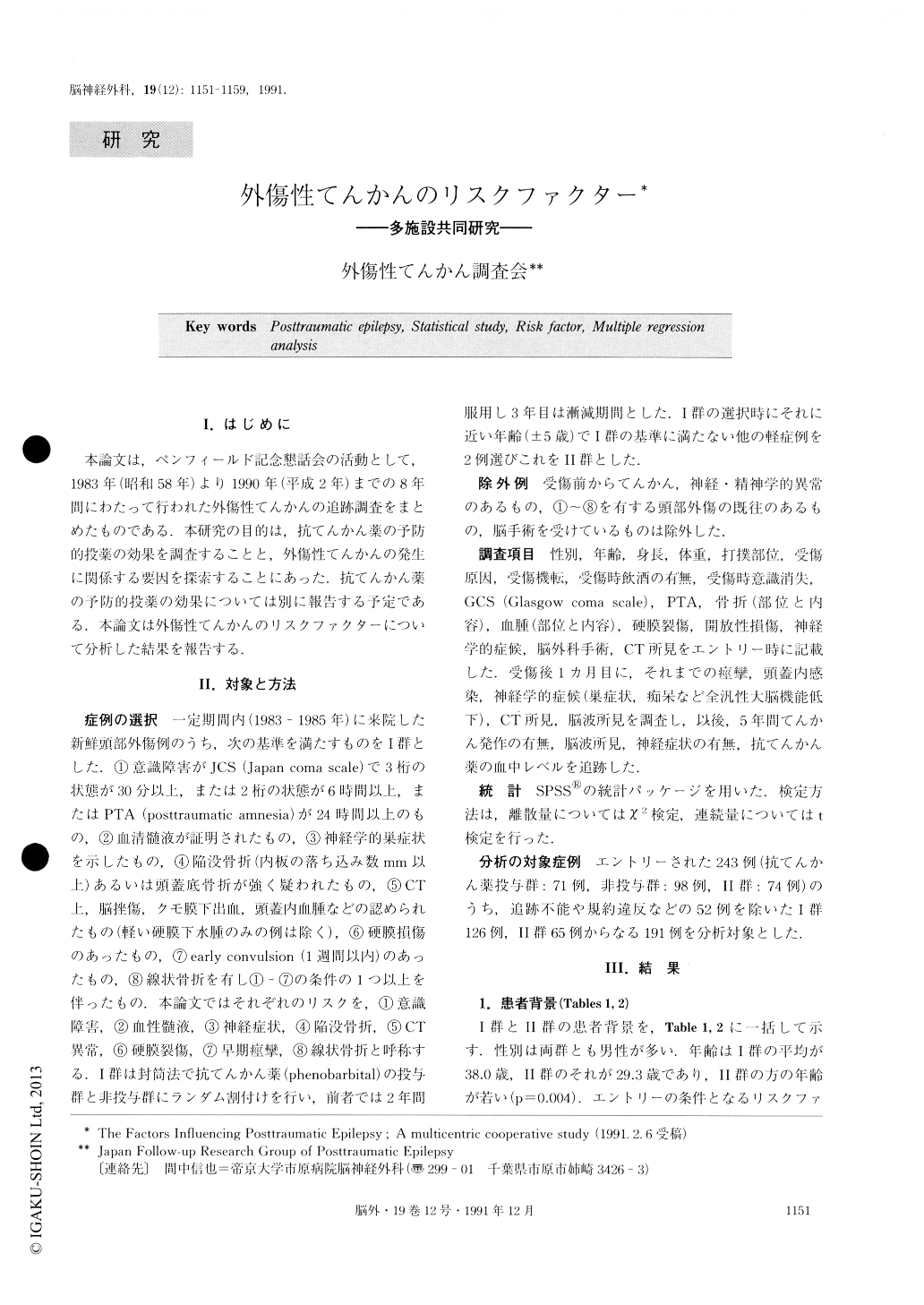
本論文は,ペンフィールド記念懇話会の活動として.1983年(昭和58年)より1990年(平成2年)までの8年間にわたって行われた外傷性てんかんの追跡調査をまとめたものである.本研究の目的は,抗てんかん薬の予防的投薬の効果を調査することと,外傷性てんかんの発生に関係する要因を探索することにあった.抗てんかん薬の予防的投薬の効果については別に報告する予定である.本論文は外傷性てんかんのリスクファクターについて分析した結果を報告する.
A multicentric cooperative study was performed to investigate the factors influencing posttraumatic epilepsy. The patients with fresh head injury from 1983 through 1990 were entered in this study. The cases were divided into two groups and followed-up for five years ; the patients with severe head injury and who satisfied the criteria belonged to group I. Those with mild head injury were classified into group II. The criteria for group I was that the patients had one or more of the following risks; disturbance of conscious-ness, bloody cerebrospinal fluid, focal neurological sign, depressed fracture or basal fracture, abnormal CT, du-ral tear, early convulsion and/or linear fracture. After drop-out cases were excluded, 191 cases out of 241 were analyzed. The number of cases was 126 (66.0%) for group I and 65 (34.0%) for group II. Six-teen patients (12.7%) of group I developed seizure, whereas nobody of group II experienced seizure. The difference between the patients with and with-out seizures was analyzed. The statistical significant difference was discovered in the following factors ; dis-turbance of consciousness (GCS and the duration), foc-al and generalized neurological sign, abnormal CT, mul-tiple risks, intracerebral hematoma, surgery, alcohol drinking and abnormal EEG a month after the injury. The relative risk rates were calculated. The highest risk for posttraumatic seizure was disturbance of con-sciousness extending over more than one month. This was followed by five other indicators of risk; abnormal EEG at one month, surgery, focal neurological sign, alcohol drinking, generalized neurological sign, and in-tracerebral hematoma.
Multiple regression analysis suggested that the post-traumatic seizure occurred most likely in the patient who suffered from generalized neurological sign, with early convulsion and/or having abnormal CT one month after injury.
It was concluded that the severity of cerebral injury was highly related to the occurrence of the posttrauma-tic epilepsy.
Copyright © 1991, Igaku-Shoin Ltd. All rights reserved.