Japanese
English
特集 異常運動
The Role of the Basal Ganglia in Movement
DICK J. P. R
1
,
MARSDEN C. D
1
1Department of Neurology, Institute of Psychiatry
pp.299-315
発行日 1985年4月10日
Published Date 1985/4/10
DOI https://doi.org/10.11477/mf.1431905689
- 有料閲覧
PPV購入案内
1,320円 (1,200円+税10%) こちらは、299ページから315ページの文献です。
PPV(ペイ・パー・ビュー)とは、論文(記事)単位で購入・閲覧ができるサービスです。
購入には医書.jp本会員登録が必要です。
会員登録完了後に改めて上記「購入サイトへ」を選択してください。
または「購入サイトへ」選択後に「購入ログイン」、「新規会員登録」の順に進んでください。
会員登録について詳しくはをご確認ください。
購入には医書.jp本会員登録が必要です。
会員登録完了後に改めて上記「購入サイトへ」を選択してください。
または「購入サイトへ」選択後に「購入ログイン」、「新規会員登録」の順に進んでください。
会員登録について詳しくはをご確認ください。
- Abstract 文献概要
- 1ページ目 Look Inside
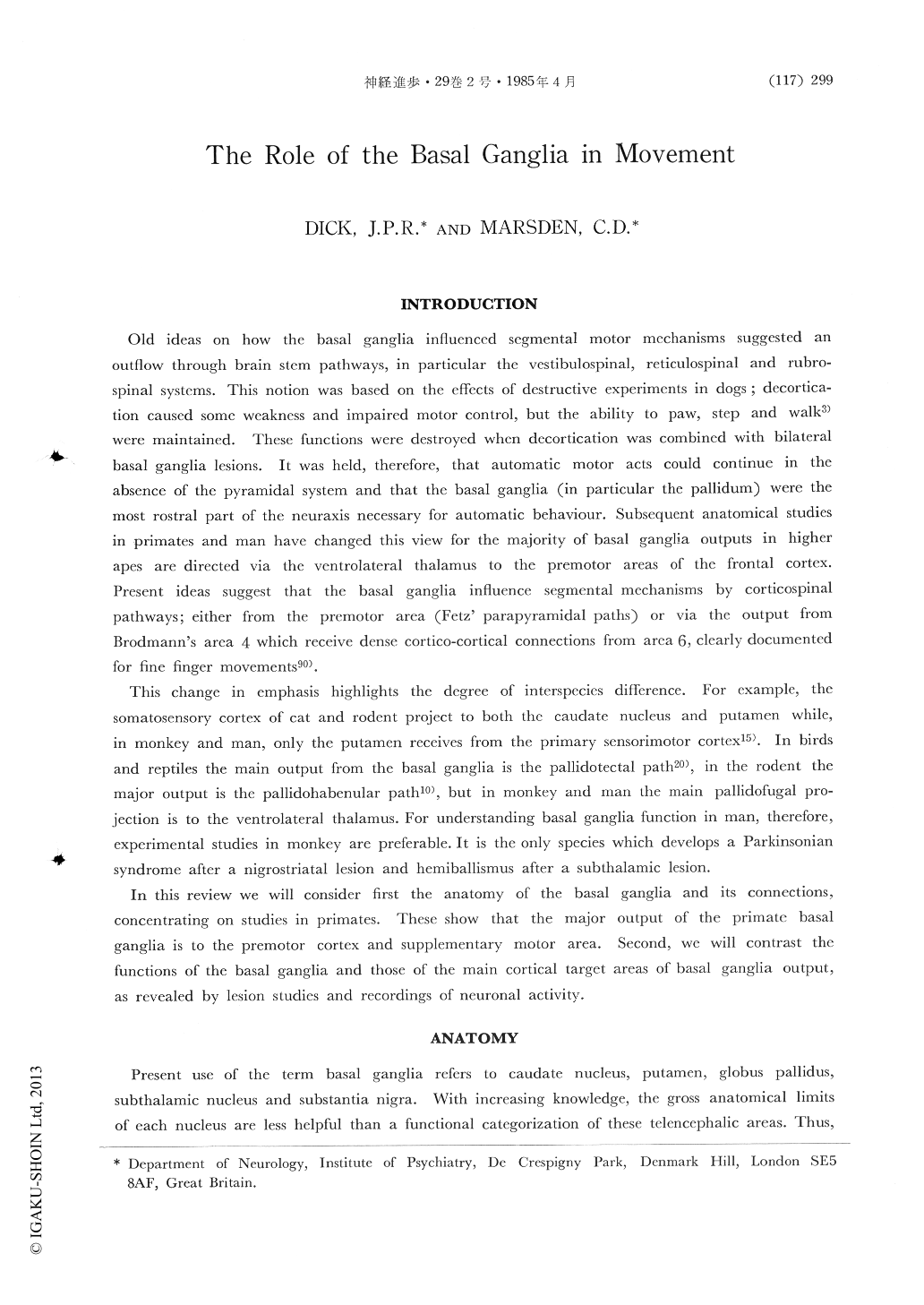
INTRODUCTION
Old ideas on how the basal ganglia influenced segmental motor mechanisms suggested an outflow through brain stem pathways, in particular the vestibulospinal, reticulospinal and rubrospinal systems.This notion was based on the effects of destructive experiments in dogs;decortication caused some weakness and impaired motor control, but the ability to paw, step and walk3)were maintained.These functions were destroyed when decortication was combined with bilateral basal ganglia lesions.
Copyright © 1985, Igaku-Shoin Ltd. All rights reserved.