Japanese
English
- 有料閲覧
PPV購入案内
1,320円 (1,200円+税10%) こちらは、763ページから774ページの文献です。購入には医書.jp本会員登録が必要です。
会員登録完了後に改めて上記「購入サイトへ」を選択してください。
または「購入サイトへ」選択後に「購入ログイン」、「新規会員登録」の順に進んでください。
会員登録について詳しくはをご確認ください。
- Abstract 文献概要
- 1ページ目 Look Inside
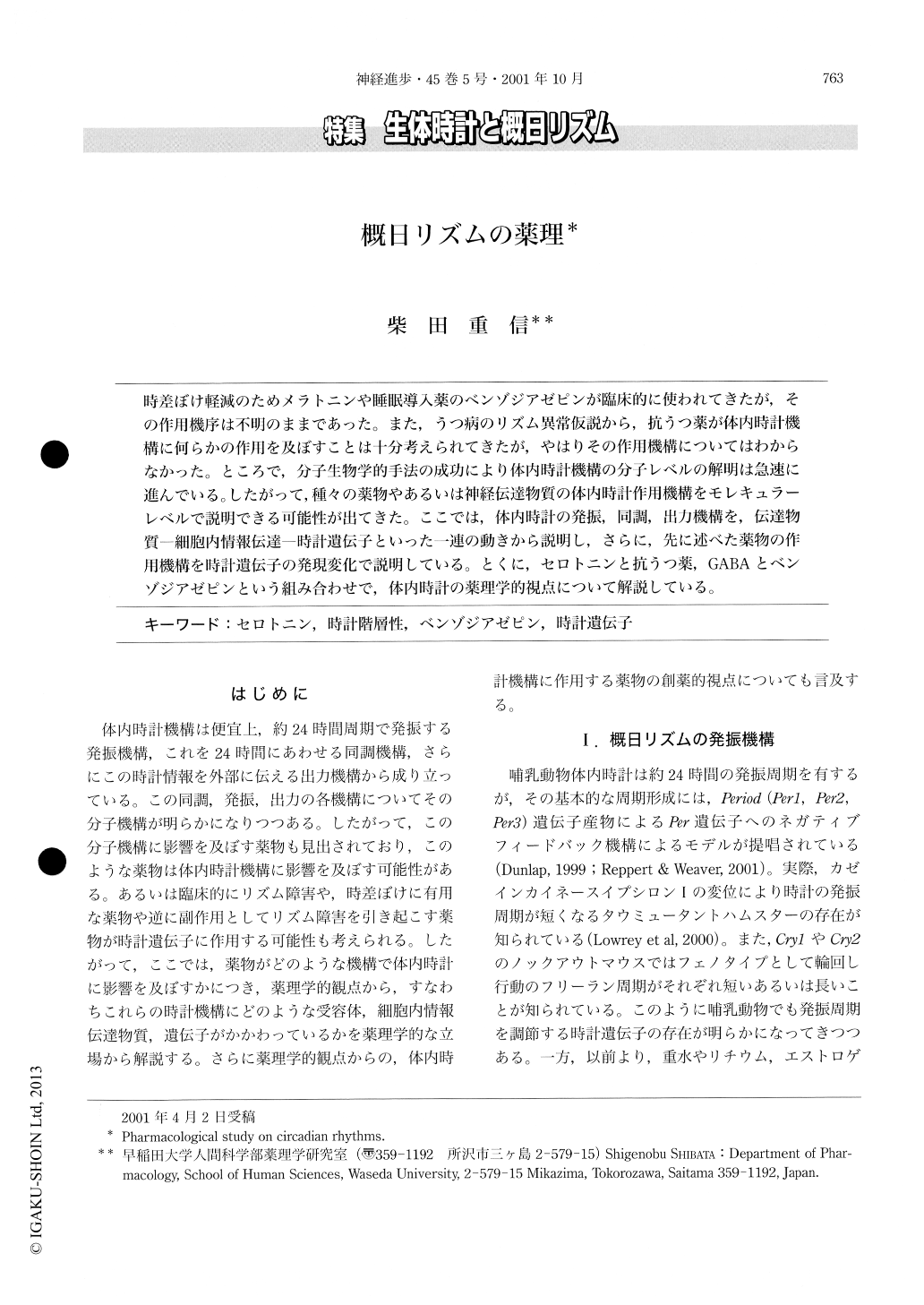
時差ぼけ軽減のためメラトニンや睡眠導人薬のベンゾジアゼピンが臨床的に使われてきたが,その作用機序は不明のままであった。また,うつ病のリズム異常仮説から,抗うつ薬が体内時計機構に何らかの作用を及ぼすことは十分考えられてきたが,やはりその作用機構についてはわからなかった。ところで,分子生物学的手法の成功により体内時計機構の分子レベルの解明は急速に進んでいる。したがって,種々の薬物やあるいは神経伝達物質の体内時計作用機構をモレキュラーレベルで説明できる可能性が出てきた。ここでは,体内時計の発振,同調,出力機構を,伝達物質一細胞内情報伝達一時計遺伝子といった一連の動きから説明し,さらに,先に述べた薬物の作川機構を時計遺伝子の発現変化で説明している。とくに,セロトニンと抗うっ薬,GABAとベンゾジアゼピンという組み合わせで,体内時計の薬理学的視点について解説している。
Precise, rhythmic, daily change of the internal milieu is a conspicuous feature of all living organisms. It affects temporal patterns of all kinds of behaviors during a day and deeply influences both social structure and daily life of individual human beings. These daily variations arise from the internal circadian mechanisms. Three functions of the endogenous clock are discriminated as a rhythm generation, entrainment to light-dark cycle and output from the clock. Endogenous clock is localized in the suprachiasmatic nucleus (SCN) in mammals. Recent papers dem-onstrated strong expression of clock genes such as Per1, Per2 and Per3 in the SCN. As serotonin/antidepressant and GABA/benzodiazepine drugs affect the light and non-light-induced entrainment, these drugs can regulate the circadian oscillation of clock genes and environmental stimuli-induced change of Per gene expression in the SCN.
There are two main stimuli that entrain circadian rhythm ; light-dark cycle (LD) and restricted feeding. Light resets circadian clock with induction of Per1 and Per2 gene in the SCN, the locus of a main oscillator. We exam-ined which stimuli, restricted feeding (RF) or lighting, reset clocks in the mouse brain clock such as cerebral cor-tex and/or peripheral clock such as liver because of the widespread expression (hippocampus, cerebellum and also peripheral tissue) of Per genes. Mice were allowed access to food for 4 h during daytime (7 h advance of feeding time) under LD or constant darkness. The peaks of Per1 and Per2 mRNA in the cerebral cortex and liver were ad-vanced 6-12 h after 6 days of RF, whereas those in SCN were unaffected. The increase of Per expression by RF treatment was observed in SCN-lesioned mice. The present results suggest that RF strongly entrained the ex-pression of Per and clock-controlled gene in the cerebral cortex and liver without affecting light-dependent SCN clock function. Moreover, I mentioned the possibility that some drugs are useful to keep physiological homeosta-sis through their action on biological systems (main, brain and peripheral clocks).
Copyright © 2001, Igaku-Shoin Ltd. All rights reserved.