Japanese
English
- 有料閲覧
PPV購入案内
1,320円 (1,200円+税10%) こちらは、159ページから166ページの文献です。購入には医書.jp本会員登録が必要です。
会員登録完了後に改めて上記「購入サイトへ」を選択してください。
または「購入サイトへ」選択後に「購入ログイン」、「新規会員登録」の順に進んでください。
会員登録について詳しくはをご確認ください。
- Abstract 文献概要
- 1ページ目 Look Inside
- 参考文献 Reference
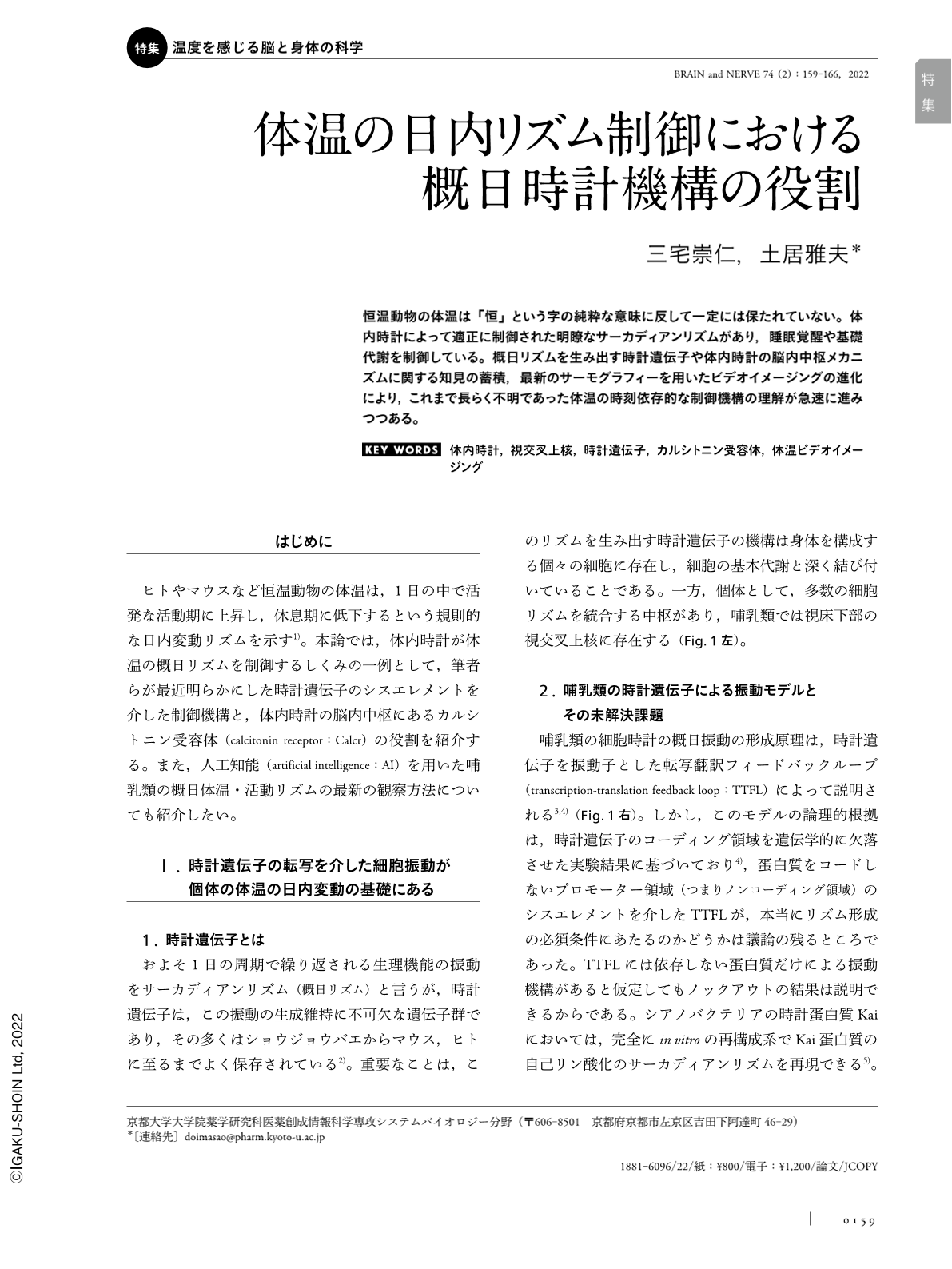
恒温動物の体温は「恒」という字の純粋な意味に反して一定には保たれていない。体内時計によって適正に制御された明瞭なサーカディアンリズムがあり,睡眠覚醒や基礎代謝を制御している。概日リズムを生み出す時計遺伝子や体内時計の脳内中枢メカニズムに関する知見の蓄積,最新のサーモグラフィーを用いたビデオイメージングの進化により,これまで長らく不明であった体温の時刻依存的な制御機構の理解が急速に進みつつある。
Abstract
Body temperature of thermostatic animals does not stay constant but displays a regular circadian fluctuation, which has a role in maintaining homeostasis of sleep and metabolism as well as entraining the peripheral circadian clocks in the body. Following the discovery of clock genes that generate the circadian rhythm and the master clock structure in the brain and recent advances in infrared temperature imaging, there is a greater opportunity to investigate the mechanism underlying body temperature regulation, which currently remains unclear. In this review, we summarize our recent findings on a mechanism of body temperature regulation through a non-coding cis-element of the core clock gene Per2. The body temperature during siesta is controlled by the calcitonin receptors, which exhibit restricted expression in the suprachiasmatic nucleus, the locus of the central circadian clock in the brain. This review also refers to a recent machine learning-assisted thermography recording procedure, a technique that enables real-time simultaneous monitoring of circadian fluctuations in body temperature, locomotor activity, feeding, and drinking behaviors of animals. We will discuss the current challenges and open questions in understanding the molecular and circuit level mechanisms that give rise to circadian rhythms in body temperature.
Copyright © 2022, Igaku-Shoin Ltd. All rights reserved.