Japanese
English
- 有料閲覧
PPV購入案内
1,320円 (1,200円+税10%) こちらは、507ページから515ページの文献です。購入には医書.jp本会員登録が必要です。
会員登録完了後に改めて上記「購入サイトへ」を選択してください。
または「購入サイトへ」選択後に「購入ログイン」、「新規会員登録」の順に進んでください。
会員登録について詳しくはをご確認ください。
- Abstract 文献概要
- 1ページ目 Look Inside
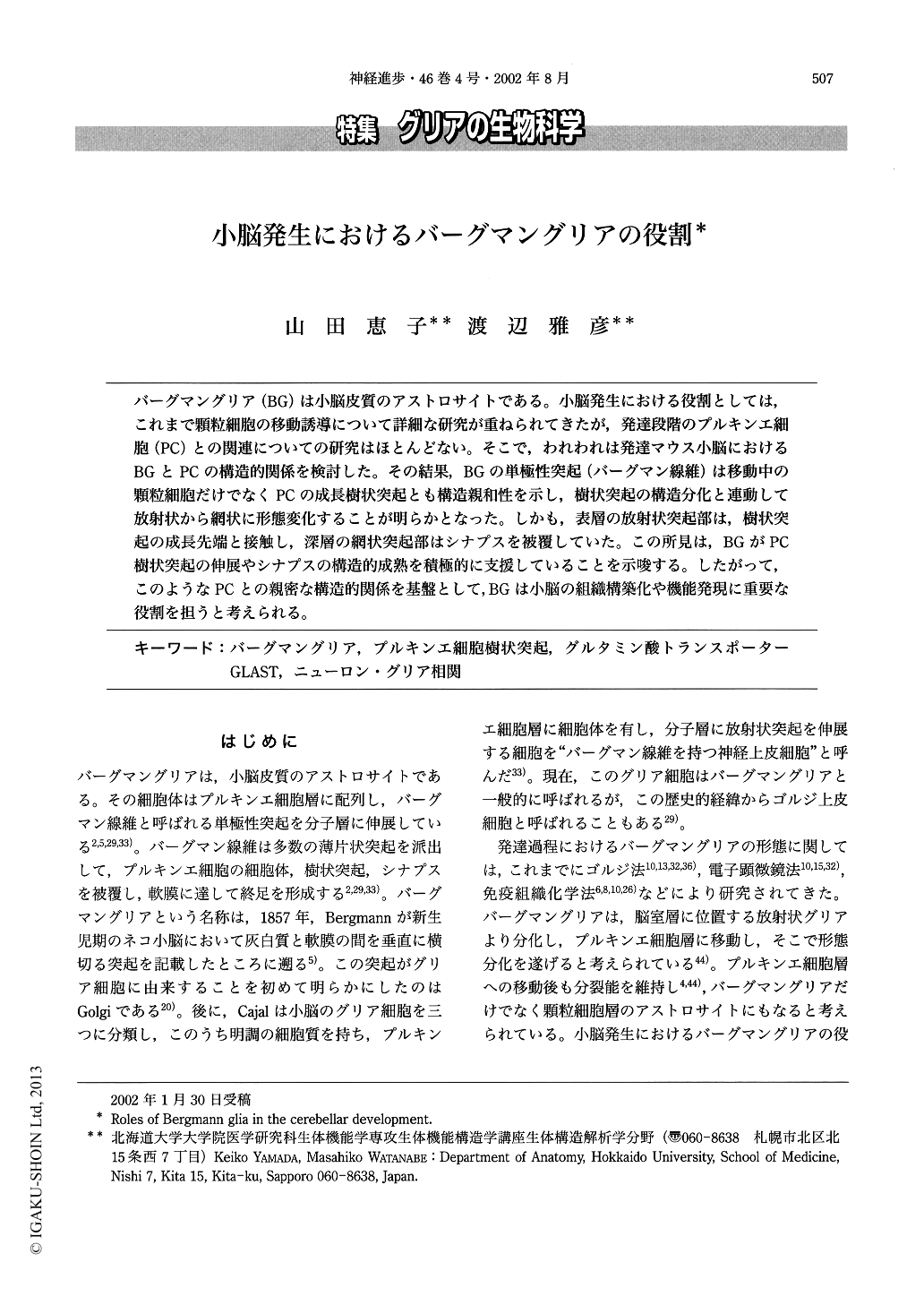
バーグマングリア(BG)は小脳皮質のアストロサイトである。小脳発生における役割としては,これまで顆粒細胞の移動誘導について詳細な研究が重ねられてきたが,発達段階のプルキンエ細胞(PC)との関連についての研究はほとんどない。そこで,われわれは発達マウス小脳におけるBGとPCの構造的関係を検討した。その結果,BGの単極性突起(バーグマン線維)は移動中の顆粒細胞だけでなくPCの成長樹状突起とも構造親和性を示し,樹状突起の構造分化と連動して放射状から網状に形態変化することが明らかとなった。しかも,表層の放射状突起部は,樹状突起の成長先端と接触し,深層の網状突起部はシナプスを被覆していた。この所見は,BGがPC樹状突起の伸展やシナプスの構造的成熟を積極的に支援していることを示唆する。したがって,このようなPCとの親密な構造的関係を基盤として,BGは小脳の組織構築化や機能発現に重要な役割を担うと考えられる。
The Bergmann glia (BG) is a unipolar astrocyte in the cerebellar cortex. As a role of BG, an extensive attention has been paid to the guidance of migrating granule cells. However, little is known for structural and functional relationships between BG and developing Purkinje cell (PC) . Thus, we investigated their structural relationships in the developing mouse cerebellum. By immunohistochemistry for astrocyte-specific glutamate transporter GLAST, we found that BG fibers transformed from rod-like to reticular fibers from the bottom of the molecular layer upward.
Copyright © 2002, Igaku-Shoin Ltd. All rights reserved.