Japanese
English
- 有料閲覧
PPV購入案内
1,320円 (1,200円+税10%) こちらは、67ページから76ページの文献です。購入には医書.jp本会員登録が必要です。
会員登録完了後に改めて上記「購入サイトへ」を選択してください。
または「購入サイトへ」選択後に「購入ログイン」、「新規会員登録」の順に進んでください。
会員登録について詳しくはをご確認ください。
- Abstract 文献概要
- 1ページ目 Look Inside
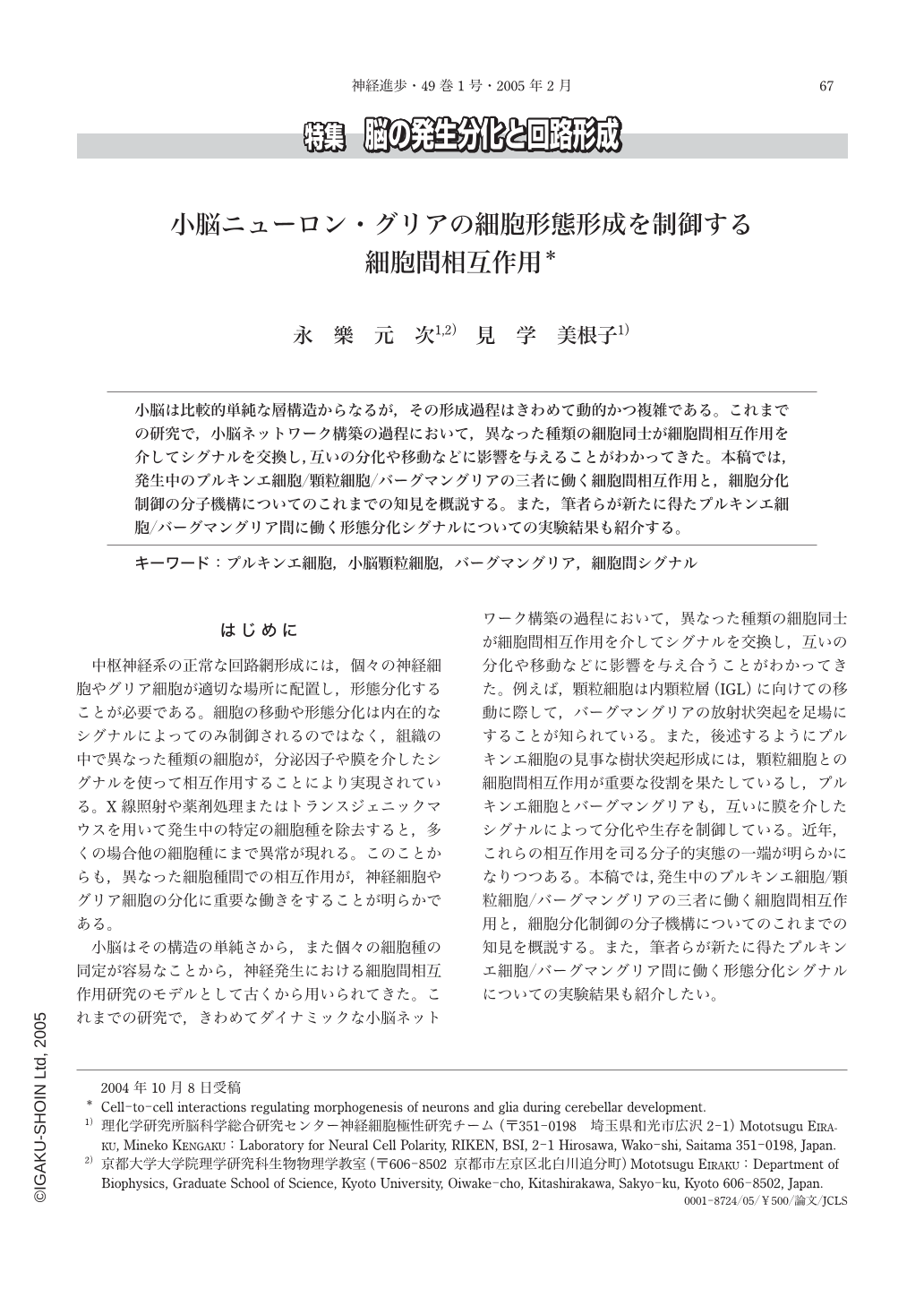
小脳は比較的単純な層構造からなるが,その形成過程はきわめて動的かつ複雑である。これまでの研究で,小脳ネットワーク構築の過程において,異なった種類の細胞同士が細胞間相互作用を介してシグナルを交換し,互いの分化や移動などに影響を与えることがわかってきた。本稿では,発生中のプルキンエ細胞/顆粒細胞/バーグマングリアの三者に働く細胞間相互作用と,細胞分化制御の分子機構についてのこれまでの知見を概説する。また,筆者らが新たに得たプルキンエ細胞/バーグマングリア間に働く形態分化シグナルについての実験結果も紹介する。
In spite of its relatively simple structure, the layer formation of the cerebellum consists of very dynamic and complicated steps of migration and morphogenesis of constituent neurons and glia. Extensive studies have revealed that cerebellar cells exchange signals through cell-to-cell interactions and mutually regulate differentiation during the processes of dynamic cerebellar network construction. It has been shown that granule cells migrate toward the inner granule layer using Bergmann fibers as a scaffold. On the other hand, elaborate branching of Purkinje cell dendrites is regulated by signals from granule cell axons that vertically contact with Purkinje cell dendrites. Purkinje cell dendrites in turn regulate formation and morphogenesis of Bergmann glial fibers that tightly associate with synapses on Purkinje cell dendrites. We have recently identified DNER as a signal from Purkinje cell dendrites that regulates morphogenesis of Bergmann glia. This review will summarize recent progress in the molecular mechanisms of cell-to-cell interactions between the Purkinje cell, granule cell and Bergmann glia during the cytoarchitectonic formation of the cerebellum.
Copyright © 2005, Igaku-Shoin Ltd. All rights reserved.