Japanese
English
- 有料閲覧
PPV購入案内
1,320円 (1,200円+税10%) こちらは、630ページから634ページの文献です。購入には医書.jp本会員登録が必要です。
会員登録完了後に改めて上記「購入サイトへ」を選択してください。
または「購入サイトへ」選択後に「購入ログイン」、「新規会員登録」の順に進んでください。
会員登録について詳しくはをご確認ください。
- Abstract 文献概要
- 1ページ目 Look Inside
- 参考文献 Reference
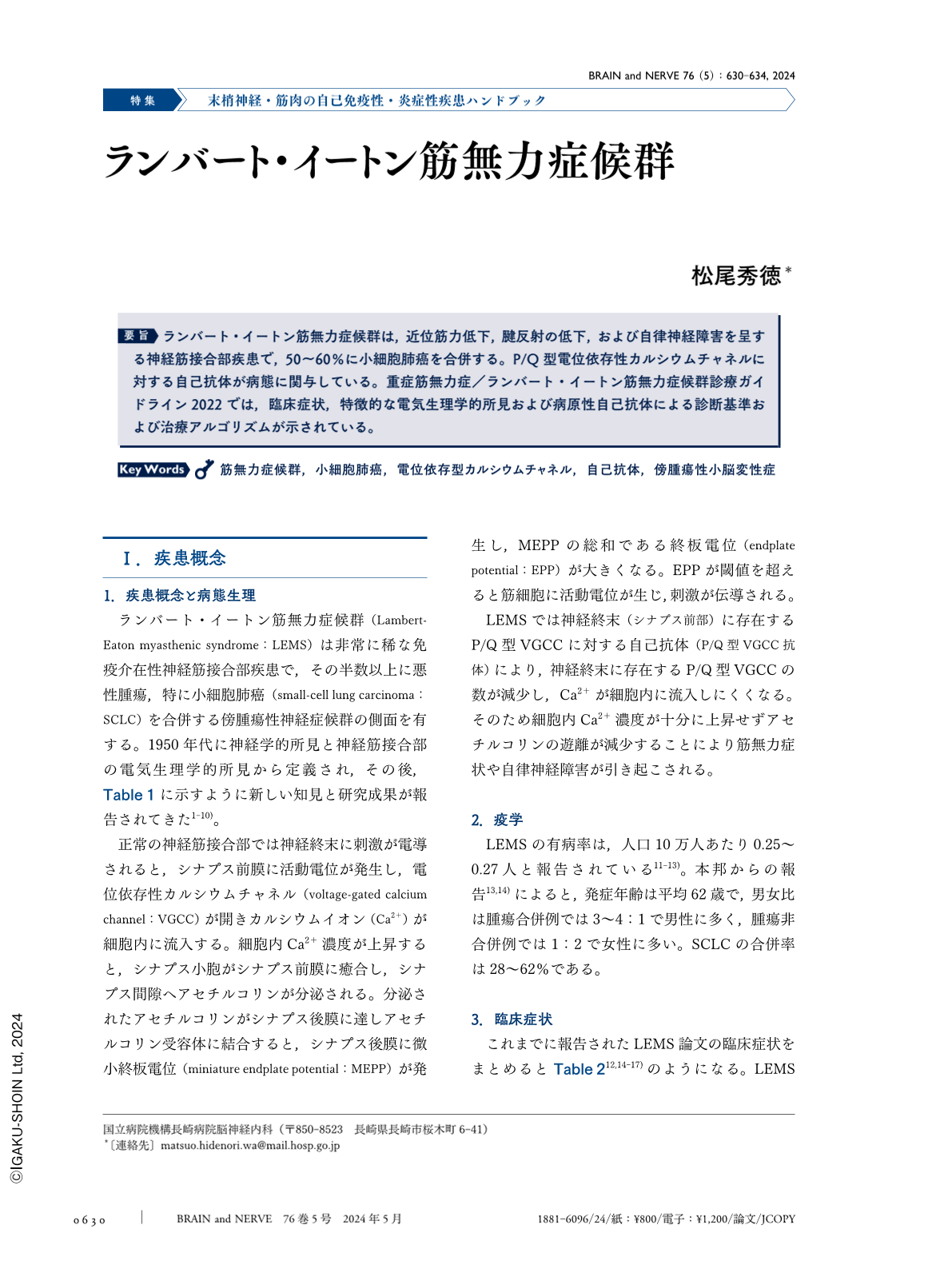
ランバート・イートン筋無力症候群は,近位筋力低下,腱反射の低下,および自律神経障害を呈する神経筋接合部疾患で,50〜60%に小細胞肺癌を合併する。P/Q型電位依存性カルシウムチャネルに対する自己抗体が病態に関与している。重症筋無力症/ランバート・イートン筋無力症候群診療ガイドライン2022では,臨床症状,特徴的な電気生理学的所見および病原性自己抗体による診断基準および治療アルゴリズムが示されている。
Abstract
Lambert-Eaton myasthenic syndrome (LEMS), an autoimmune disorder that affects the neuromuscular junction, is characterized by proximal muscle weakness, reduction of tendon reflexes, and autonomic dysfunction. LEMS shows a prevalence of approximately 0.25-0.27 per 100,000 population. The characteristic muscle weakness observed in patients with LEMS is attributed to the role of pathogenic autoantibodies directed against voltage-gated calcium channels (VGCC) present on the presynaptic nerve terminal. Notably, 50-60% of patients with LEMS have an associated tumor, small-cell lung carcinoma (SCLC), which also expresses functional voltage-gated calcium channels (VGCC). The Japanese LEMS diagnostic criteria 2022 recommend documentation of typical electrophysiological abnormalities combined with myasthenic symptoms for accurate diagnosis. P/Q-type VGCC antibody positivity strongly supports the diagnosis. Treatment options are categorized as oncological treatment, immunotherapy, and symptomatic treatments. Effective treatment of the tumor can improve LEMS in patients with SCLC. Most patients benefit from 3,4-diaminopyridine administration for symptomatic treatment. A treatment algorithm is established by the clinical practice guidelines 2022.
Copyright © 2024, Igaku-Shoin Ltd. All rights reserved.