Japanese
English
- 有料閲覧
PPV購入案内
1,320円 (1,200円+税10%) こちらは、837ページから845ページの文献です。購入には医書.jp本会員登録が必要です。
会員登録完了後に改めて上記「購入サイトへ」を選択してください。
または「購入サイトへ」選択後に「購入ログイン」、「新規会員登録」の順に進んでください。
会員登録について詳しくはをご確認ください。
- Abstract 文献概要
- 1ページ目 Look Inside
- 参考文献 Reference
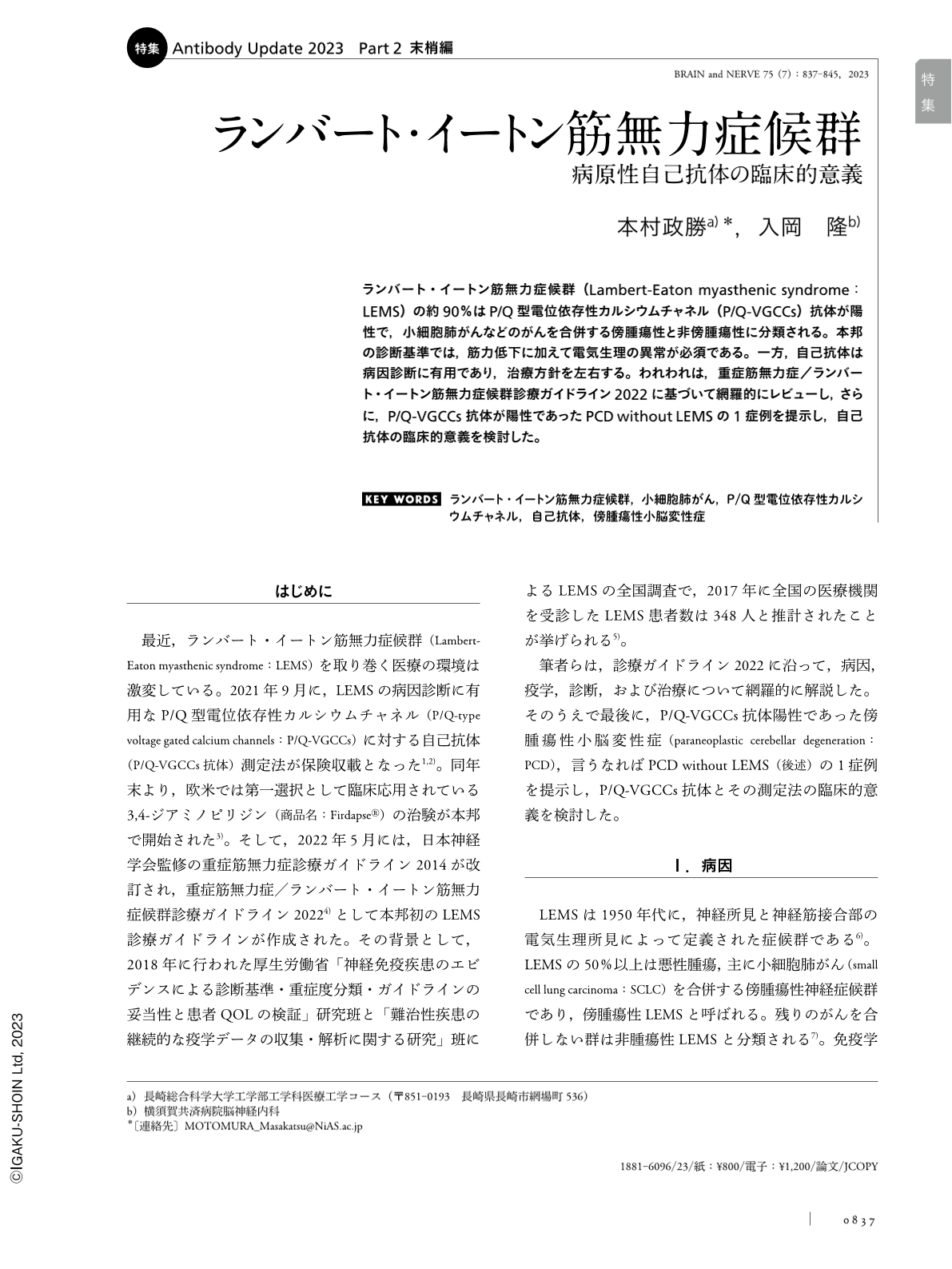
ランバート・イートン筋無力症候群(Lambert-Eaton myasthenic syndrome:LEMS)の約90%はP/Q型電位依存性カルシウムチャネル(P/Q-VGCCs)抗体が陽性で,小細胞肺がんなどのがんを合併する傍腫瘍性と非傍腫瘍性に分類される。本邦の診断基準では,筋力低下に加えて電気生理の異常が必須である。一方,自己抗体は病因診断に有用であり,治療方針を左右する。われわれは,重症筋無力症/ランバート・イートン筋無力症候群診療ガイドライン2022に基づいて網羅的にレビューし,さらに,P/Q-VGCCs抗体が陽性であったPCD without LEMSの1症例を提示し,自己抗体の臨床的意義を検討した。
Abstract
Approximately 90% of patients with Lambert-Eaton myasthenic syndrome (LEMS) are positive for P/Q-type voltage-gated calcium channels (VGCCs) antibodies, and can be broadly divided into two groups: paraneoplastic, especially with small cell lung carcinoma and, non-paraneoplastic, without cancer. Under the Japanese LEMS diagnostic criteria 2022, abnormal electrophysiological results is mandatory for diagnosis in addition to muscle weakness. Contrastingly, autoantibodies are useful for diagnosing the etiology and influence treatment strategies. We comprehensively reviewed the MG/LEMS 2022 practice guidelines. Moreover, we presented a case of PCD without LEMS that was positive for P/Q-type VGCCs antibodies_and discussed the clinical significance of the autoantibodies.
Copyright © 2023, Igaku-Shoin Ltd. All rights reserved.