Japanese
English
- 有料閲覧
PPV購入案内
1,320円 (1,200円+税10%) こちらは、445ページから451ページの文献です。購入には医書.jp本会員登録が必要です。
会員登録完了後に改めて上記「購入サイトへ」を選択してください。
または「購入サイトへ」選択後に「購入ログイン」、「新規会員登録」の順に進んでください。
会員登録について詳しくはをご確認ください。
- Abstract 文献概要
- 1ページ目 Look Inside
- 参考文献 Reference
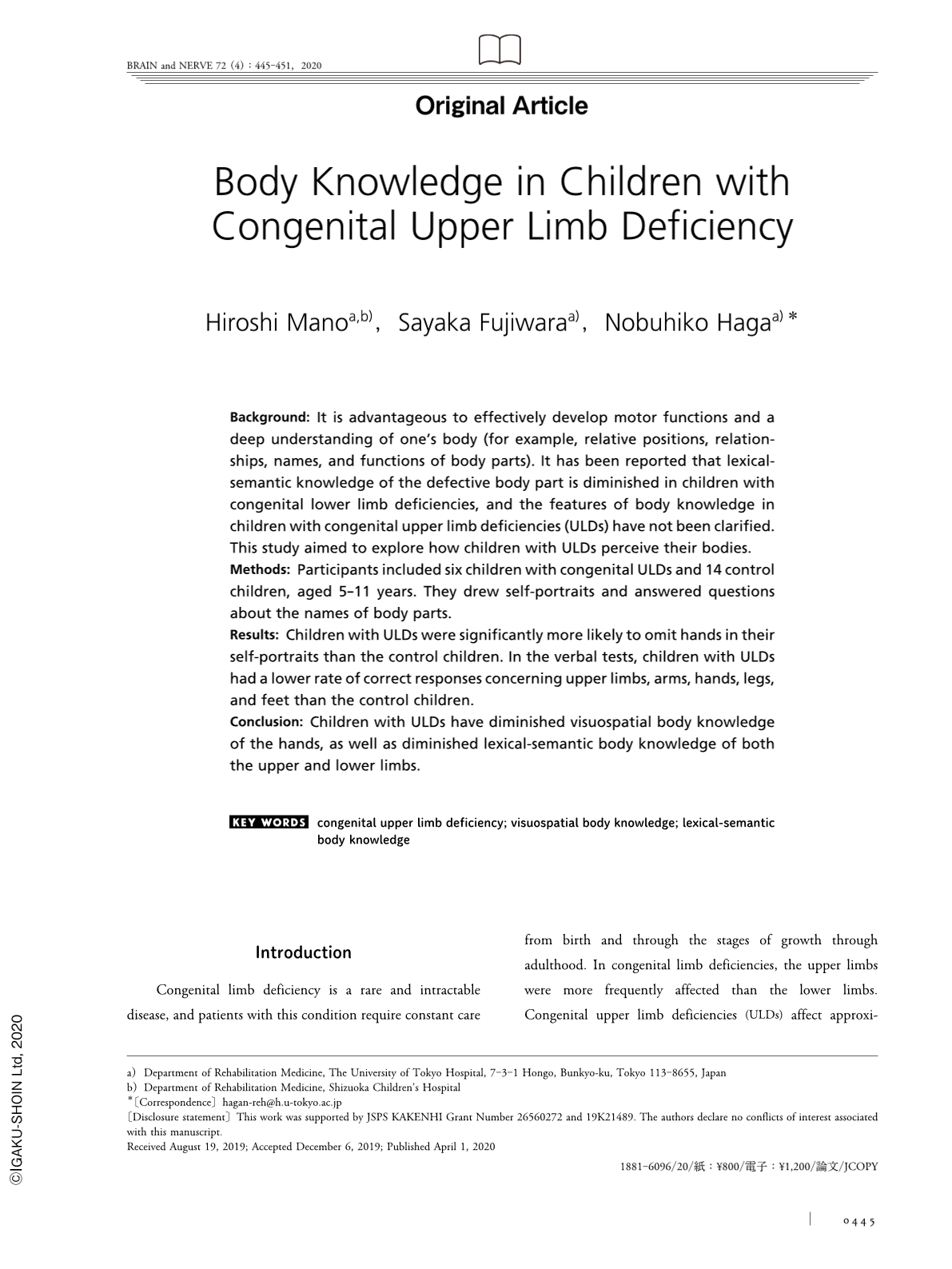
Background: It is advantageous to effectively develop motor functions and a deep understanding of one's body (for example, relative positions, relationships, names, and functions of body parts). It has been reported that lexical-semantic knowledge of the defective body part is diminished in children with congenital lower limb deficiencies, and the features of body knowledge in children with congenital upper limb deficiencies (ULDs) have not been clarified. This study aimed to explore how children with ULDs perceive their bodies.
Methods: Participants included six children with congenital ULDs and 14 control children, aged 5-11 years. They drew self-portraits and answered questions about the names of body parts.
Results: Children with ULDs were significantly more likely to omit hands in their self-portraits than the control children. In the verbal tests, children with ULDs had a lower rate of correct responses concerning upper limbs, arms, hands, legs, and feet than the control children.
Conclusion: Children with ULDs have diminished visuospatial body knowledge of the hands, as well as diminished lexical-semantic body knowledge of both the upper and lower limbs.
Background: It is advantageous to effectively develop motor functions and a deep understanding of one's body (for example, relative positions, relationships, names, and functions of body parts). It has been reported that lexical-semantic knowledge of the defective body part is diminished in children with congenital lower limb deficiencies, and the features of body knowledge in children with congenital upper limb deficiencies (ULDs) have not been clarified. This study aimed to explore how children with ULDs perceive their bodies.
Methods: Participants included six children with congenital ULDs and 14 control children, aged 5-11 years. They drew self-portraits and answered questions about the names of body parts.
Results: Children with ULDs were significantly more likely to omit hands in their self-portraits than the control children. In the verbal tests, children with ULDs had a lower rate of correct responses concerning upper limbs, arms, hands, legs, and feet than the control children.
Conclusion: Children with ULDs have diminished visuospatial body knowledge of the hands, as well as diminished lexical-semantic body knowledge of both the upper and lower limbs.
Copyright © 2020, Igaku-Shoin Ltd. All rights reserved.