Japanese
English
- 有料閲覧
PPV購入案内
1,320円 (1,200円+税10%) こちらは、1195ページから1202ページの文献です。購入には医書.jp本会員登録が必要です。
会員登録完了後に改めて上記「購入サイトへ」を選択してください。
または「購入サイトへ」選択後に「購入ログイン」、「新規会員登録」の順に進んでください。
会員登録について詳しくはをご確認ください。
- Abstract 文献概要
- 1ページ目 Look Inside
- 参考文献 Reference
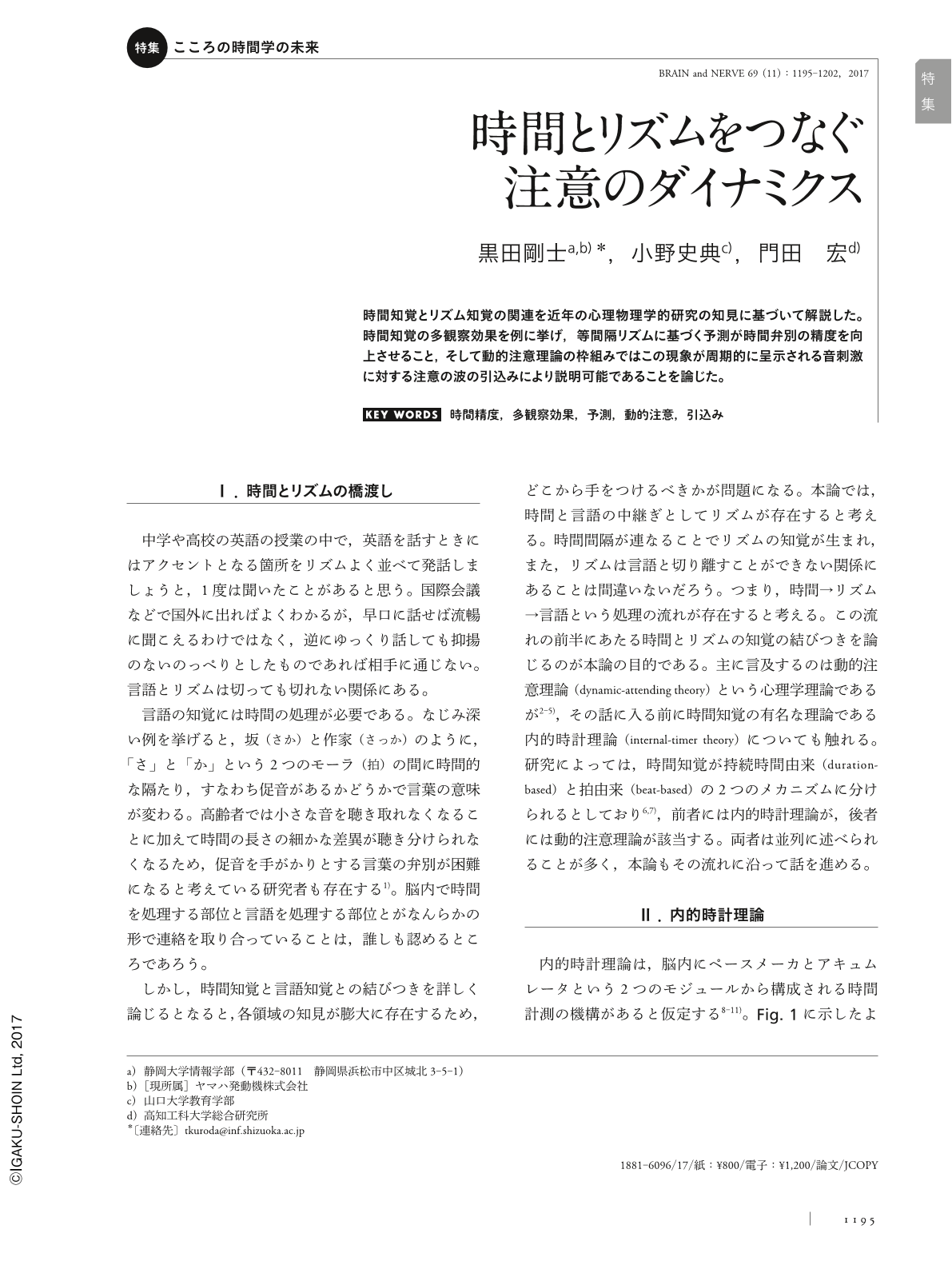
時間知覚とリズム知覚の関連を近年の心理物理学的研究の知見に基づいて解説した。時間知覚の多観察効果を例に挙げ,等間隔リズムに基づく予測が時間弁別の精度を向上させること,そして動的注意理論の枠組みではこの現象が周期的に呈示される音刺激に対する注意の波の引込みにより説明可能であることを論じた。
Abstract
Relations between time and rhythm perception are discussed in this review of psychophysical research relevant to the multiple-look effect and dynamic-attending theory. Discrimination of two neighboring intervals that are marked by three successive sounds is improved when the presentation of the first (standard, S) interval is repeated before that of the second (comparison, C), as SSSSC. This improvement in sensitivity, called the multiple-look effect, occurs because listeners (1) perceive regular rhythm during the repetition of the standard interval, (2) predict the timing of subsequent sounds, and (3) detect sounds that are deviated from the predicted timing. The dynamic-attending theory attributes such predictions to the entrainment of attentional rhythms. An endogenous attentional rhythm is synchronized with the periodic succession of sounds marking the repeated standard. The standard and the comparison are discriminated on the basis of whether the ending marker of the comparison appears at the peak of the entrained attentional rhythm. This theory is compatible with the findings of recent neurophysiological studies that relate temporal prediction to neural oscillations.
Copyright © 2017, Igaku-Shoin Ltd. All rights reserved.