Japanese
English
- 有料閲覧
PPV購入案内
1,320円 (1,200円+税10%) こちらは、219ページから225ページの文献です。購入には医書.jp本会員登録が必要です。
会員登録完了後に改めて上記「購入サイトへ」を選択してください。
または「購入サイトへ」選択後に「購入ログイン」、「新規会員登録」の順に進んでください。
会員登録について詳しくはをご確認ください。
- Abstract 文献概要
- 1ページ目 Look Inside
- 参考文献 Reference
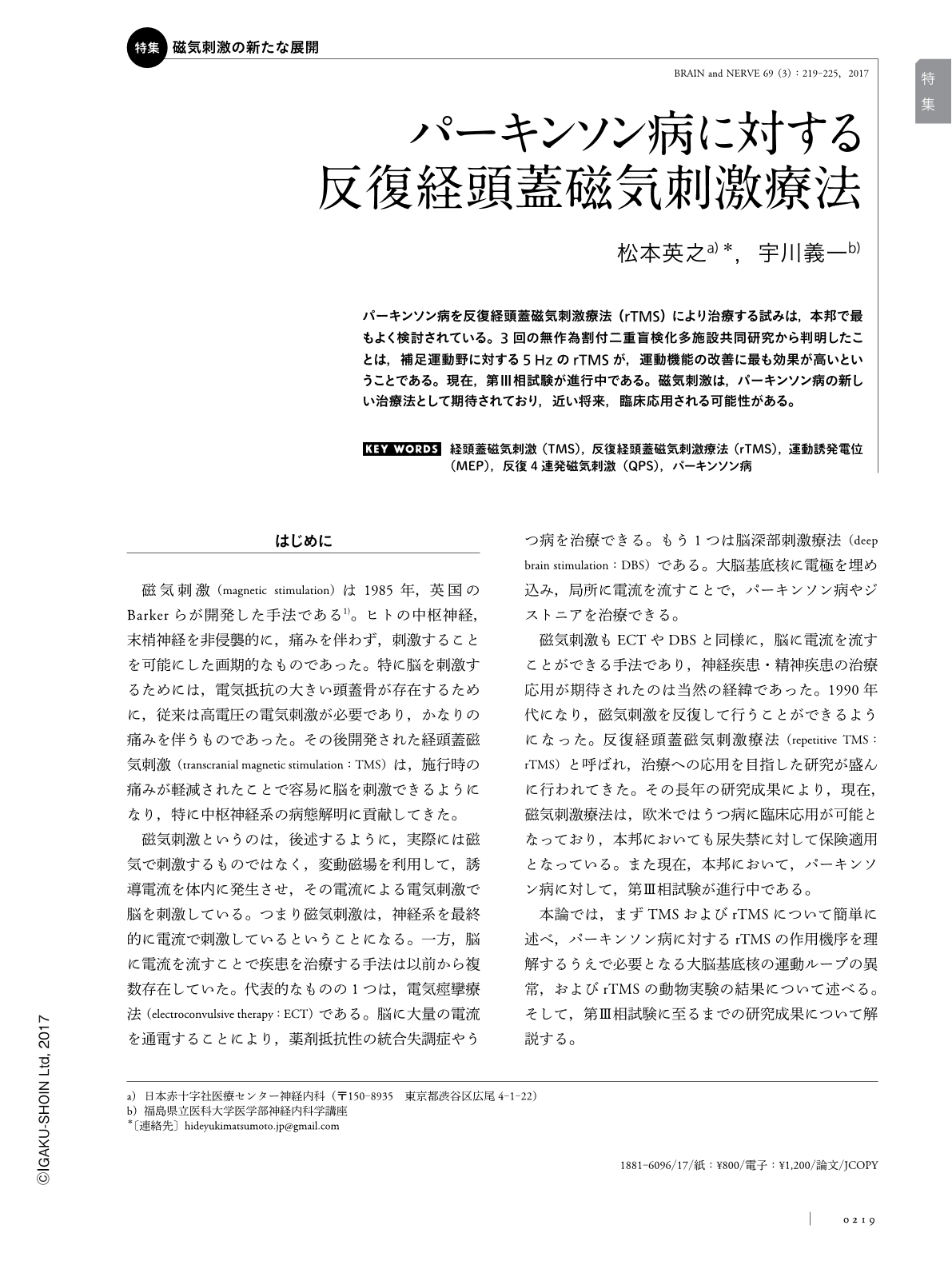
パーキンソン病を反復経頭蓋磁気刺激療法(rTMS)により治療する試みは,本邦で最もよく検討されている。3回の無作為割付二重盲検化多施設共同研究から判明したことは,補足運動野に対する5HzのrTMSが,運動機能の改善に最も効果が高いということである。現在,第Ⅲ相試験が進行中である。磁気刺激は,パーキンソン病の新しい治療法として期待されており,近い将来,臨床応用される可能性がある。
Abstract
This study aimed to review the effectiveness of repetitive transcranial magnetic stimulation (rTMS) for Parkinson's disease (PD). rTMS can modulate the neural networks in the human brain for a certain period, i.e., it can induce neural plasticity. Randomized, double-blind, sham-controlled, multicenter studies on rTMS for PD have been conducted three times in Japan (in 2003, 2008, and 2013). These studies revealed that 5-Hz rTMS over the supplementary motor area (SMA) is the most effective modality for improving motor symptoms. Several functional imaging studies showed reduced SMA excitability in patients with PD, probably secondary to basal ganglia dysfunction. Therefore, 5-Hz rTMS is assumed to normalize SMA excitability and amend basal ganglia function secondarily. Currently, a phase III trial is being conducted in Japan. Therefore, in the near future, 5-Hz rTMS can be used as a therapeutic modality for PD treatment. In addition, several powerful rTMS have been developed recently, including quadripulse stimulation (QPS), which most potently induces neural plasticity. QPS is also expected to be a potential therapeutic tool to treat patients with PD.
Copyright © 2017, Igaku-Shoin Ltd. All rights reserved.