Japanese
English
- 有料閲覧
PPV購入案内
1,320円 (1,200円+税10%) こちらは、945ページから950ページの文献です。購入には医書.jp本会員登録が必要です。
会員登録完了後に改めて上記「購入サイトへ」を選択してください。
または「購入サイトへ」選択後に「購入ログイン」、「新規会員登録」の順に進んでください。
会員登録について詳しくはをご確認ください。
- Abstract 文献概要
- 1ページ目 Look Inside
- 参考文献 Reference
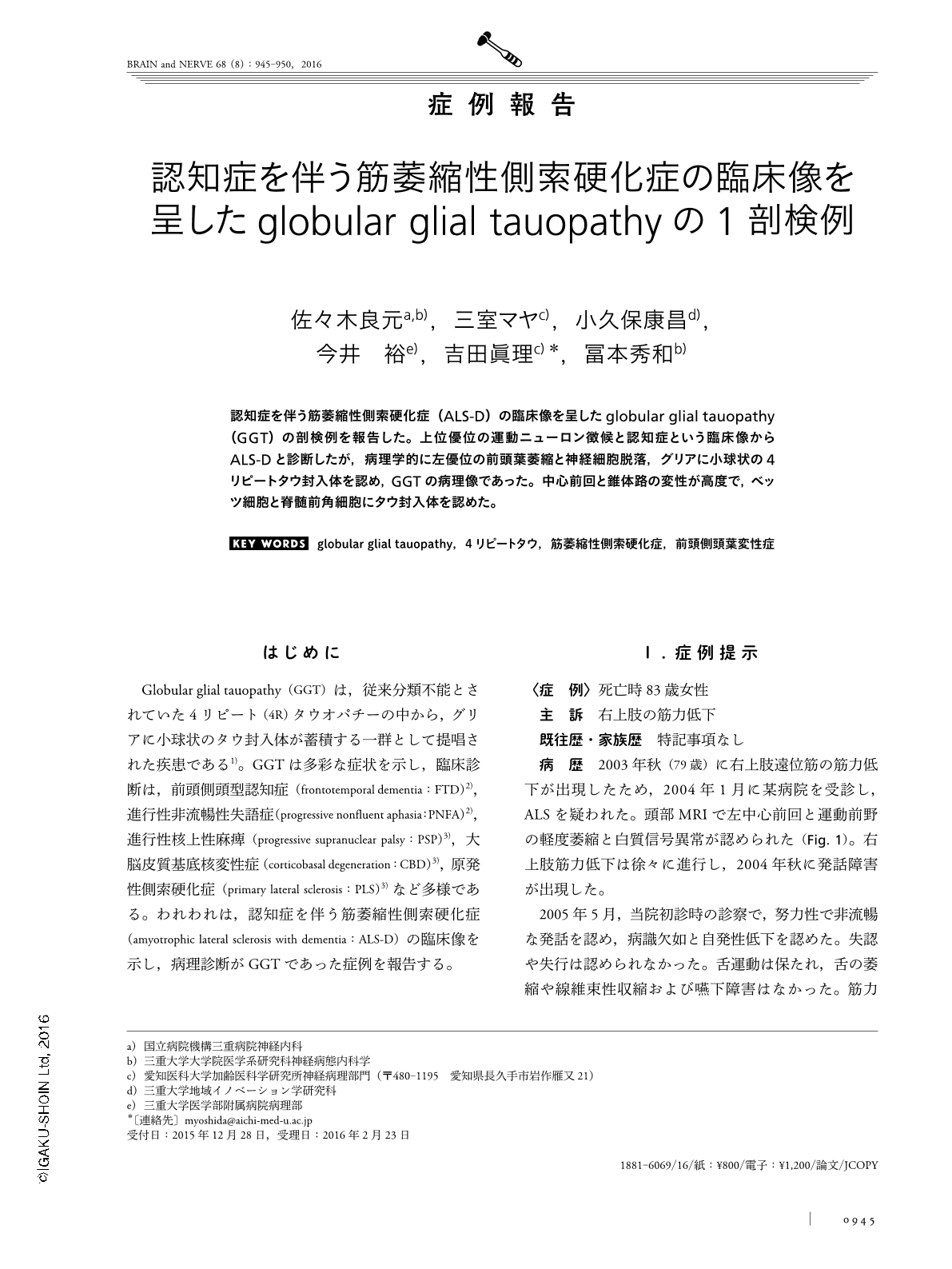
認知症を伴う筋萎縮性側索硬化症(ALS-D)の臨床像を呈したglobular glial tauopathy(GGT)の剖検例を報告した。上位優位の運動ニューロン徴候と認知症という臨床像からALS-Dと診断したが,病理学的に左優位の前頭葉萎縮と神経細胞脱落,グリアに小球状の4リピートタウ封入体を認め,GGTの病理像であった。中心前回と錐体路の変性が高度で,ベッツ細胞と脊髄前角細胞にタウ封入体を認めた。
Abstract
We report an autopsy case of globular glial tauopathy (GGT) presenting clinically with amyotrophic lateral sclerosis (ALS) with dementia. A 79-year-old female developed weakness in the right upper limb, which progressed gradually. She developed apathy and speech disorder at 80 years of age. On neurological examination, she showed signs of upper and lower motor neuron disorder and dementia, but no extrapyramidal signs. The clinical diagnosis was ALS with dementia. The autopsy revealed left predominant marked atrophy of the frontal lobe due to severe neuronal loss and Gliosis. Immunohistochemistry using anti-4-repeat tau antibody revealed numerous globular glial inclusions. Severe neurodegeneration in the primary motor cortex and corticospinal tract was observed. There were distinctive tau-positive inclusions in both Betz and anterior horn cells. TDP-43-positive inclusions in motor neurons were not detected. Sequence analysis of the tau gene revealed no mutations in exons 1-5, 7, 9-13, or the adjacent intronic sequences. GGT can cause a clinical phenotype of ALS with dementia.
(Received December 28, 2015; Accepted February 23, 2016; Published August 1, 2016)
Copyright © 2016, Igaku-Shoin Ltd. All rights reserved.