Japanese
English
- 有料閲覧
PPV購入案内
1,320円 (1,200円+税10%) こちらは、1210ページから1217ページの文献です。購入には医書.jp本会員登録が必要です。
会員登録完了後に改めて上記「購入サイトへ」を選択してください。
または「購入サイトへ」選択後に「購入ログイン」、「新規会員登録」の順に進んでください。
会員登録について詳しくはをご確認ください。
- Abstract 文献概要
- 1ページ目 Look Inside
- 参考文献 Reference
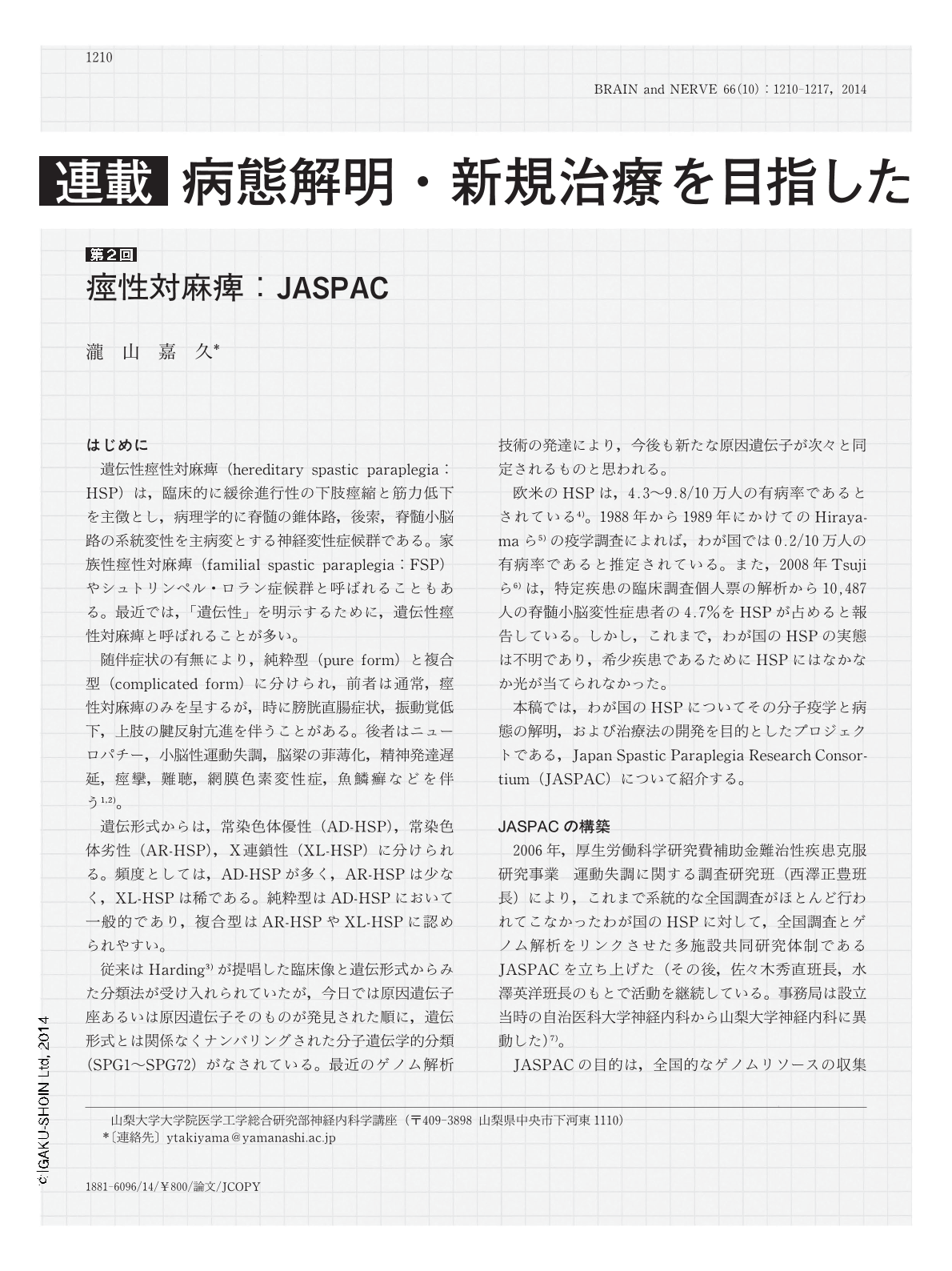
はじめに
遺伝性痙性対麻痺(hereditary spastic paraplegia:HSP)は,臨床的に緩徐進行性の下肢痙縮と筋力低下を主徴とし,病理学的に脊髄の錐体路,後索,脊髄小脳路の系統変性を主病変とする神経変性症候群である。家族性痙性対麻痺(familial spastic paraplegia:FSP)やシュトリンペル・ロラン症候群と呼ばれることもある。最近では,「遺伝性」を明示するために,遺伝性痙性対麻痺と呼ばれることが多い。
随伴症状の有無により,純粋型(pure form)と複合型(complicated form)に分けられ,前者は通常,痙性対麻痺のみを呈するが,時に膀胱直腸症状,振動覚低下,上肢の腱反射亢進を伴うことがある。後者はニューロパチー,小脳性運動失調,脳梁の菲薄化,精神発達遅延,痙攣,難聴,網膜色素変性症,魚鱗癬などを伴う1,2)。
遺伝形式からは,常染色体優性(AD-HSP),常染色体劣性(AR-HSP),X連鎖性(XL-HSP)に分けられる。頻度としては,AD-HSPが多く,AR-HSPは少なく,XL-HSPは稀である。純粋型はAD-HSPにおいて一般的であり,複合型はAR-HSPやXL-HSPに認められやすい。
従来はHarding3)が提唱した臨床像と遺伝形式からみた分類法が受け入れられていたが,今日では原因遺伝子座あるいは原因遺伝子そのものが発見された順に,遺伝形式とは関係なくナンバリングされた分子遺伝学的分類(SPG1〜SPG72)がなされている。最近のゲノム解析技術の発達により,今後も新たな原因遺伝子が次々と同定されるものと思われる。
欧米のHSPは,4.3〜9.8/10万人の有病率であるとされている4)。1988年から1989年にかけてのHirayamaら5)の疫学調査によれば,わが国では0.2/10万人の有病率であると推定されている。また,2008年Tsujiら6)は,特定疾患の臨床調査個人票の解析から10,487人の脊髄小脳変性症患者の4.7%をHSPが占めると報告している。しかし,これまで,わが国のHSPの実態は不明であり,希少疾患であるためにHSPにはなかなか光が当てられなかった。
本稿では,わが国のHSPについてその分子疫学と病態の解明,および治療法の開発を目的としたプロジェクトである,Japan Spastic Paraplegia Research Consortium(JASPAC)について紹介する。
Abstract
Japan Spastic Paraplegia Research Consortium (JASPAC), a nationwide clinical and genetic survey of patients with hereditary spastic paraplegia (HSP), was started in 2006 as a project of the Research Committee for Ataxic Diseases of the Ministry of Health, Labor, and Welfare, Japan. To date (April 4, 2014), 448 indexed patients with HSP have been registered from 46 prefectures in Japan. We are now performing molecular testing of the HSP patients using Sanger sequencing (SPG4, SPG11, SPG31, and ARSACS), comparative genomic hybridization (CGH) array (SPG1, 2, 3A, 4, 5, 6, 7, 8, 10, 11, 13, 15, 17, 20, 21, 31, 33, 39, 42, ABCD1, alsin, and ARSACS), and resequencing microarray (SPG1, 2, 3A, 4, 5, 6, 7, 8, 10, 11, 13, 17, 20, 21, 31, 33, and ABCD1). In 206 Japanese families with autosomal dominant HSP, SPG4 was the most common form, accounting for 38%, followed by SPG3A (5%), SPG31 (5%), SPG10 (2%), and SPG8 (1%). In 88 patients with autosomal recessive HSP, although SPG11 was the most common form, accounting for 6%, most showed significant genetic heterogeneity. The results of molecular testing will be applicable to patients in terms of improved positive diagnosis, follow-up, and genetic counseling. JASPAC will contribute to elucidating the molecular mechanisms underlying HSP, and will facilitate the development of better treatments for HSP.
Copyright © 2014, Igaku-Shoin Ltd. All rights reserved.