Japanese
English
- 有料閲覧
PPV購入案内
1,320円 (1,200円+税10%) こちらは、1121ページから1132ページの文献です。購入には医書.jp本会員登録が必要です。
会員登録完了後に改めて上記「購入サイトへ」を選択してください。
または「購入サイトへ」選択後に「購入ログイン」、「新規会員登録」の順に進んでください。
会員登録について詳しくはをご確認ください。
- Abstract 文献概要
- 1ページ目 Look Inside
- 参考文献 Reference
はじめに
グルタミン酸は,哺乳類中枢神経系において約80%の神経細胞が用いる主要な興奮性神経伝達物質であり,脳の形成や記憶・学習,認知,運動制御などの高次脳機能に重要な役割を果たしている1)。しかし,その機能的な重要性の反面,興奮毒性という概念で表されるように,過剰なグルタミン酸は神経細胞障害作用を持ち,さまざまな神経・精神疾患の原因と考えられている(Fig.1)2,3)。
グルタミン酸の高次脳機能における役割に比べ,脳形成における役割は不明な点が多い。In vitroの実験系では,グルタミン酸が脳の形成に重要な役割を果たすことが示されているが,個体レベルでのデータは少ない。筆者らのグループは,グルタミン酸の興奮毒性を再現したマウスを作製し,興奮毒性が脳の形成障害を起こすことを個体レベルで明らかにしてきた。本稿では,グルタミン酸の脳形成における役割を歴史的な経緯も含めて概説する。
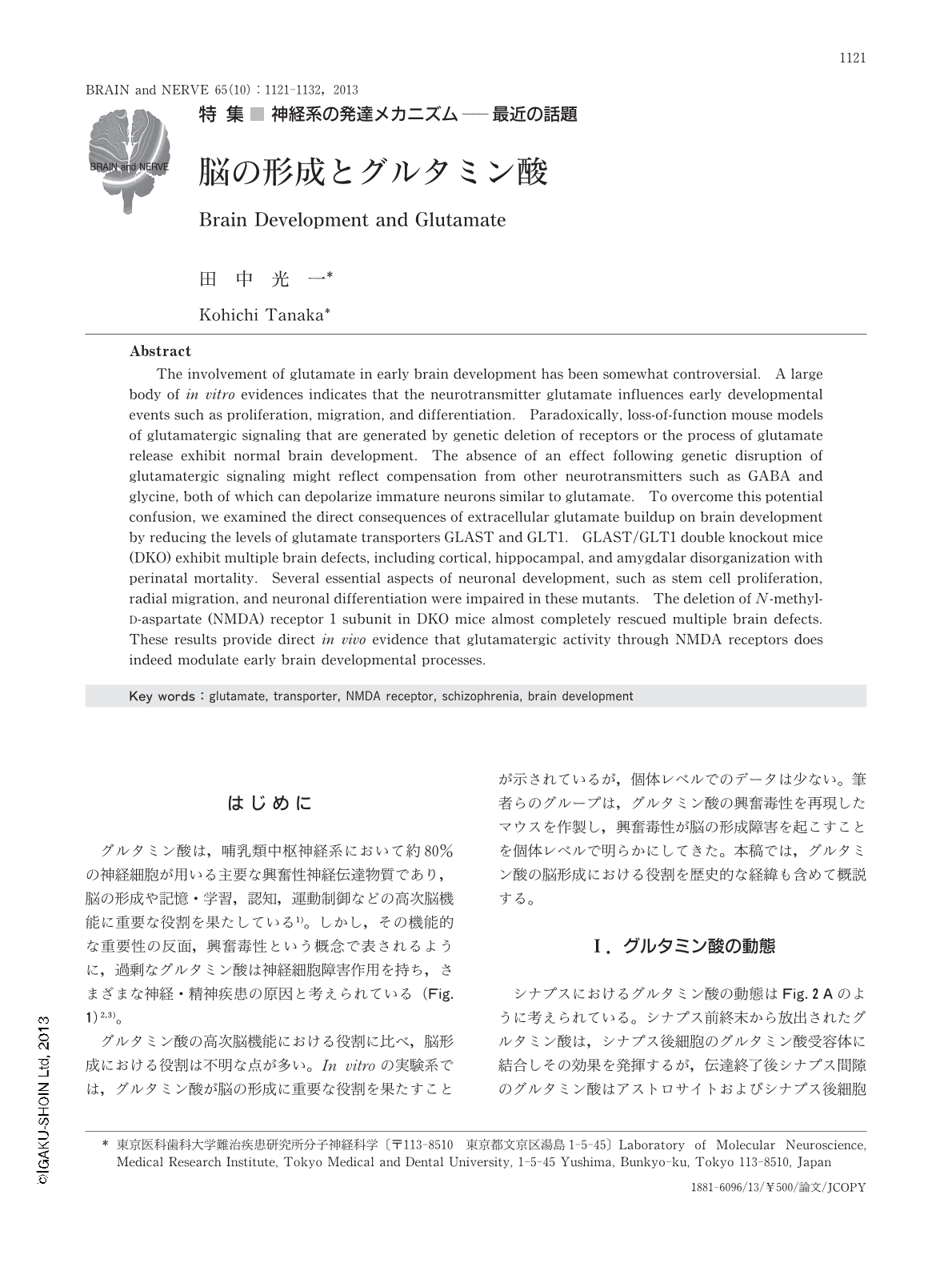
Abstract
The involvement of glutamate in early brain development has been somewhat controversial. A large body of in vitro evidences indicates that the neurotransmitter glutamate influences early developmental events such as proliferation, migration, and differentiation. Paradoxically, loss-of-function mouse models of glutamatergic signaling that are generated by genetic deletion of receptors or the process of glutamate release exhibit normal brain development. The absence of an effect following genetic disruption of glutamatergic signaling might reflect compensation from other neurotransmitters such as GABA and glycine, both of which can depolarize immature neurons similar to glutamate. To overcome this potential confusion, we examined the direct consequences of extracellular glutamate buildup on brain development by reducing the levels of glutamate transporters GLAST and GLT1. GLAST/GLT1 double knockout mice (DKO) exhibit multiple brain defects, including cortical, hippocampal, and amygdalar disorganization with perinatal mortality. Several essential aspects of neuronal development, such as stem cell proliferation, radial migration, and neuronal differentiation were impaired in these mutants. The deletion of N-methyl-D-aspartate (NMDA) receptor 1 subunit in DKO mice almost completely rescued multiple brain defects. These results provide direct in vivo evidence that glutamatergic activity through NMDA receptors does indeed modulate early brain developmental processes.
Copyright © 2013, Igaku-Shoin Ltd. All rights reserved.