Japanese
English
- 有料閲覧
PPV購入案内
1,320円 (1,200円+税10%) こちらは、649ページから655ページの文献です。購入には医書.jp本会員登録が必要です。
会員登録完了後に改めて上記「購入サイトへ」を選択してください。
または「購入サイトへ」選択後に「購入ログイン」、「新規会員登録」の順に進んでください。
会員登録について詳しくはをご確認ください。
- Abstract 文献概要
- 1ページ目 Look Inside
- 参考文献 Reference
はじめに
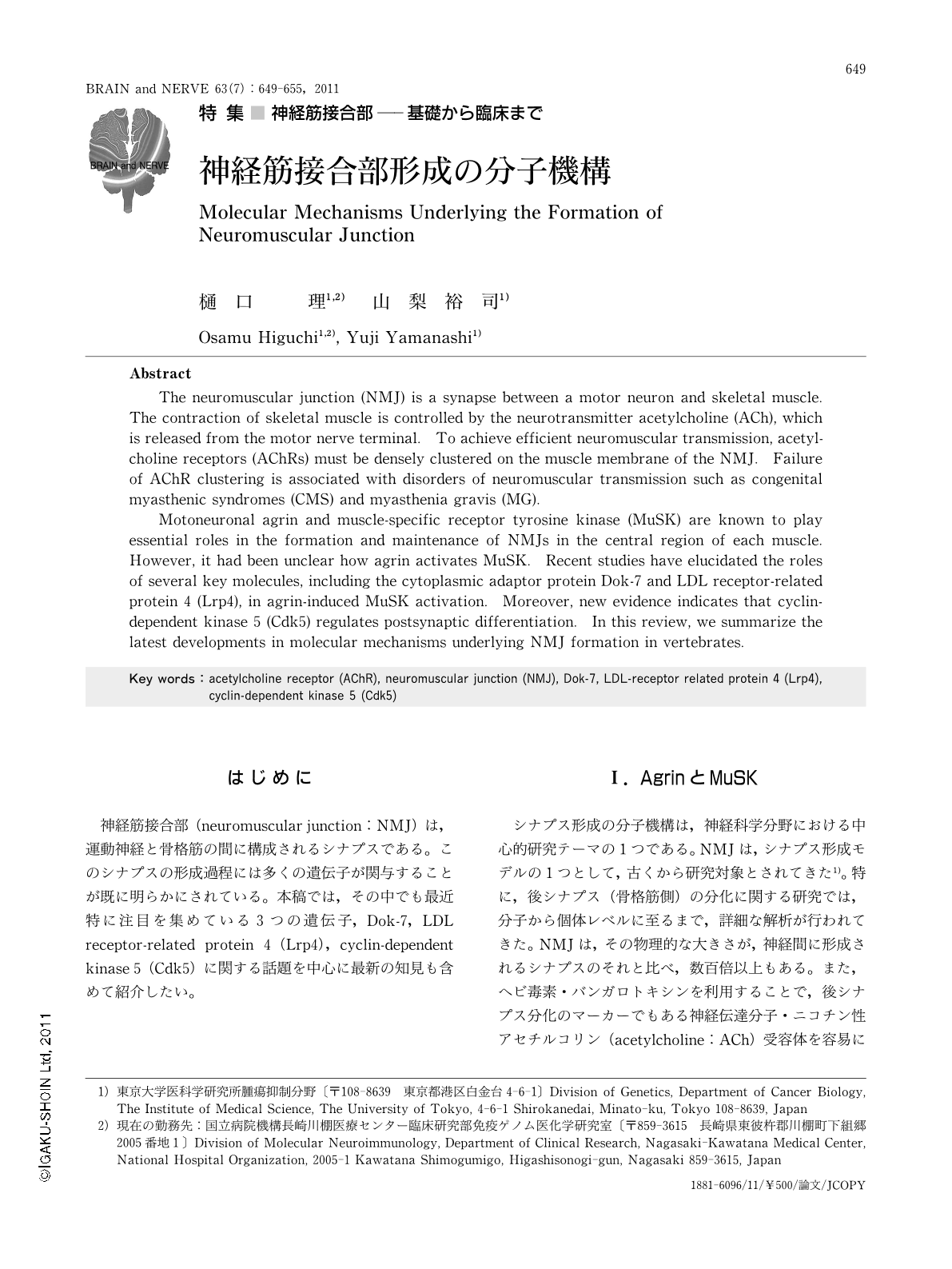
神経筋接合部(neuromuscular junction:NMJ)は,運動神経と骨格筋の間に構成されるシナプスである。このシナプスの形成過程には多くの遺伝子が関与することが既に明らかにされている。本稿では,その中でも最近特に注目を集めている3つの遺伝子,Dok-7,LDL receptor-related protein 4(Lrp4),cyclin-dependent kinase 5(Cdk5)に関する話題を中心に最新の知見も含めて紹介したい。
Abstract
The neuromuscular junction (NMJ) is a synapse between a motor neuron and skeletal muscle. The contraction of skeletal muscle is controlled by the neurotransmitter acetylcholine (ACh), which is released from the motor nerve terminal. To achieve efficient neuromuscular transmission, acetylcholine receptors (AChRs) must be densely clustered on the muscle membrane of the NMJ. Failure of AChR clustering is associated with disorders of neuromuscular transmission such as congenital myasthenic syndromes (CMS) and myasthenia gravis (MG).
Motoneuronal agrin and muscle-specific receptor tyrosine kinase (MuSK) are known to play essential roles in the formation and maintenance of NMJs in the central region of each muscle. However,it had been unclear how agrin activates MuSK. Recent studies have elucidated the roles of several key molecules,including the cytoplasmic adaptor protein Dok-7 and LDL receptor-related protein 4 (Lrp4),in agrin-induced MuSK activation. Moreover,new evidence indicates that cyclin-dependent kinase 5 (Cdk5) regulates postsynaptic differentiation. In this review,we summarize the latest developments in molecular mechanisms underlying NMJ formation in vertebrates.
Copyright © 2011, Igaku-Shoin Ltd. All rights reserved.