Japanese
English
- 有料閲覧
PPV購入案内
1,320円 (1,200円+税10%) こちらは、571ページから574ページの文献です。購入には医書.jp本会員登録が必要です。
会員登録完了後に改めて上記「購入サイトへ」を選択してください。
または「購入サイトへ」選択後に「購入ログイン」、「新規会員登録」の順に進んでください。
会員登録について詳しくはをご確認ください。
- Abstract 文献概要
- 1ページ目 Look Inside
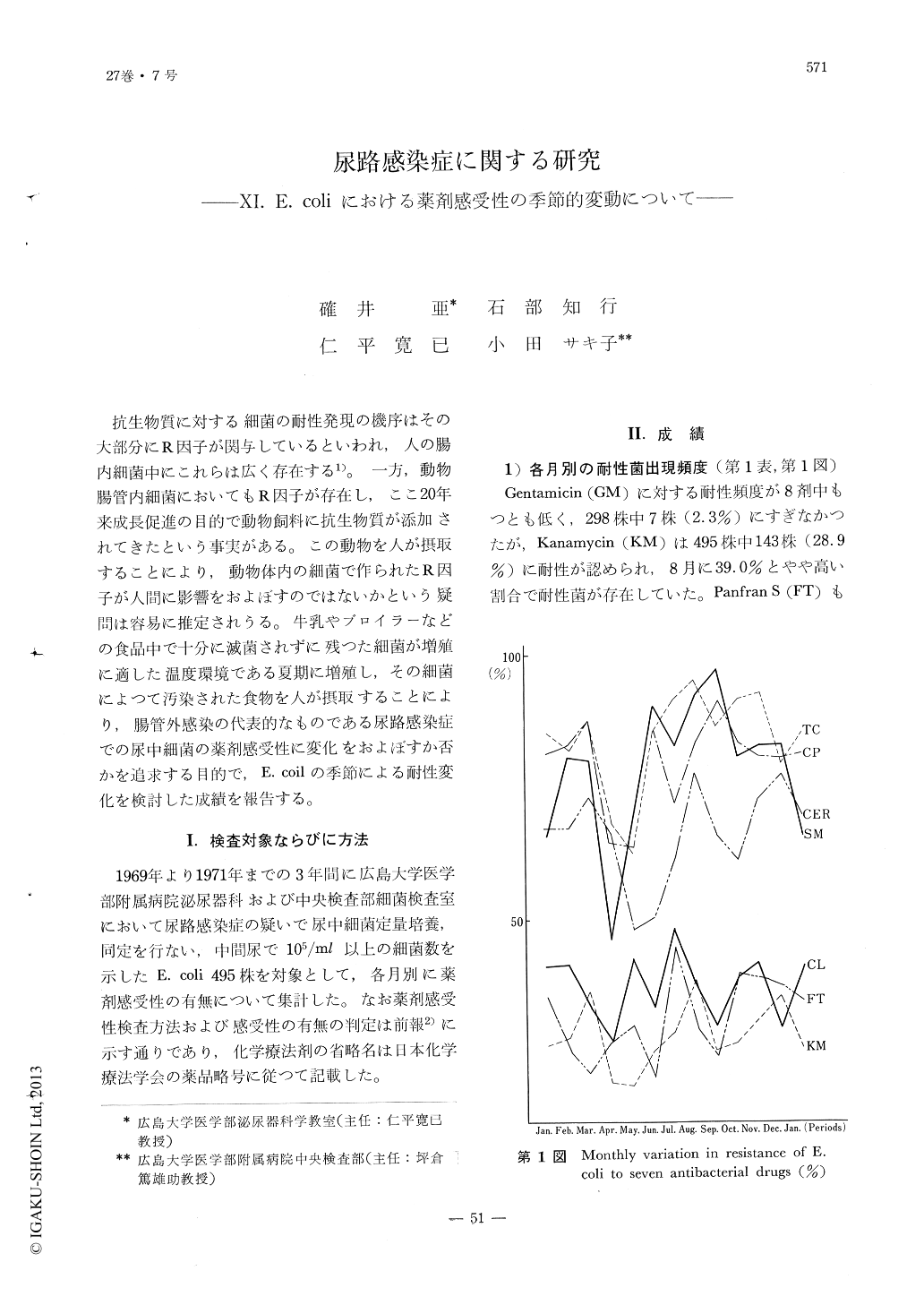
抗生物質に対する細菌の耐性発現の機序はその大部分にR因子が関与しているといわれ,人の腸内細菌中にこれらは広く存在する1)。一方,動物腸管内細菌においてもR因子が存在し,ここ20年来成長促進の目的で動物飼料に抗生物質が添加されてきたという事実がある。この動物を人が摂取することにより,動物体内の細菌で作られたR因子が人間に影響をおよぼすのではないかという疑問は容易に推定されうる。牛乳やブロイラーなどの食品中で十分に滅菌されずに残つた細菌が増殖に適した温度環境である夏期に増殖し,その細菌によつて汚染された食物を人が摂取することにより,腸管外感染の代表的なものである尿路感染症での尿中細菌の薬剤感受性に変化をおよぼすか否かを追求する目的で,E.coilの季節による耐性変化を検討した成績を報告する。
Monthly variation of sensitivity to 8 drugs were studied on 495 strains of E. coli isolated from patients with urinary tract infection, in the 3 years between 1969 to 1971 at the urological department and bacteriological department of the Central Laboratory, of the Hiroshima University Hospital.
The incidence of resistant strain of E. coli showed the lowest to GM in 2.3% and the highest to TC in 85.1%.
The incidence of resistant strain which rose during summer showed the highest of 12% to SM, followed by TC 8% and CL, FT, KM ranged between 2.6% to 4.7%, while CP, CER, GM showed the tendency to be low during the summer time.
Copyright © 1973, Igaku-Shoin Ltd. All rights reserved.