Japanese
English
- 有料閲覧
PPV購入案内
1,320円 (1,200円+税10%) こちらは、359ページから362ページの文献です。購入には医書.jp本会員登録が必要です。
会員登録完了後に改めて上記「購入サイトへ」を選択してください。
または「購入サイトへ」選択後に「購入ログイン」、「新規会員登録」の順に進んでください。
会員登録について詳しくはをご確認ください。
- Abstract 文献概要
- 1ページ目 Look Inside
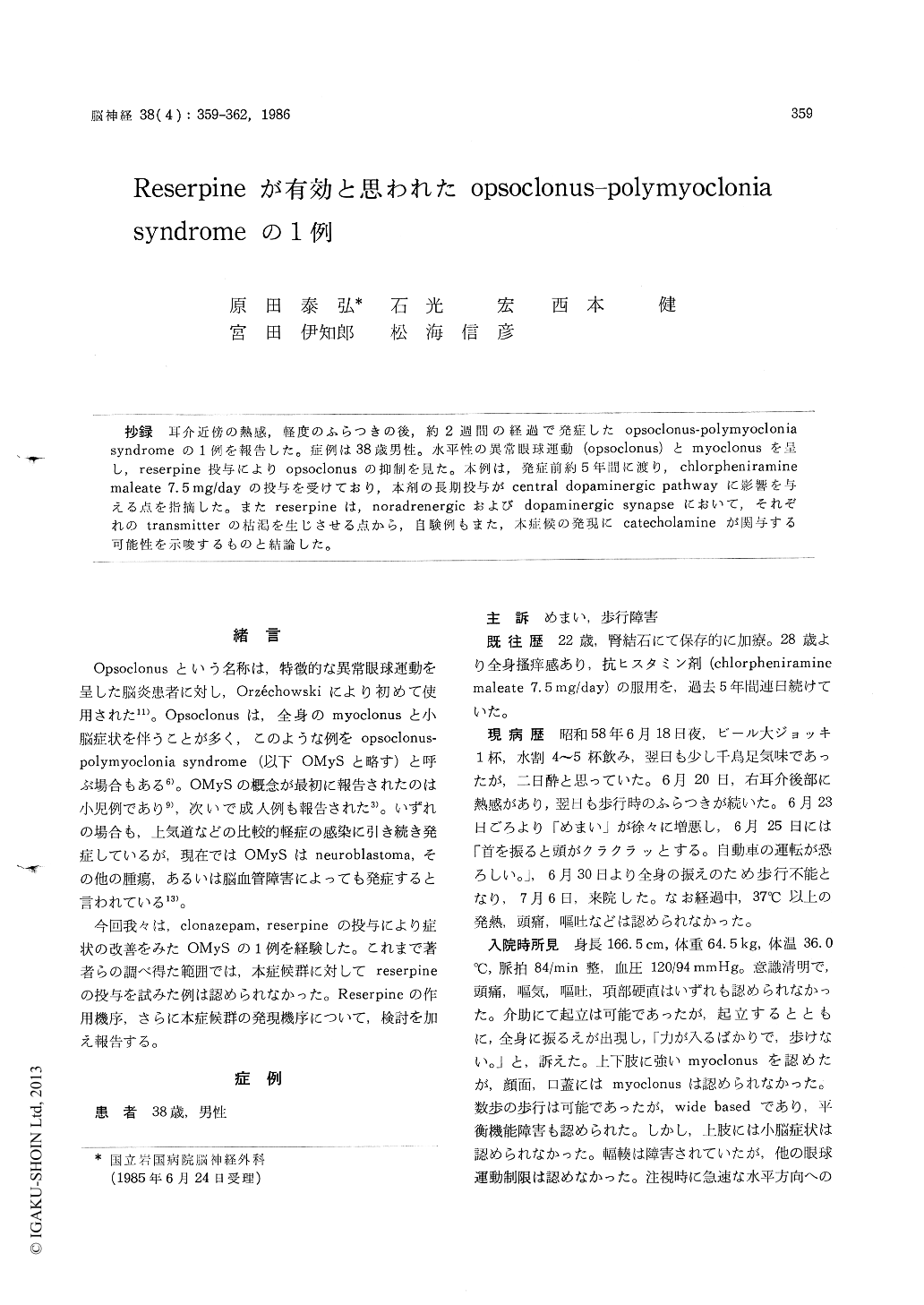
抄録 耳介近傍の熱感,軽度のふらつきの後,約2週間の経過で発症したopsoclonus-polymyocloniasyndromeの1例を報告した。症例は38歳男性。水平性の異常眼球運動(opsoclonus)とmyoclonusを呈し,reserpine投与によりopsoclonusの抑制を見た。本例は,発症前約5年間に渡り,chlorpheniraminemaleate 7.5mg/dayの投与を受けており,本剤の長期投与がcentral dopaminergic pathwayに影響を与える点を指摘した。またreserpineは,noradrenergicおよびdopaminergic synapseにおいて,それぞれのtransmitterの枯渇を生じさせる点から,自験例もまた,本症候の発現にcatecholamineが関与する可能性を示唆するものと結論した。
A 38-year-old man was admitted to Iwakuni National Hospital on July 6, 1978, with the com-plaints of difficulty seeing and walking. Two weeks before admission, he first experienced dizziness and it slowly progressed to uncontrollable tremor-like movements of the whole body. On admission, he was alert, oriented and afebrile. He had not experienced nausea, vomiting nor headache. He showed irregular horizontal oscillations of the eyes. Electronystagmographic study showed that this jerky eye movement appeared especially with changes of fixation of the eyes. It was also record-ed during conjugate eye movement, and while he closed his eyes. He was ataxic, unable to walk, but no other abnormalities in cerebellar functions were observed. Spinal tap was performed and yielded watery clear cerebrospinal fluid containing 9/mm3 mononuclear cells. Clonazepam was given, 1. 5 mg per day, for three days followed by doses of 3 mg per day. Improvement in walking was observed one week after starting the medication, when reserpine was started at a dose of 1 mg per day and increased to a dose of 1. 5 mg per day in three days. One week after starting reserpine, opsoclonus improved markedly and he became able to read again. He was discharged home on Sep-tember 3, 1978.
Six months after admission, reserpine was de-creased to 0.5 mg per day. Difficulty in reading developed within a month. Reserpine was given 1.0 mg per day and the doses was continuously given for next three months. One year after admis-sion, he is back to his former occupation without medication. He complains of slight difficulty in reading for more than an hour, and in watching TV.
Thirty cases of opsoclonus-polymyoclonia synd-rome due to infection or of unknown etiology were reported in Japan. Corticosteroids or ACTH was recommended as an effective therapy. In the recent literature, clonazepam and TRH were also considered effective for this syndrome. although the latter shows its effect only for limited duration. Effectiveness of reserpine in this syndrome was not found in the literature. Reserpine produces long-lasting depletion of catecholamines. The pres-ent case supports the possibility that this syn-drome is induced by an excessive storage of catecholamines as some authors indicate.
Copyright © 1986, Igaku-Shoin Ltd. All rights reserved.