Japanese
English
- 有料閲覧
PPV購入案内
1,320円 (1,200円+税10%) こちらは、709ページから713ページの文献です。購入には医書.jp本会員登録が必要です。
会員登録完了後に改めて上記「購入サイトへ」を選択してください。
または「購入サイトへ」選択後に「購入ログイン」、「新規会員登録」の順に進んでください。
会員登録について詳しくはをご確認ください。
- Abstract 文献概要
- 1ページ目 Look Inside
I.はじめに
現在臨床的に使用し得る脳循環測定法には全脳的脳循環測定法としてN2O法8)があり,局所的脳循環測定法として85Kr Clearance5)11)法がある。このほか電磁流量計7),超音波減衰9),Rheography6)などによる脳循環測定の試みが行なわれている。しかしながらこれらの方法では局所脳循環動態を連続的に記録することが不可能であり,時々刻々とうつり変わる循環動態を局所の脳代謝と対比しながら観察することが不可能である。われわれは実験的に脳局所代謝を局所脳循環との関連においてとらえるべく諸種測定法を試みてきたが,いずれも一長一短があつて実用に供しがたく新しい測定法の開発の必要に迫られた。このような目的で従来のheat cIearance法に改良を加え一応実験的に使用し得る段階に達したので報告する。
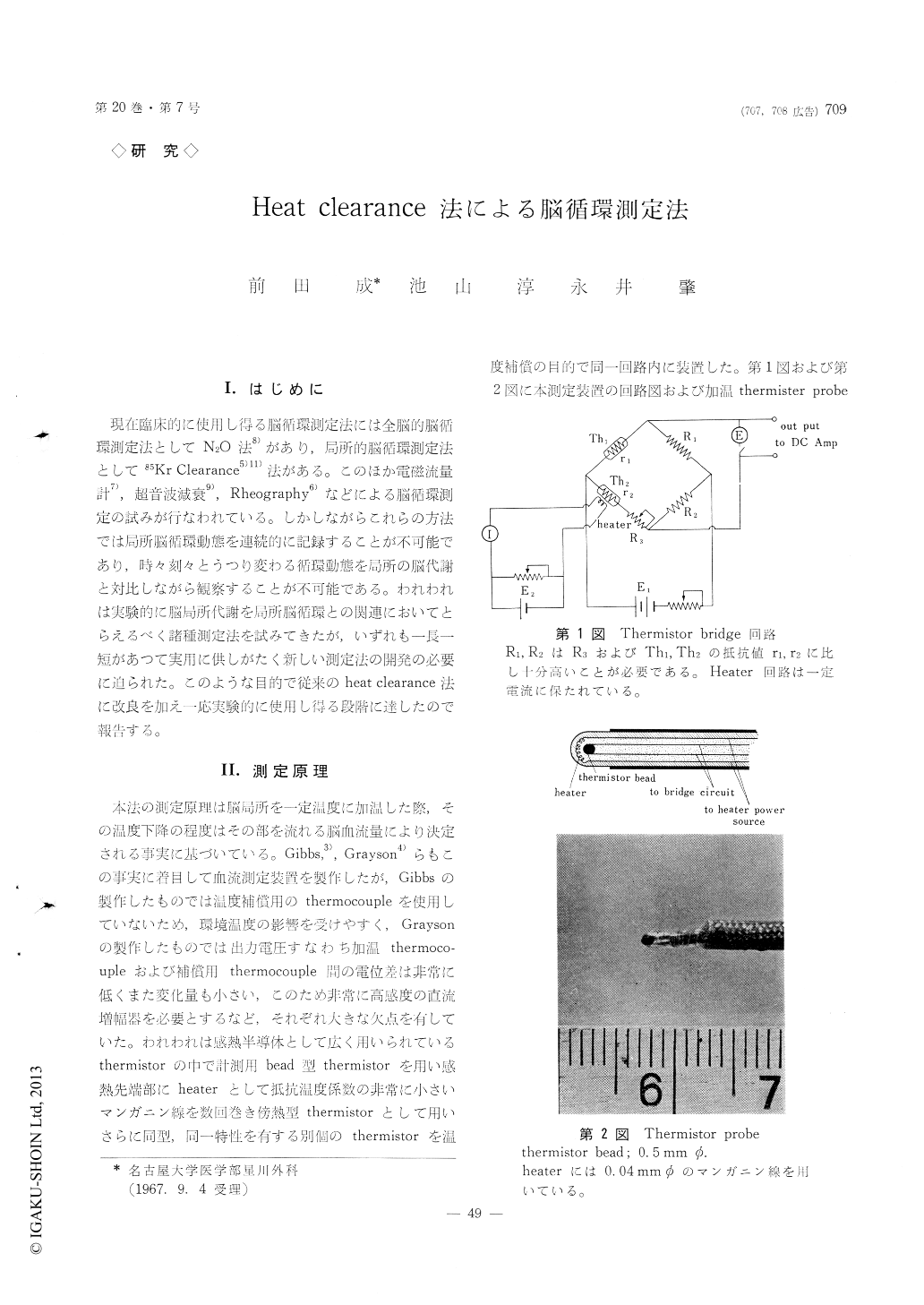
In order to measure regional cerebral blood flow continuously, we have devised a thermoelectric flow meter consisting of two thermistors, one of which has a tiny heater warmed by the steady amount of DC. The principle of this method is that increased blood flow may cool the heated thermistor probe and that decreased flow may allow the probe to be heated up. Gibbs and Grayson introduced a thermoelectric blood flow recorder using heated thermocouple. It has been proved that our thermoelectric flow recorder is superior to their devices in sensitivity and stabil-ity. Besides, it is very small in size (bead 0.5 mmcb) enough to be inserted into the brain tissue without any serious injury
The following basic study on this method was made.
1. Influence of brain temperature on the ther-moelectric flow meter.
To eliminate the errors due to change in the brain temperature, another thermistor with the same size, shape and thermoresistance wired into a self-com-pensating bridge circuit, was also inserted into the brain tissue 5-7 mm apart from the heated probe.
2. Temperature field around the heated thermistor probe.
In the dead brain, the temperature of the heated thermistor probe reached to the distance of 8 mm, while in the living brain it did not further than 3 mm due to cooling by the blood flow. This fact means that our heated probe measures the blood flow less than 1 cm3 of the brain tissue.
3. Perfusion rate and out put voltage of the bridge circuit.
ΔE; out put voltage increment
R1=R2; high resistor
Δr2; resistance increment of heated ther-mistor by blood flow
E1 ; power voltage of the bridge circuit
ΔE=Δr2/R1E1
This formula implies that the out put voltage will be a function of the resistance of the heated ther-mistor, that is, the out put voltage is proportional to the blood flow. To avoid an error, the power voltage (E1) must be controlled so that the ther-mistor bead may not be heated by itself. Therefore, we adjusted the power voltage to keep DC through the thermistor within 100 μA. Liquid paraffin kept between 27℃ up to 37℃ was flowed through a tube to which two thermistor probes were attached. Al-though the relationship between the perfusion rate and the out put voltage was not always linear, the former increased proportionally to the latter.
To estimate the blood flow quantitatively, of course, measurements of the heat conductivity of the brain tissue are to be investigated. Thermistor flow meter, however, was sensitive and stable enough to record the serial changes in regional cerebral blood flow, compared with the original form using thermocouple. It also might be applicable to measure the blood flow of the vessels and other organs such as the liver and kidney.
Copyright © 1968, Igaku-Shoin Ltd. All rights reserved.