Japanese
English
- 有料閲覧
PPV購入案内
1,320円 (1,200円+税10%) こちらは、782ページから789ページの文献です。購入には医書.jp本会員登録が必要です。
会員登録完了後に改めて上記「購入サイトへ」を選択してください。
または「購入サイトへ」選択後に「購入ログイン」、「新規会員登録」の順に進んでください。
会員登録について詳しくはをご確認ください。
- Abstract 文献概要
- 1ページ目 Look Inside
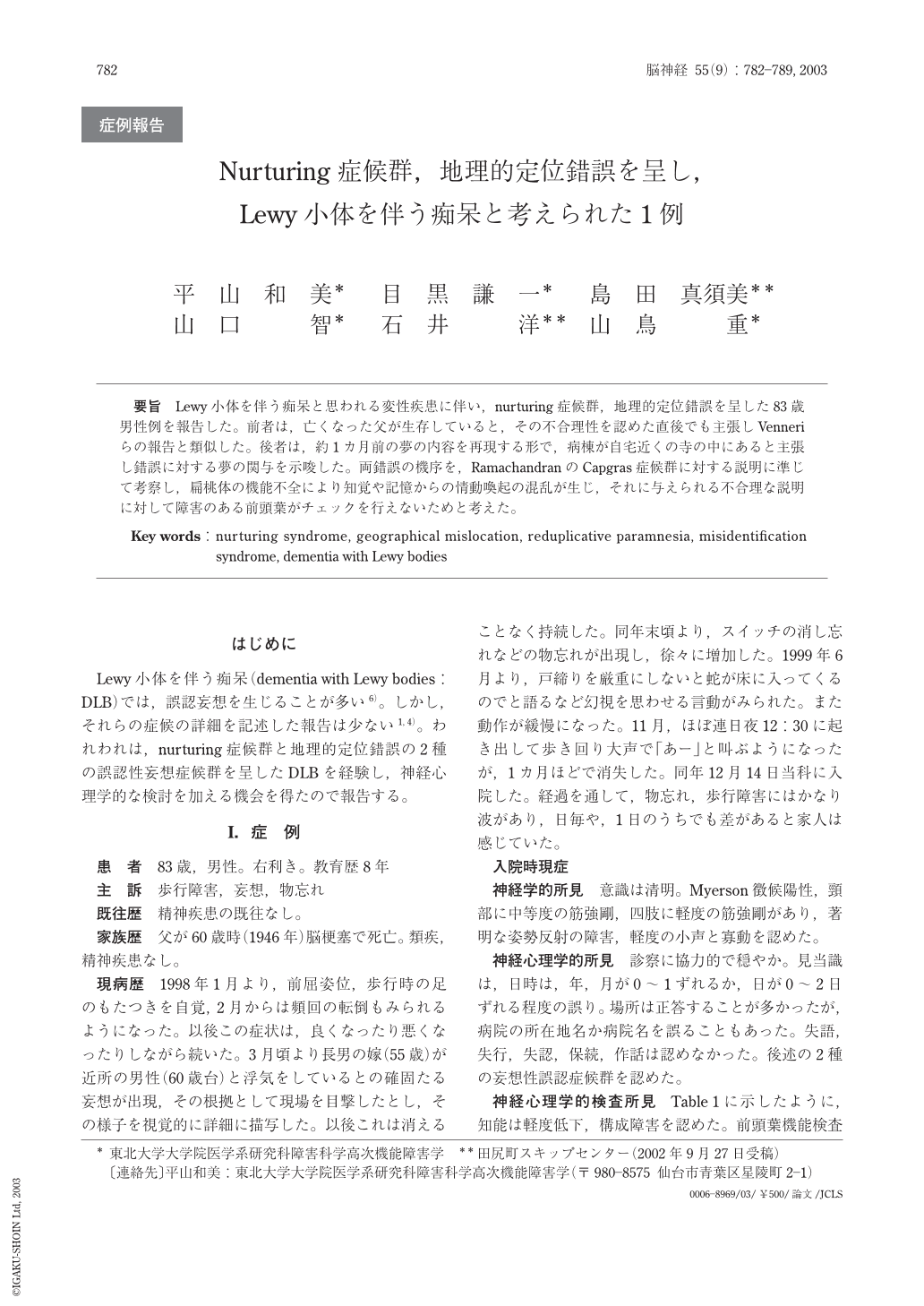
要旨 Lewy小体を伴う痴呆と思われる変性疾患に伴い,nurturing症候群,地理的定位錯誤を呈した83歳男性例を報告した。前者は,亡くなった父が生存していると,その不合理性を認めた直後でも主張しVenneriらの報告と類似した。後者は,約1カ月前の夢の内容を再現する形で,病棟が自宅近くの寺の中にあると主張し錯誤に対する夢の関与を示唆した。両錯誤の機序を,RamachandranのCapgras症候群に対する説明に準じて考察し,桃体の機能不全により知覚や記憶からの情動喚起の混乱が生じ,それに与えられる不合理な説明に対して障害のある前頭葉がチェックを行えないためと考えた。
Abstract
A 83-year-old right handed man developed nurturing syndrome and geographical mislocation (misidentification of places) as a result of dementia with Lewy bodies. He showed parkinsonism, fluctuating cognition, repeated falls, systematic delusions (delusional jealousy with vivid feeling of witness), rapid eye movement sleep behavior disorder, and mild dementia. His brain MRI showed atrophy of bilateral temporal tips and amygdala. A FDG-PET showed decrease of glucose metabolism in right frontal lobe and left temporo-parietal areas. He showed constructional disability, frontal lobe dysfunction, mild deterioration of immediate memory, mild anterograde amnesia, and retrograde amnesia for recent events. Aphasia, apraxia, agnosia, confabulation, or deterioration of facial perception was not noted. He could state the genealogy, ages and recent whereabouts of his relatives, and could state the locations and geographical relationships of his neighboring buildings. He insisted that his fatherユs existence, who had died 52 years ago, although he talked about the episode of his death just before. One month after having a dream that his sickroom was in a fictitious branch of our hospital which located in his neighboring temple, he developed a delusion that his ward was actually in the temple. The former disorder seems to correspond to the nurturing syndrome described by Venneri et al.(2000), and the latter one suggested us that his dream was causally involved in the formation of geographical mis-localization. After Ramachandranユs explanation for Capgrasユ syndrome, we hypothesized that mis-arousal of familiarity evoked by visual perception or memory was attributable to the dysfunction of amygdala, and failure of consistency-checking was caused by the dysfunction of the right frontal lobe.
Copyright © 2003, Igaku-Shoin Ltd. All rights reserved.