Japanese
English
- 有料閲覧
PPV購入案内
1,320円 (1,200円+税10%) こちらは、189ページから195ページの文献です。購入には医書.jp本会員登録が必要です。
会員登録完了後に改めて上記「購入サイトへ」を選択してください。
または「購入サイトへ」選択後に「購入ログイン」、「新規会員登録」の順に進んでください。
会員登録について詳しくはをご確認ください。
- Abstract 文献概要
- 1ページ目 Look Inside
- 参考文献 Reference
はじめに
レビー小体を伴う痴呆(認知症)(dementia with Lewy bodies: DLB)は欧米ではアルツハイマー病(Alzheimer's disease: AD)に次いで多い老年期の認知症性疾患である。DLB international workshopの従来の臨床診断基準1)では,臨床的確診(probable DLB)には認知症に加え,認知機能変動,パーキンソン症状,幻視の3主徴のうち2つが,臨床的疑診(possible DLB)には3主徴のうち1つが必要とされてきた。一方2005年に改定された臨床診断基準2)では,示唆的所見としてレム睡眠行動異常症(REM sleep behavior disorder: RBD),高度の抗精神病薬感受性,大脳基底核のドパミントランスポーター取り込み低下の3項目が追加された。そして従来の診断手続きに加え,3主徴の1つと示唆的所見の1つ以上の存在によってprobable DLBと診断すること,および示唆的所見のみの1つ以上の存在によってpossible DLBと診断することが可能とされた。
RBDは筋活動の低下を伴わない異常なREM睡眠(REM sleep without atonia)の出現を特徴とし,激しい寝言,夢に伴った複雑な四肢および体幹の運動,睡眠中の暴力的または危険行動などが特徴とされる。これらは本来REM睡眠中には抑制されるべき抗重力筋の筋活動が十分抑制されないために,REM睡眠中の夢体験が行動化する現象と考えられている。これらの行動は睡眠からの覚醒とともに消失し,覚醒したときの意識は保たれているため,夜驚症,睡眠時遊行症などとともに,parasomnia(睡眠時随伴症)に分類される3)。
生前にRBDを呈し,剖検で病理学的にDLBと診断された症例4)の報告以降,DLB患者にRBDが高率に合併することが指摘され5,6),上記のとおり改定診断基準の示唆的所見にも採用されることとなった2)。認知症性疾患の鑑別診断におけるRBDの重要性は増しているが,一般の認知症診療の場でRBDを臨床的かつ操作的に評価する方法はいまだ確立されていない。そこで本研究では,RBDを中心とする夜間の睡眠障害の検出を目的として,RBDの症状を主たるターゲットとした構造化インタビューを作成し,ADおよびDLB患者の家族に施行して検討を行った。
Abstract
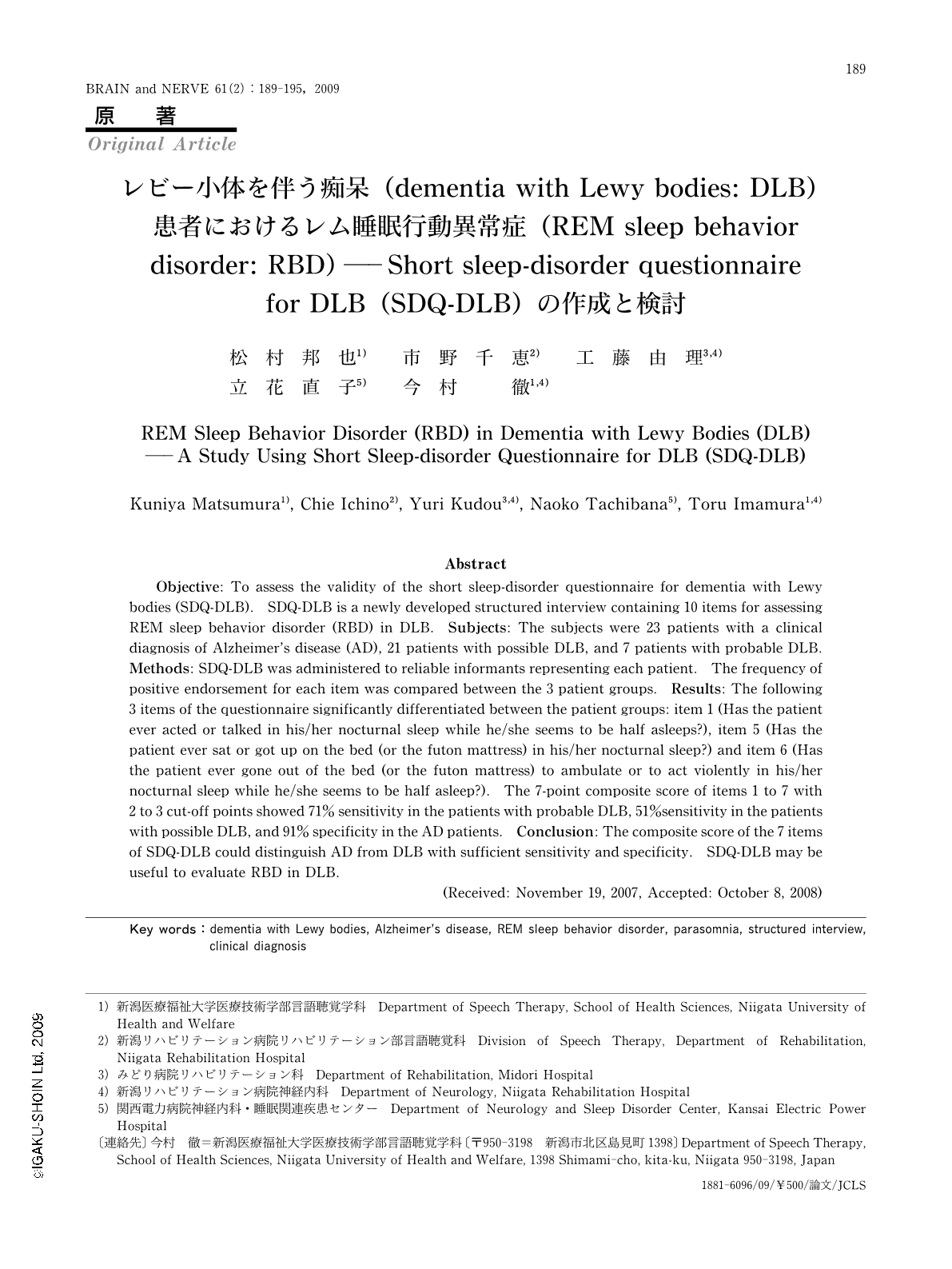
Objective: To assess the validity of the short sleep-disorder questionnaire for dementia with Lewy bodies (SDQ-DLB). SDQ-DLB is a newly developed structured interview containing 10 items for assessing REM sleep behavior disorder (RBD) in DLB. Subjects: The subjects were 23 patients with a clinical diagnosis of Alzheimer's disease (AD), 21 patients with possible DLB, and 7 patients with probable DLB. Methods: SDQ-DLB was administered to reliable informants representing each patient. The frequency of positive endorsement for each item was compared between the 3 patient groups. Results: The following 3 items of the questionnaire significantly differentiated between the patient groups: item 1 (Has the patient ever acted or talked in his/her nocturnal sleep while he/she seems to be half asleeps?), item 5 (Has the patient ever sat or got up on the bed (or the futon mattress) in his/her nocturnal sleep?) and item 6 (Has the patient ever gone out of the bed (or the futon mattress) to ambulate or to act violently in his/her nocturnal sleep while he/she seems to be half asleep?). The 7-point composite score of items 1 to 7 with 2 to 3 cut-off points showed 71% sensitivity in the patients with probable DLB, 51%sensitivity in the patients with possible DLB, and 91% specificity in the AD patients. Conclusion: The composite score of the 7 items of SDQ-DLB could distinguish AD from DLB with sufficient sensitivity and specificity. SDQ-DLB may be useful to evaluate RBD in DLB.
(Received: November 19,2007,Accepted: October 8,2008)
Copyright © 2009, Igaku-Shoin Ltd. All rights reserved.