Japanese
English
- 有料閲覧
PPV購入案内
1,320円 (1,200円+税10%) こちらは、389ページから394ページの文献です。購入には医書.jp本会員登録が必要です。
会員登録完了後に改めて上記「購入サイトへ」を選択してください。
または「購入サイトへ」選択後に「購入ログイン」、「新規会員登録」の順に進んでください。
会員登録について詳しくはをご確認ください。
- Abstract 文献概要
- 1ページ目 Look Inside
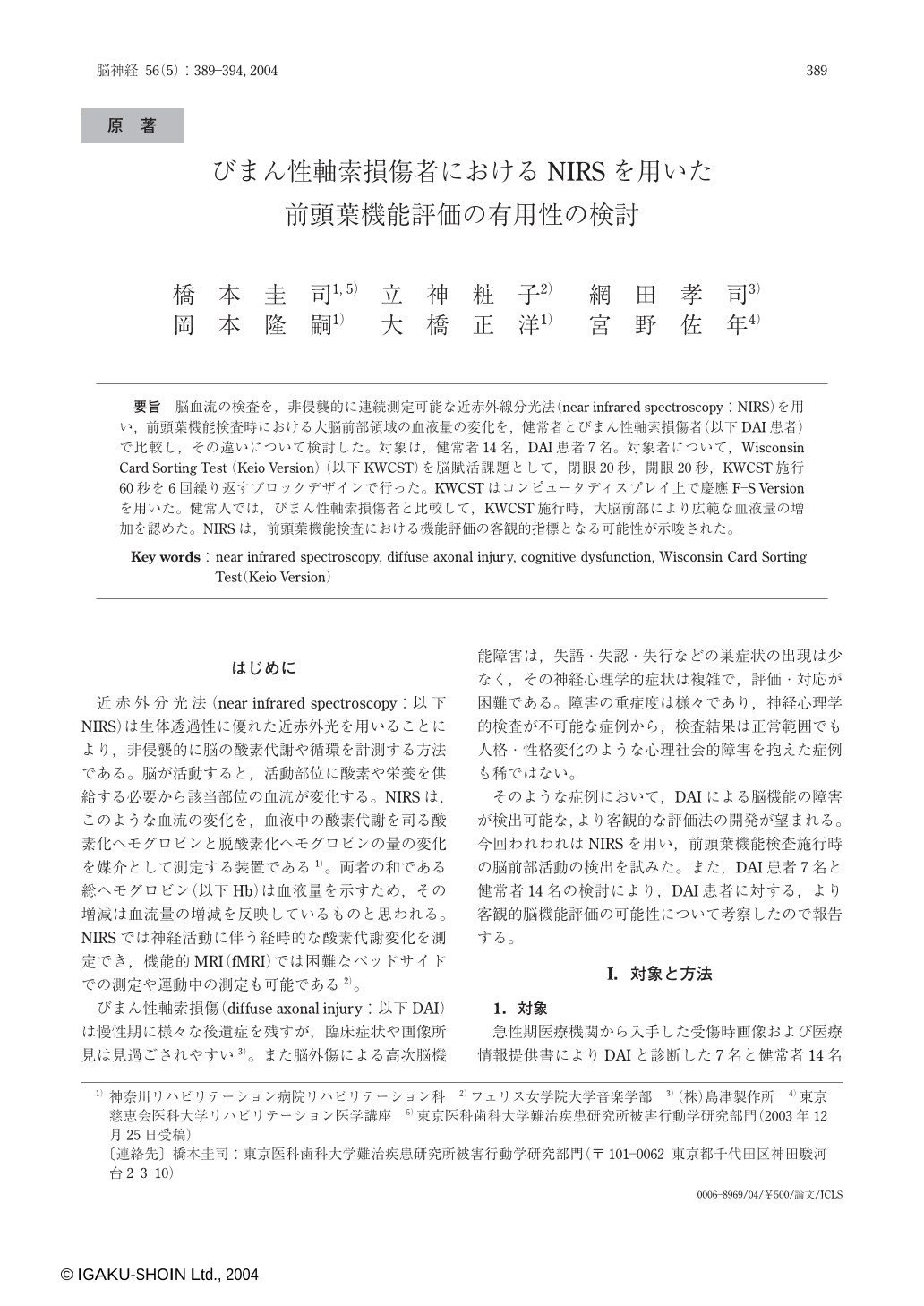
要旨 脳血流の検査を,非侵襲的に連続測定可能な近赤外線分光法(near infrared spectroscopy:NIRS)を用い,前頭葉機能検査時における大脳前部領域の血液量の変化を,健常者とびまん性軸索損傷者(以下DAI患者)で比較し,その違いについて検討した。対象は,健常者14名,DAI患者7名。対象者について,Wisconsin Card Sorting Test (Keio Version) (以下KWCST)を脳賦活課題として,閉眼20秒,開眼20秒,KWCST施行60秒を6回繰り返すブロックデザインで行った。KWCSTはコンピュータディスプレイ上で慶應F-S Versionを用いた。健常人では,びまん性軸索損傷者と比較して,KWCST施行時,大脳前部により広範な血液量の増加を認めた。NIRSは,前頭葉機能検査における機能評価の客観的指標となる可能性が示唆された。
The purpose of this study is to compare diffuse axonal injury(DAI) patients with healthy controls by using near infrared spectroscopy(NIRS). The Wisconsin Card Sorting Test Keio Version(KWCST), a standard task paradigm to detect human frontal lobe dysfunction was set as a method. The result of the examination showed that compared with DAI patients, wider increase of total hemoglobin was admitted in the frontal part of the brain of healthy people during the KWCST. This suggests that NIRS would serve as an objective indicator to evaluate the frontal lobe function in DAI patients.
(Received : December 25, 2003)
Copyright © 2004, Igaku-Shoin Ltd. All rights reserved.