Japanese
English
- 有料閲覧
PPV購入案内
1,320円 (1,200円+税10%) こちらは、669ページから673ページの文献です。購入には医書.jp本会員登録が必要です。
会員登録完了後に改めて上記「購入サイトへ」を選択してください。
または「購入サイトへ」選択後に「購入ログイン」、「新規会員登録」の順に進んでください。
会員登録について詳しくはをご確認ください。
- Abstract 文献概要
- 1ページ目 Look Inside
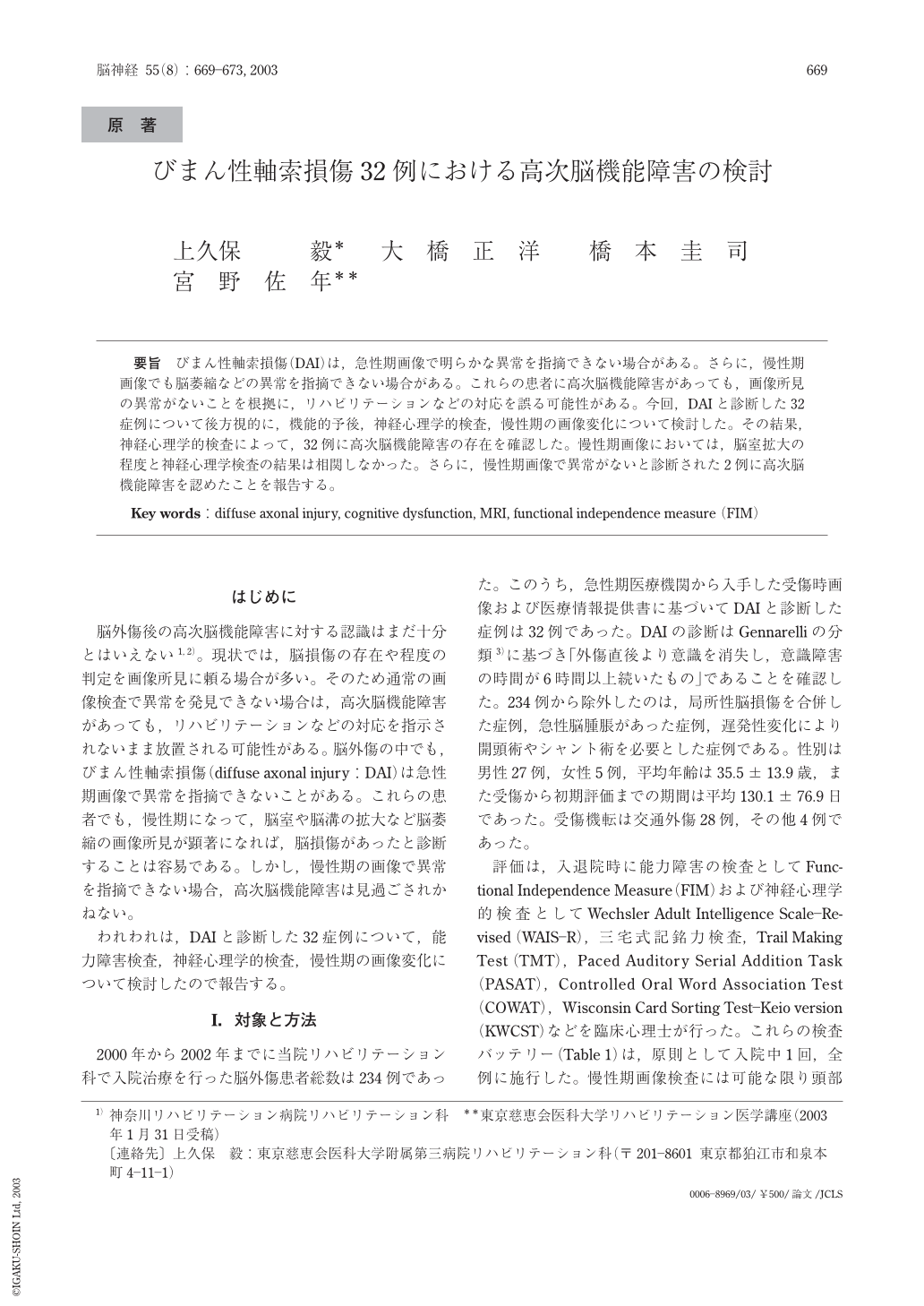
要旨 びまん性軸索損傷(DAI)は,急性期画像で明らかな異常を指摘できない場合がある。さらに,慢性期画像でも脳萎縮などの異常を指摘できない場合がある。これらの患者に高次脳機能障害があっても,画像所見の異常がないことを根拠に,リハビリテーションなどの対応を誤る可能性がある。今回,DAIと診断した32症例について後方視的に,機能的予後,神経心理学的検査,慢性期の画像変化について検討した。その結果,神経心理学的検査によって,32例に高次脳機能障害の存在を確認した。慢性期画像においては,脳室拡大の程度と神経心理学検査の結果は相関しなかった。さらに,慢性期画像で異常がないと診断された2例に高次脳機能障害を認めたことを報告する。
In acute stage of traumatic brain injury, it is not easy to diagnose diffuse axonal injury (DAI) by computer imaging. Even in chronic stage, DAIs occasionally show no remarkable abnormality by ordinal CT or MRI images.
We retrospectively studied 32 DAI cases by the Functional Independence Measure (FIM), a battery of neuropsychological tests and CT or MRI films of acute and chronic phase. The result showed decrease of cognitive function in 32 DAI cases.
The degree of enlargement of the ventricles in chronic stage did not correlate with cognitive dysfunction.
Copyright © 2003, Igaku-Shoin Ltd. All rights reserved.