Japanese
English
- 有料閲覧
PPV購入案内
1,320円 (1,200円+税10%) こちらは、971ページから978ページの文献です。購入には医書.jp本会員登録が必要です。
会員登録完了後に改めて上記「購入サイトへ」を選択してください。
または「購入サイトへ」選択後に「購入ログイン」、「新規会員登録」の順に進んでください。
会員登録について詳しくはをご確認ください。
- Abstract 文献概要
- 1ページ目 Look Inside
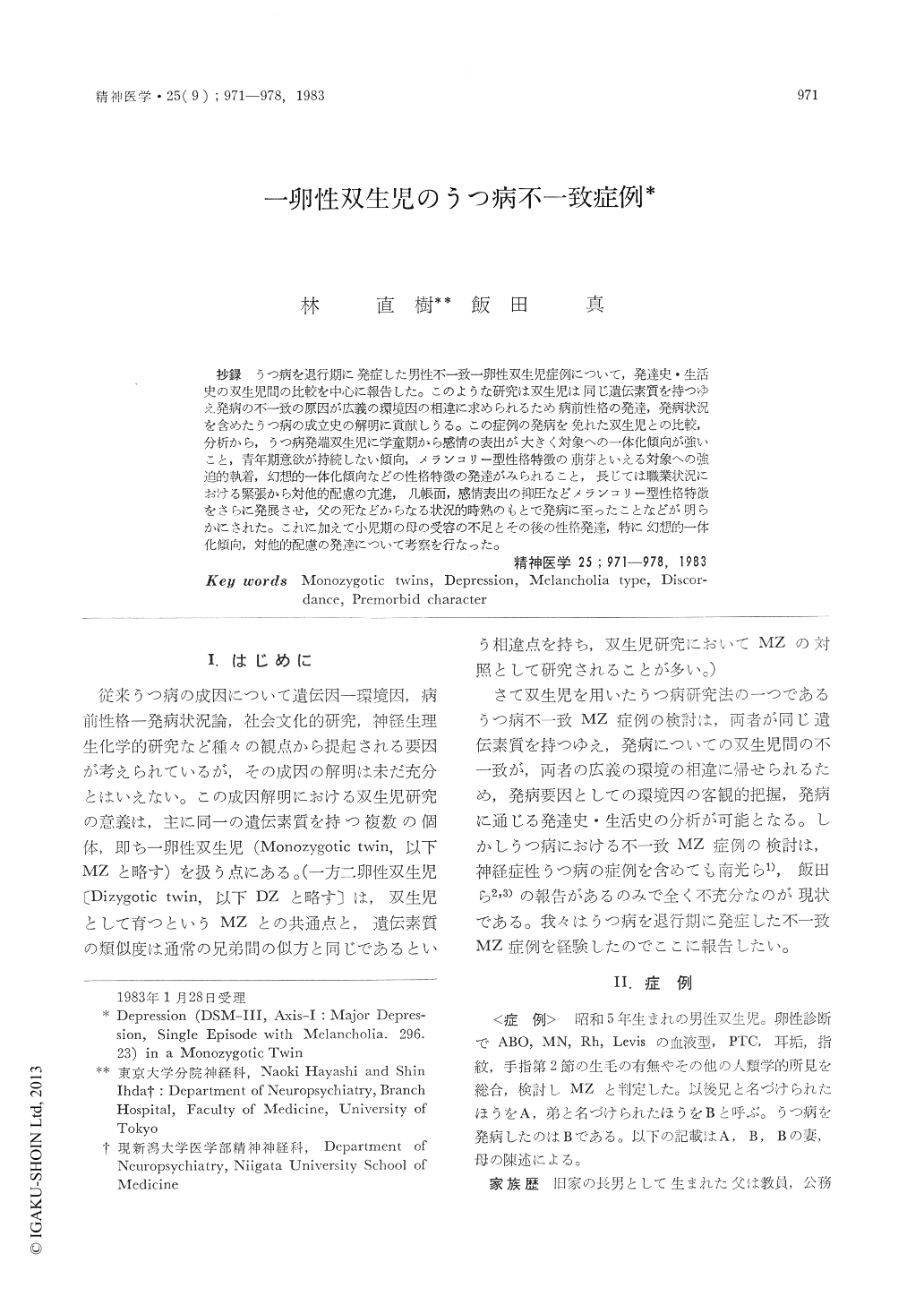
抄録 うつ病を退行期に発症した男性不一致一卵性双生児症例について,発達史・生活史の双生児間の比較を中心に報告した。このような研究は双生児は同じ遺伝素質を持つゆえ発病の不一致の原因が広義の環境因の相違に求められるため病前性格の発達,発病状況を含めたうつ病の成立史の解明に貢献しうる。この症例の発病を免れた双生児との比較,分析から,うつ病発端双生児に学童期から感情の表出が大きく対象への一体化傾向が強いこと,青年期意欲が持続しない傾向,メランコリー型性格特徴の萌芽といえる対象への強迫的執着,幻想的一体化傾向などの性格特徴の発達がみられること,長じては職業状況における緊張から対他的配慮の亢進,几帳面,感情表出の抑圧などメランコリー型性格特微をさらに発展させ,父の死などからなる状況的時熟のもとで発病に至ったことなどが明らかにされた。これに加えて小児期の母の受容の不足とその後の性格発達,特に幻想的一体化傾向,対他的配慮の発達について考察を行なった。
We presented the case of a discordant male monozygotic twin of depression (DSM-Ⅲ, Axis Ⅰ : 296. 23), and compared developmental history, personality traits, and life history of this index twin (IT) with those of cotwin (CT).
Because the discordant monozygotic twins have the same genetic predisposition, their discordance is not to be attributed to genetic factors, but rather to developmental and environmental difference. Therefore, we are able to investigate some aspects of the processes involved in the development of depression, including the development of the premorbid character, "Melancholia type"(Tellenbach),and depression-precipitating life events.
We found several developmental and life historical differences between the twins. At birth, IT weighed 300g less than CT, and their physical unequality could be recognized until they were about 10 years old. During childhood, they were brought up strictly by their parents, and their mother forced them to study hard and to compete with each other academically. They worked hard, but IT was usually inferior to CT. IT tended to express his emotions snore openly, to be more active and to make friends more easily than CT. From adolescence IT tended to have "illusory feelings of unity with others" (Doi), and to make obsessive efforts in academics and sports, which was thought to be the first appearance of one of the characteristics of Melancholia type character. However, he sometimes failed to carry through his efforts, as he became bored. CT, on the other hand, was cool and constantly diligent, and excelled academically. In adulthood IT worked eagerly at his job, unconsciously craving for the acceptance of others. Devoted to his job, he internalized strict occupational morals to his superego, suppressed his emotional expressions, and his personality traits became very similar to those of the Melancholiatype. When he was 50 years old, under such stresses as the burden of his job and the death of his father, he was overcome by depression.
We found IT's personality traits were like those of the Melancholia type, while CT's were cyclothymic (Kretschmer), but with some characteristics of the Melancholia type. We thought the twins to be genetically predisposed to be cyclothymic, but IT developed the Melancholia type character as pathological personality traits deriving from cyclothymia before the onset of depression.
We further considered how environmental and developmental conditions, for example, IT's rejection by his mother in his nurturing environment, had influenced the genesis of the Melancholia type character and depression. We conjectured the developmental course of depression : Genetic predisposition of depression (cyclothymia)-Some defect in the nurturing environment-Deviant character development-Burden of his job-Development of the Melancholia type character-Depression-precipitating conditions-Onset of depression.
Copyright © 1983, Igaku-Shoin Ltd. All rights reserved.