Japanese
English
- 有料閲覧
PPV購入案内
1,320円 (1,200円+税10%) こちらは、263ページから270ページの文献です。購入には医書.jp本会員登録が必要です。
会員登録完了後に改めて上記「購入サイトへ」を選択してください。
または「購入サイトへ」選択後に「購入ログイン」、「新規会員登録」の順に進んでください。
会員登録について詳しくはをご確認ください。
- Abstract 文献概要
- 1ページ目 Look Inside
- 参考文献 Reference
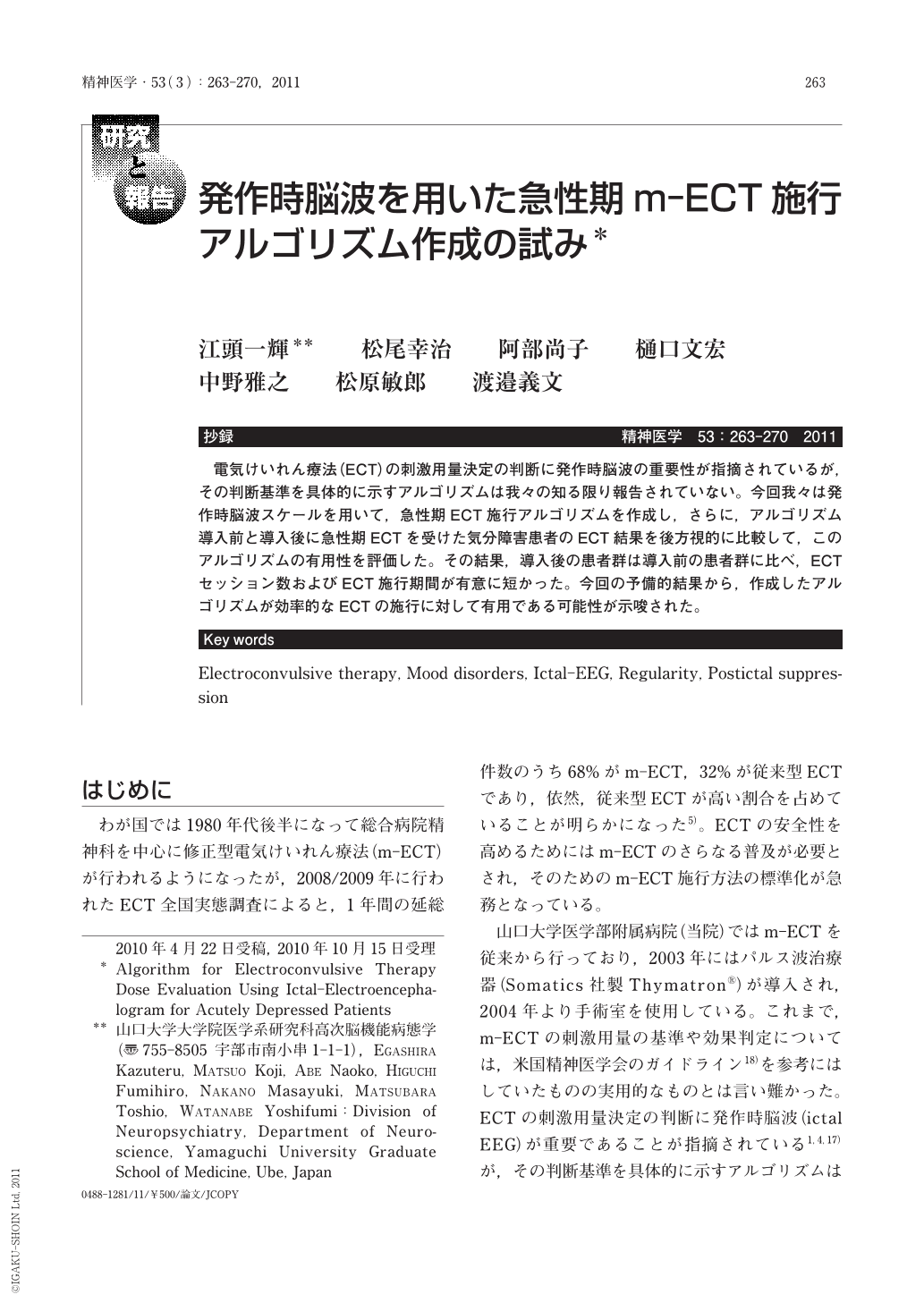
抄録
電気けいれん療法(ECT)の刺激用量決定の判断に発作時脳波の重要性が指摘されているが,その判断基準を具体的に示すアルゴリズムは我々の知る限り報告されていない。今回我々は発作時脳波スケールを用いて,急性期ECT施行アルゴリズムを作成し,さらに,アルゴリズム導入前と導入後に急性期ECTを受けた気分障害患者のECT結果を後方視的に比較して,このアルゴリズムの有用性を評価した。その結果,導入後の患者群は導入前の患者群に比べ,ECTセッション数およびECT施行期間が有意に短かった。今回の予備的結果から,作成したアルゴリズムが効率的なECTの施行に対して有用である可能性が示唆された。
Although ictal electroencephalogram (EEG) has been suggested to be crucial for the evaluation of stimulus doses in electroconvulsive therapy (ECT), to our knowledge, no algorithm has yet been reported for dose evaluation in ECT using ictal EEG. Here, we report an ECT algorithm that includes an ictal EEG evaluation scale for the assessment of ECT sessions. To determine the validity of our ECT algorithm, we performed a chart review to compare the ECT outcomes and side effects in patients who had received ECT with and without doses evaluated using the algorithm. Patients in the former case required a shorter period for ECT and fewer ECT sessions to return to the euthymic state than those in the latter case. These preliminary results suggest that the algorithm may be useful for an efficient ECT.
Copyright © 2011, Igaku-Shoin Ltd. All rights reserved.