Japanese
English
- 有料閲覧
PPV購入案内
1,320円 (1,200円+税10%) こちらは、453ページから457ページの文献です。購入には医書.jp本会員登録が必要です。
会員登録完了後に改めて上記「購入サイトへ」を選択してください。
または「購入サイトへ」選択後に「購入ログイン」、「新規会員登録」の順に進んでください。
会員登録について詳しくはをご確認ください。
- Abstract 文献概要
- 1ページ目 Look Inside
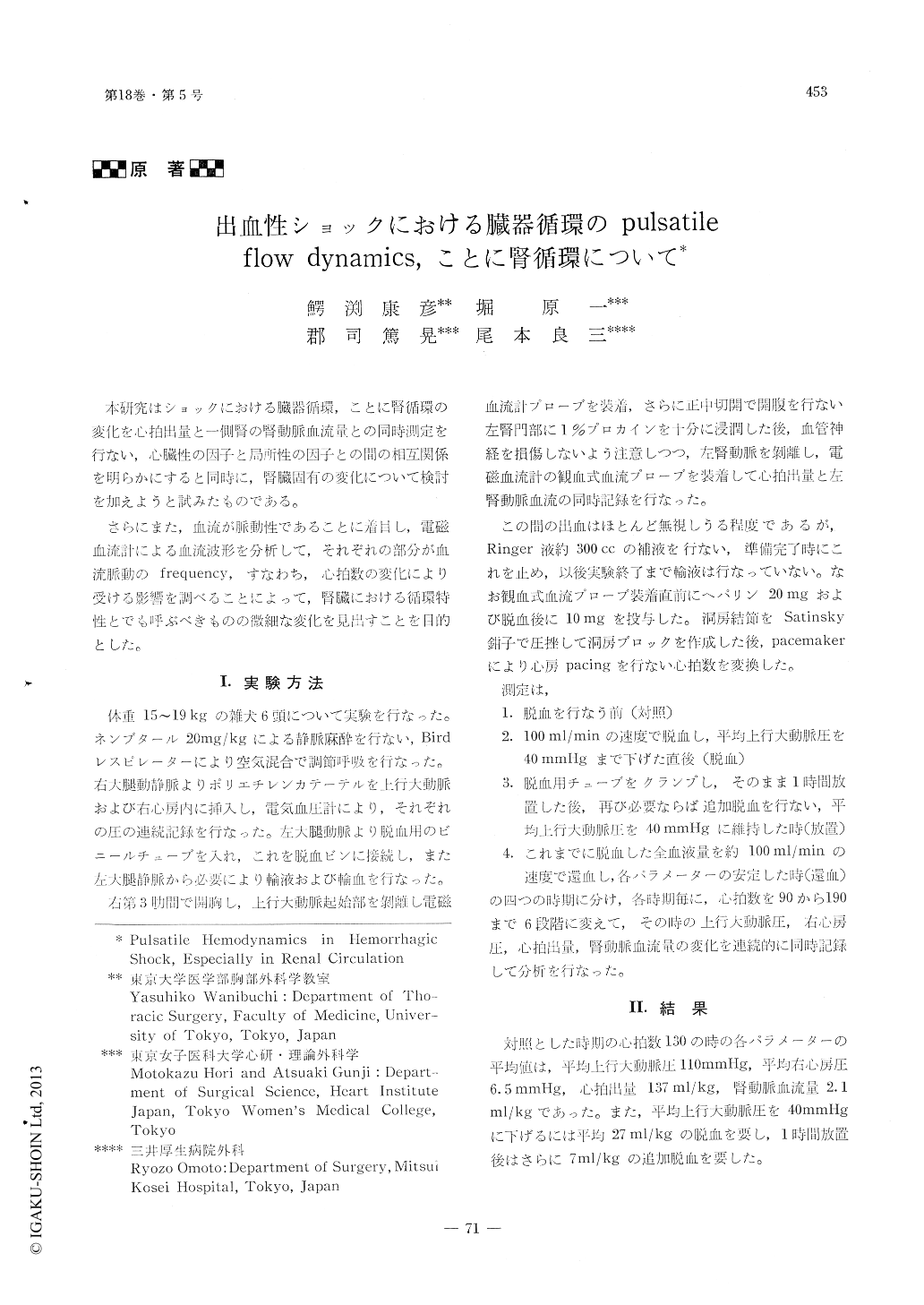
本研究はショックにおける臓器循環,ことに腎循環の変化を心拍出量と一側腎の腎動脈血流量との同時測定を行ない,心臓性の因子と局所性の因子との間の相互関係を明らかにすると同時に,腎臓固有の変化について検討を加えようと試みたものである。
さらにまた,血流が脈動性であることに着目し,電磁血流計による血流波形を分析して,それぞれの部分が血流脈動のfrequency,すなわち,心拍数の変化により受ける影響を調べることによって,腎臓における循環特性とでも呼ぶべきものの微細な変化を見出すことを目的とした。
In the 6 mongrel dogs, cardiac output and unilateral renal artery blood flow were recorded simultaneously, using electromanometer and electromagnetic flowmeter to observe the cha-nge of regional circulation during hemorrhagic shock, from the view point of pulsatile flow hemodynamics.
Blood flow distribution to one kidney is de-creased as the shock progresses, and the re-gional change in renal circulation should always be discussed on this decreased distri-bution. Mild failure of cardiac function is observed after one hour hypotension and "heart rate dependency" of cardiac output is appare-ntly increased.
In low cardiac output, renal artery blood flow has a tendency to increase with the in-creased heart rate. As the shock progresses, the steady flow fraction in renal artery blood flow is markedly decreased, and on the contrary, the pulsatile flow fraction increases. This fact is very suggestive of the meaning of pulsatile nature in circulation.
Copyright © 1970, Igaku-Shoin Ltd. All rights reserved.