Japanese
English
- 有料閲覧
PPV購入案内
1,320円 (1,200円+税10%) こちらは、95ページから99ページの文献です。購入には医書.jp本会員登録が必要です。
会員登録完了後に改めて上記「購入サイトへ」を選択してください。
または「購入サイトへ」選択後に「購入ログイン」、「新規会員登録」の順に進んでください。
会員登録について詳しくはをご確認ください。
- Abstract 文献概要
- 1ページ目 Look Inside
- 参考文献 Reference
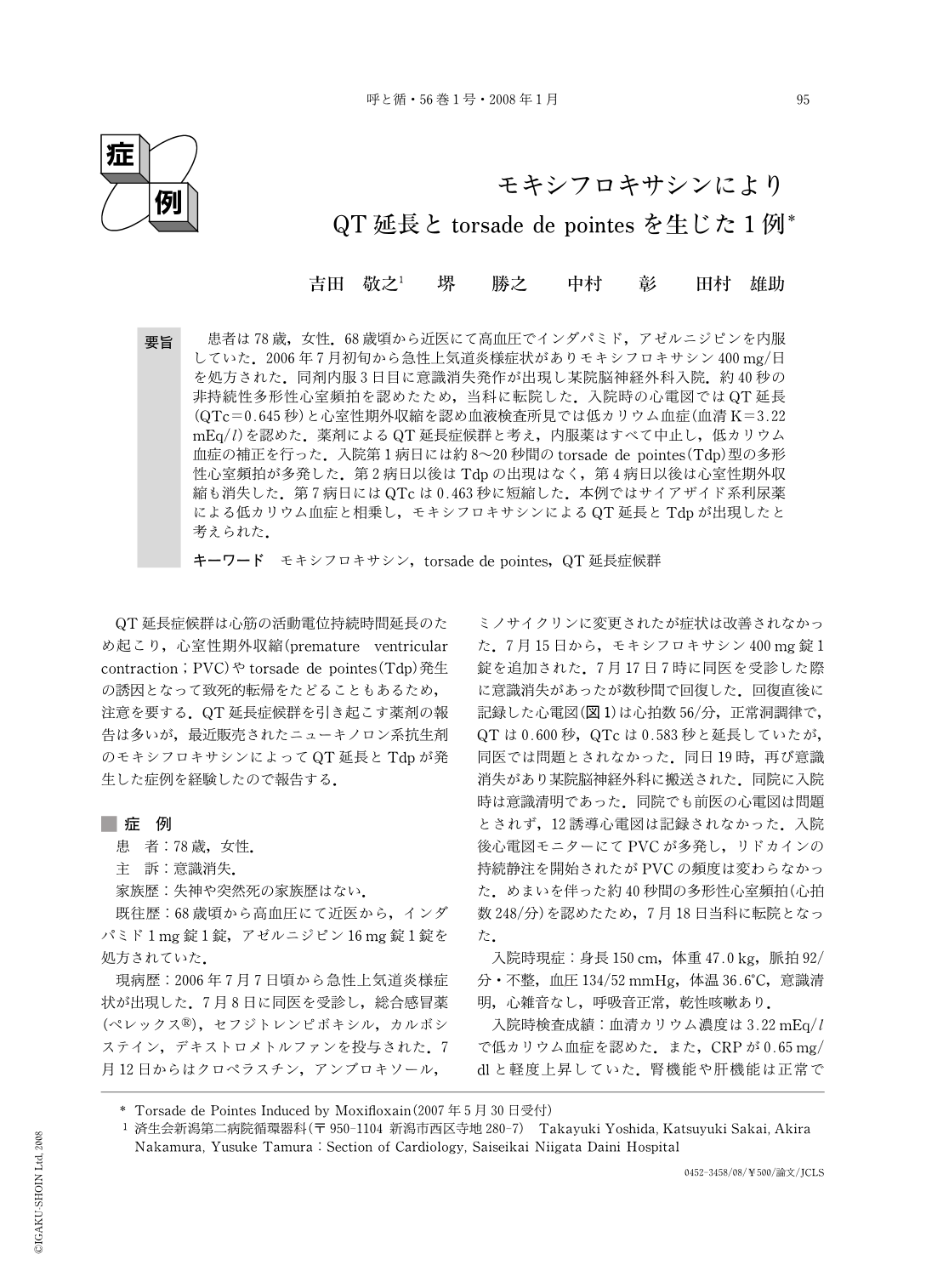
要旨 患者は78歳,女性.68歳頃から近医にて高血圧でインダパミド,アゼルニジピンを内服していた.2006年7月初旬から急性上気道炎様症状がありモキシフロキサシン400mg/日を処方された.同剤内服3日目に意識消失発作が出現し某院脳神経外科入院.約40秒の非持続性多形性心室頻拍を認めたため,当科に転院した.入院時の心電図ではQT延長(QTc=0.645秒)と心室性期外収縮を認め血液検査所見では低カリウム血症(血清K=3.22mEq/l)を認めた.薬剤によるQT延長症候群と考え,内服薬はすべて中止し,低カリウム血症の補正を行った.入院第1病日には約8~20秒間のtorsade de pointes(Tdp)型の多形性心室頻拍が多発した.第2病日以後はTdpの出現はなく,第4病日以後は心室性期外収縮も消失した.第7病日にはQTcは0.463秒に短縮した.本例ではサイアザイド系利尿薬による低カリウム血症と相乗し,モキシフロキサシンによるQT延長とTdpが出現したと考えられた.
OBJECTIVE: A case of torsade de pointes in a patient receiving moxifloxacin.
CASE SUMMARY: The patient was a 78-year-old woman with hypertension treated by indapamide and azelnidipine for 10 years. She consulted her personal physician for acute upper respiratory inflammation, and antibiotic therapy with oral moxifloxacin 400 mg/day was initiated. She developed syncope and was hospitalized after 3 days of treatment with moxifloxacin. The electrocardiogram on admission showed marked QT interval prolongation(QTc=0.645sec). The blood examination showed hypokalemia(K=3.22mEq/l). The electrocardiogram monitor confirmed several episodes of torsade de pointes and numerous premature ventricular contractions on the first day. All oral medicines including moxifloxacin and indapamide were terminated and potassium chloride and magnesium sulfate were administered intravenously. The woman's QTc interval subsequently returned to baseline. Torsade de pointes did not recur after the second day.
DISCUSSION: Administration of certain fluoroquinolones has previously been associated with QT interval prolongation on the electrocardiogram and ventricular arrhythmia. Blockade of the human cardiac K channel HERG often underlies such clinical findings. Moxifloxacin also inhibits HERG channel currents at therapeutic doses. In this case, moxifloxacin may lead to QT prolongation and occurrence of torsade de pointes. In addition, hypokalemia induced by thiazide diuretic may correlate with the QT prolongation.
CONCLUSIONS: In patients with underlying risk factors for a prolonged QT interval, the use of moxifloxacin can further lengthen the interval and ultimately trigger episodes of torsade de pointes. Therefore, moxifloxacin administration in these patients should be monitored closely.
Copyright © 2008, Igaku-Shoin Ltd. All rights reserved.