Japanese
English
- 有料閲覧
PPV購入案内
1,320円 (1,200円+税10%) こちらは、1921ページから1929ページの文献です。購入には医書.jp本会員登録が必要です。
会員登録完了後に改めて上記「購入サイトへ」を選択してください。
または「購入サイトへ」選択後に「購入ログイン」、「新規会員登録」の順に進んでください。
会員登録について詳しくはをご確認ください。
- Abstract 文献概要
- 1ページ目 Look Inside
- 参考文献 Reference
- サイト内被引用 Cited by
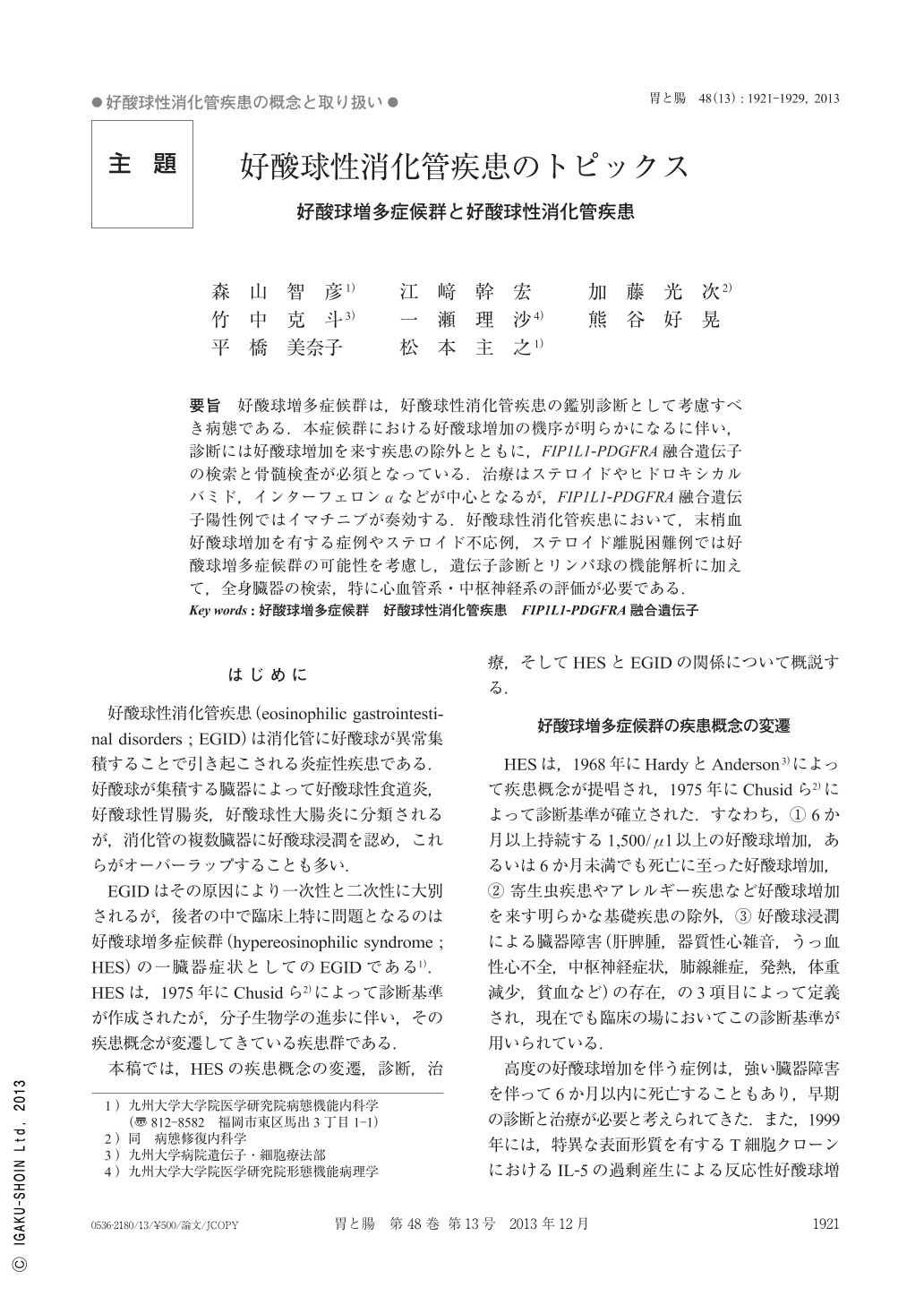
要旨 好酸球増多症候群は,好酸球性消化管疾患の鑑別診断として考慮すべき病態である.本症候群における好酸球増加の機序が明らかになるに伴い,診断には好酸球増加を来す疾患の除外とともに,FIP1L1-PDGFRA融合遺伝子の検索と骨髄検査が必須となっている.治療はステロイドやヒドロキシカルバミド,インターフェロンαなどが中心となるが,FIP1L1-PDGFRA融合遺伝子陽性例ではイマチニブが奏効する.好酸球性消化管疾患において,末梢血好酸球増加を有する症例やステロイド不応例,ステロイド離脱困難例では好酸球増多症候群の可能性を考慮し,遺伝子診断とリンパ球の機能解析に加えて,全身臓器の検索,特に心血管系・中枢神経系の評価が必要である.
HES(hypereosinophilic syndrome)should be considered in the differential diagnosis of EGID(eosinophilic gastrointestinal disorders). After clarifying the mechanism of eosinophilia in HES, excluding other diseases with eosinophilia, identification of FIP1L1-PDGFRA fusion, and bone marrow examination become necessary in diagnosing HES. In patients with FIP1L1-PDGFRA fusion positive HES, imatinib mesylate leads to dramatic response. Corticosteroids, hydroxyurea, and interferon-α are effective in patients with FIP1L1-PDGFRA fusion negative HES. Genetic screening, functional analysis of lymphocytes, and evaluation for organ damage, including the cardiovascular and neurologic systems are needed for EGID patients with hypereosinophilia, steroid-dependence, and steroid-resistance.
Copyright © 2013, Igaku-Shoin Ltd. All rights reserved.