Japanese
English
- 有料閲覧
PPV購入案内
1,320円 (1,200円+税10%) こちらは、873ページから882ページの文献です。購入には医書.jp本会員登録が必要です。
会員登録完了後に改めて上記「購入サイトへ」を選択してください。
または「購入サイトへ」選択後に「購入ログイン」、「新規会員登録」の順に進んでください。
会員登録について詳しくはをご確認ください。
- Abstract 文献概要
- 1ページ目 Look Inside
- 参考文献 Reference
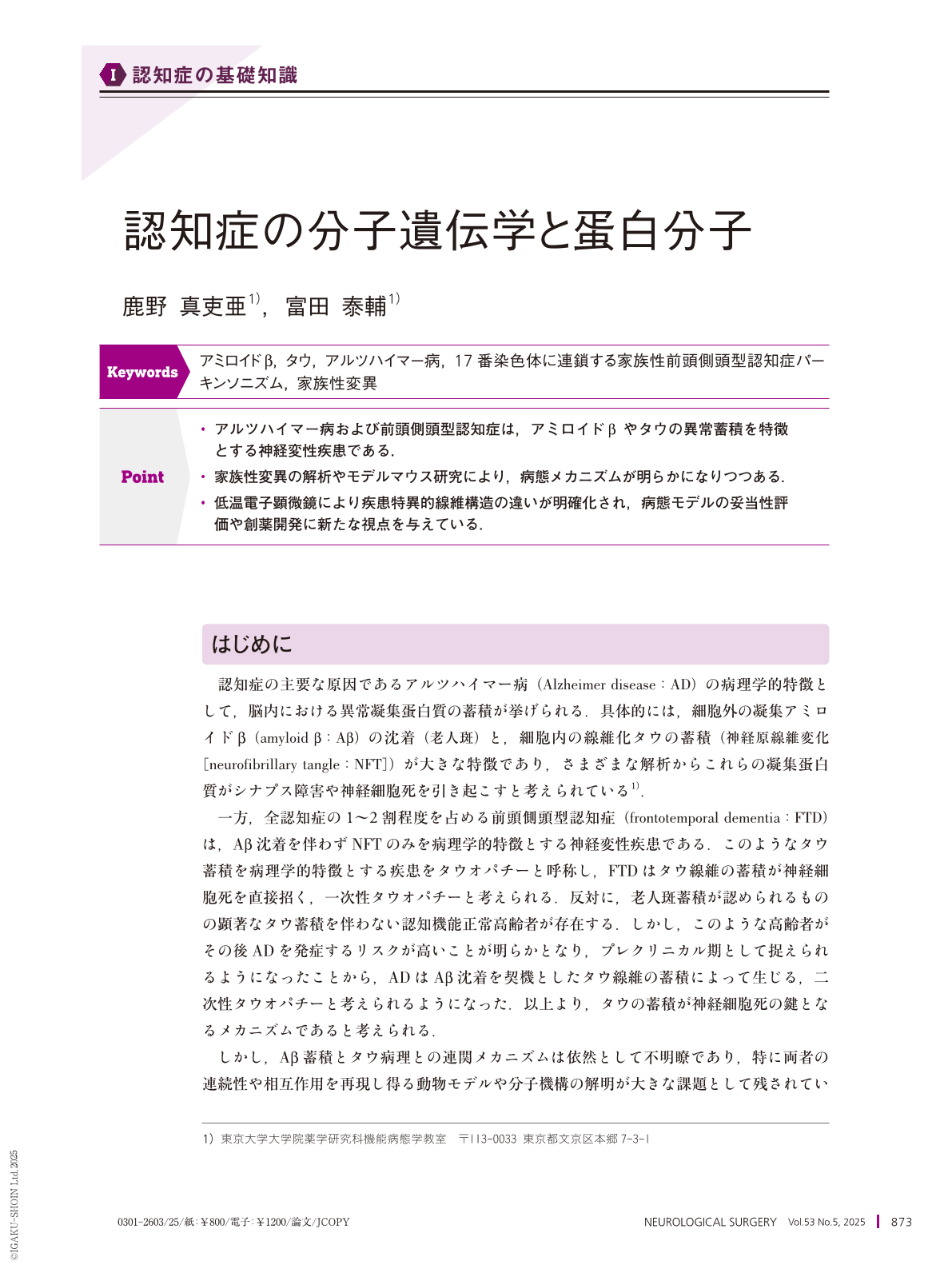
Point
・アルツハイマー病および前頭側頭型認知症は,アミロイドβやタウの異常蓄積を特徴とする神経変性疾患である.
・家族性変異の解析やモデルマウス研究により,病態メカニズムが明らかになりつつある.
・低温電子顕微鏡により疾患特異的線維構造の違いが明確化され,病態モデルの妥当性評価や創薬開発に新たな視点を与えている.
Alzheimer's disease (AD), the most common cause of dementia, is marked by the pathological accumulation of misfolded proteins in the brain. Its key pathological features include extracellular amyloid β (Aβ) plaques and intracellular tau neurofibrillary tangles, both of which contribute to synaptic dysfunction and neuronal death. Familial AD is linked to mutations in the APP, PSEN1, or PSEN2 genes, which promote increased Aβ production or aggregation. In contrast, frontotemporal dementia (FTD), including FTDP-17, is associated with MAPT mutations that lead to tau fibril accumulation independent of Aβ pathology. Recent advances in cryo-electron microscopy (cryo-EM) have revealed disease-specific conformations of Aβ and tau fibrils at atomic resolution, highlighting the role of structural polymorphism in disease progression. Aβ contributes to synaptic deficits and activates glial cells, thereby initiating neuroinflammatory responses. Genetic risk factors such as APOE and TREM2 influence these pathological processes. Transgenic mouse models carrying familial mutations have replicated certain aspects of AD pathology. However, most models fail to fully reproduce the human-like filament structures or the sequential progression from Aβ to tau pathology. Novel knock-in models, combined with cryo-EM-based validation, now provide a more accurate platform for studying disease mechanisms and developing targeted therapies.
Copyright © 2025, Igaku-Shoin Ltd. All rights reserved.