Japanese
English
- 有料閲覧
- Abstract 文献概要
- 1ページ目 Look Inside
- 参考文献 Reference
要旨
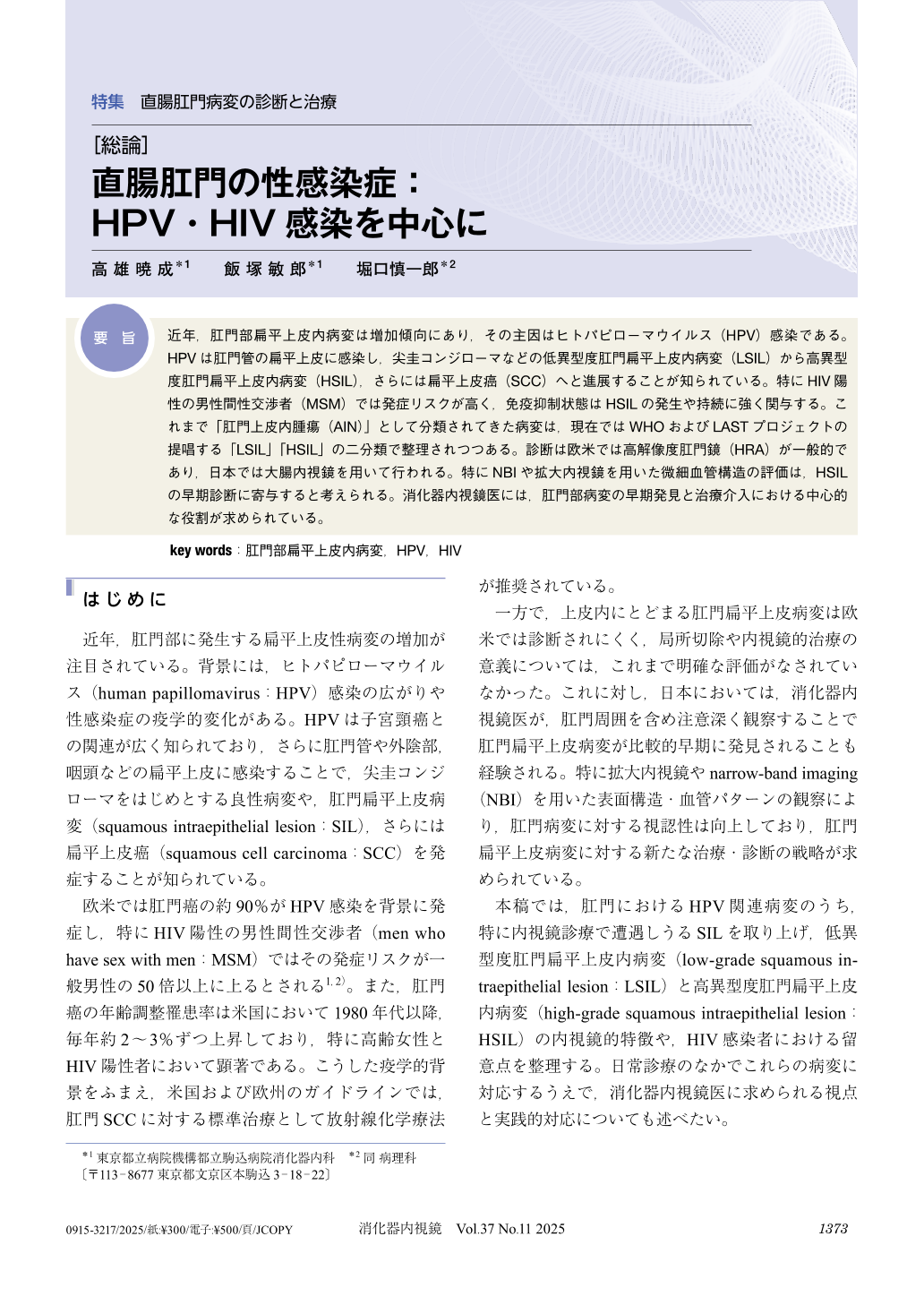
近年,肛門部扁平上皮内病変は増加傾向にあり,その主因はヒトパピローマウイルス(HPV)感染である。HPVは肛門管の扁平上皮に感染し,尖圭コンジローマなどの低異型度肛門扁平上皮内病変(LSIL)から高異型度肛門扁平上皮内病変(HSIL),さらには扁平上皮癌(SCC)へと進展することが知られている。特にHIV陽性の男性間性交渉者(MSM)では発症リスクが高く,免疫抑制状態はHSILの発生や持続に強く関与する。これまで「肛門上皮内腫瘍(AIN)」として分類されてきた病変は,現在ではWHOおよびLASTプロジェクトの提唱する「LSIL」「HSIL」の二分類で整理されつつある。診断は欧米では高解像度肛門鏡(HRA)が一般的であり,日本では大腸内視鏡を用いて行われる。特にNBIや拡大内視鏡を用いた微細血管構造の評価は,HSILの早期診断に寄与すると考えられる。消化器内視鏡医には,肛門部病変の早期発見と治療介入における中心的な役割が求められている。
In recent years, much attention has begun to be focused on the increasing incidence of anal squamous intraepithelial lesions (SIL), of which the human papillomavirus (HPV) is the primary cause. HPV infects the squamous epithelium of the anal canal and is known to progress from condyloma acuminatum to high-grade squamous intraepithelial lesions (HSIL) and eventually to squamous cell carcinoma (SCC). The risk of the development of such lesions is particularly high among HIV-positive men who have sex with men (MSM), in whom immunosuppression plays a significant role in the development and persistence of HSIL. Lesions previously classified as “anal intraepithelial neoplasias (AIN)” are now being re-classified as either “low-grade squamous intraepithelial lesions (LSIL)” or “high-grade squamous intraepithelial lesions (HSIL)” based on the proposal of the World Health Organization (WHO) and the Lower Anogenital Squamous Terminology (LAST) Project. While high-resolution anoscopy (HRA) is the standard diagnostic method in the West, use of conventional colonoscopy for this purpose in routine practice is being explored in Japan. In particular, narrow-band imaging (NBI) and magnifying endoscopy, which allow for detailed evaluation of microvascular architecture, are believed to enhance the visibility of HSIL. Therefore, gastrointestinal endoscopists are expected to play a central role in the early detection and intervention of anal lesions.
© tokyo-igakusha.co.jp. All right reserved.