Japanese
English
- 有料閲覧
- Abstract 文献概要
- 1ページ目 Look Inside
- 参考文献 Reference
- サイト内被引用 Cited by
はじめに
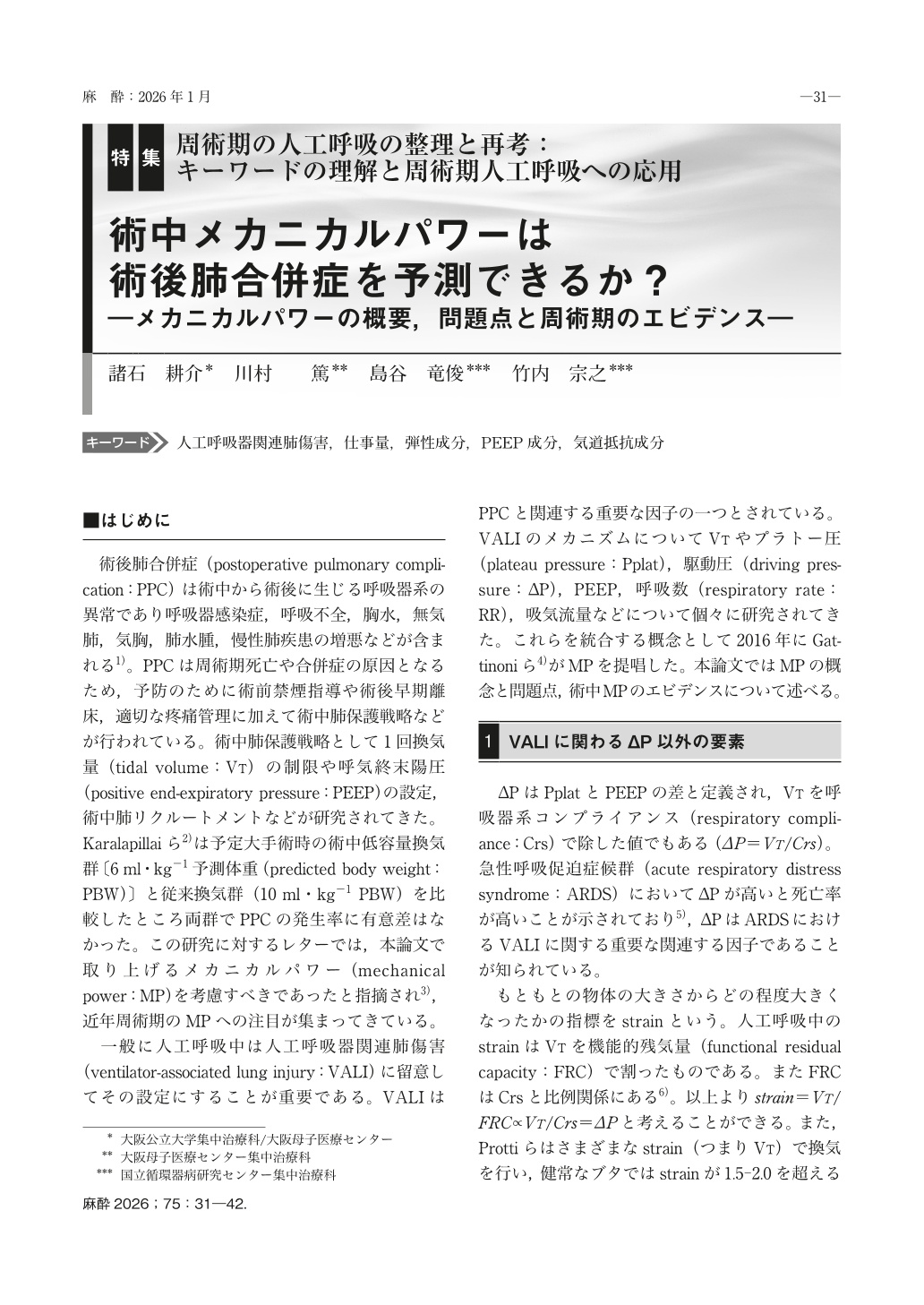
術後肺合併症(postoperative pulmonary complication:PPC)は術中から術後に生じる呼吸器系の異常であり呼吸器感染症,呼吸不全,胸水,無気肺,気胸,肺水腫,慢性肺疾患の増悪などが含まれる1)。PPCは周術期死亡や合併症の原因となるため,予防のために術前禁煙指導や術後早期離床,適切な疼痛管理に加えて術中肺保護戦略などが行われている。術中肺保護戦略として1回換気量(tidal volume:Vt)の制限や呼気終末陽圧(positive end-expiratory pressure:PEEP)の設定,術中肺リクルートメントなどが研究されてきた。Karalapillaiら2)は予定大手術時の術中低容量換気群〔6ml・kg-1予測体重(predicted body weight:PBW)〕と従来換気群(10ml・kg-1PBW)を比較したところ両群でPPCの発生率に有意差はなかった。この研究に対するレターでは,本論文で取り上げるメカニカルパワー(mechanical power:MP)を考慮すべきであったと指摘され3),近年周術期のMPへの注目が集まってきている。
一般に人工呼吸中は人工呼吸器関連肺傷害(ventilator-associated lung injury:VALI)に留意してその設定にすることが重要である。VALIはPPCと関連する重要な因子の一つとされている。VALIのメカニズムについてVtやプラトー圧(plateau pressure:Pplat),駆動圧(driving pressure:ΔP),PEEP,呼吸数(respiratory rate:RR),吸気流量などについて個々に研究されてきた。これらを統合する概念として2016年にGattinoniら4)がMPを提唱した。本論文ではMPの概念と問題点,術中MPのエビデンスについて述べる。
Postoperative pulmonary complications(PPCs)can result in other complications and perioperative mortality, and the prevention of PPCs is thus an important challenge. The potential relationship between PPCs and the intraoperative mechanical power has recently attracted attention. During mechanical ventilation, it is crucial to be aware of the risk of ventilator-associated lung injury(VALI), which is associated with PPCs. The tidal volume, plateau pressure, driving pressure(ΔP), PEEP, respiratory rate, and inspiratory flow rate have been individually investigated in efforts to clarify the mechanisms that underlie VALIs, and mechanical power was proposed as a variable that could integrate these various factors. The proposal of the concept of mechanical power was an epoch-making change that could explain VALIs, which cannot be explained by the ΔP alone. Several research groups have reported a correlation between a high mechanical power value and a high incidence of PPCs, whereas other groups have reported the absence of such a correlation. It is possible that the question of whether the mechanical power predicts the risk of a PPC depends on the surgical procedure, the duration of the surgery, and/or the patient’s preoperative respiratory function. Further research is necessary to detect the conditions in which the mechanical power is closely related to the occurrence of PPCs. The concept of mechanical power has promoted research on pulmonary protective ventilation, but an evaluation of the mechanical power alone is insufficient to predict VALIs. We hope to advance further investigation on VALIs and lung-protective ventilation by addressing the limitations of mechanical power and identifying mechanisms that underscore the concept of mechanical power.
Copyright © 2026 KOKUSEIDO CO., LTD. All Rights Reserved.